









Key takeaways
Thematic analysis (TA) is a qualitative research method for identifying, analyzing, and reporting patterns of meaning—themes—across a dataset. It's valued for its flexibility: it works across interviews, focus groups, open-ended surveys, and documents, and it isn't tied to a single theoretical framework. The most widely used approach is Braun and Clarke's six-phase process, but choosing which kind of TA you're doing—reflexive, codebook, or coding-reliability—matters just as much, since it shapes how you code, whether you use multiple coders, and how you report your findings. As your dataset grows, software like NVivo and ATLAS.ti helps you manage coding, retrieval, and audit trails without losing the nuance that makes qualitative research valuable.
If you've spent any time in qualitative research, you've likely used thematic analysis (TA)—or at least called something thematic analysis. It's one of the most widely taught and widely applied methods in the field, largely because it's genuinely flexible: it works across interviews, focus groups, open-ended survey data, and documents, and it doesn't require you to commit to a single theoretical lens before you start.
That flexibility is also what makes it easy to do badly. The most common errors in published TA—treating themes as something that simply "emerge," bolting inter-rater reliability onto reflexive work, mistaking topic summaries for genuine themes—are exactly what reviewers flag most often. This guide walks through thematic analysis the way its originators actually intended it, so you can choose the approach—and the tool—that fits your study.
What is thematic analysis?
Thematic analysis is a method for identifying and reporting patterns of meaning by analyzing qualitative data. Instead of counting how often something appears, a qualitative analysis assists in interpreting what the data means—surfacing the ideas, experiences, and perspectives that connect a dataset together.
That distinction is where a lot of researchers get tripped up. A theme isn't a bucket of everything people happened to say about a topic; that's a domain summary, and mistaking one for the other is one of the most common errors in TA. A genuine theme captures a pattern of shared meaning—what the data is really saying, not just what it's about. Braun and Clarke, whose framework underpins most modern TA practice, are explicit on this point, and getting it right from the outset is one of the clearest signals of methodological understanding.
TA suits data that's rich in perspective and language: interview transcripts, focus group discussions, open-ended survey responses, diaries, or written documents. It's a poor fit for purely numerical data, though it shows up often in mixed-methods studies alongside quantitative analysis.
Part of what makes thematic analysis approachable is that it doesn't demand a specific epistemological stance before you begin—unlike grounded theory, which comes with its own theoretical commitments, or discourse analysis, which requires close attention to language itself. That accessibility is a genuine strength, but it also means TA is easy to apply superficially. Doing it well still takes the same rigor any qualitative method requires: careful familiarization with your data, deliberate coding decisions, and honest reporting of how your themes came to be.
Discover your practical handbook for finding patterns and meaning in qualitative data. Download "The Essential Guide to Thematic Analysis" today.
What is thematic analysis used for? (and when not to use it)
Numbers are easy to analyze: compare the temperatures in two different cities on the same day, and you can easily make a judgment about which city is hotter or colder. The same kind of comparisons apply to things like population, money, television ratings, or the speed of cars. But for questions like what makes an action movie or what features are common in a tourist city, then you will likely rely on qualitative data from surveys, interviews, or focus groups. The challenge is that this sort of data is unstructured and less likely to be easily countable (how do you quantify an interesting TV show, anyways?).
This is where thematic analysis comes in. A thematic analysis process is best suited to understanding experiences, perceptions, and meaning-making, and it's flexible enough to apply across nearly every discipline, from healthcare to education to market research. That range is exactly why so many researchers reach for it by default—but "flexible" doesn't mean "universal." Knowing when TA isn't the right tool is as important as knowing when it is.
Use thematic analysis when you need to:
- Understand how people experience or make sense of something
- Identify recurring patterns of meaning across a dataset
- Work across multiple data types—interviews, surveys, documents—within one study
- Take a flexible approach that isn't locked into a single theoretical framework
Thematic analysis usually isn't the right choice when you need to:
- Quantify how often specific categories occur—that's content analysis
- Build a new theory grounded in your data—that's grounded theory
- Examine how language or structure itself shapes meaning—that's discourse or narrative analysis
Picking the wrong method for your research question is a common, avoidable misstep. If frequency counts or theory generation are the actual goal, TA won't get you there, even though it's often the default choice simply because it's the most familiar.
Thematic analysis vs. other qualitative methods
| Method | What it produces | Best for | Key difference from TA |
|---|---|---|---|
| Thematic analysis | Patterns of meaning (themes) across a dataset | Understanding experiences and perceptions across flexible data types | Baseline method |
| Content analysis | Frequency counts of predefined categories | Systematic, often quantifiable coding of large text volumes | Counts occurrences rather than interpreting meaning |
| Grounded theory | A theory grounded in and generated from the data | Building new explanatory frameworks or models | Aims to generate theory, not just identify patterns |
| Discourse analysis | Analysis of how language constructs meaning and power | Studying language use, framing, and social context | Focuses on how something is said, not just what is said |
| Narrative analysis | Structured stories and how they're told | Understanding individual accounts and storytelling structure | Preserves whole narratives rather than fragmenting data into potential themes |
The three approaches to thematic analysis (and why the difference matters)
Most guides stop at "thematic analysis has six steps" and move on. That's an incomplete picture. In their more recent work, Braun and Clarke identified three distinct schools of thematic analysis, and conflating them is one of the most common reasons reviewers push back on published TA.
- Reflexive thematic analysis: Themes are actively generated by the researcher through close, iterative engagement with the data. Coding is organic and evolves as understanding deepens, and the researcher's subjectivity is treated as a resource, not a bias to eliminate. This is the most widely taught form of TA.
- Codebook thematic analysis: Uses a structured codebook, often mapped to an existing framework, and suits applied or team-based research where consistency across coders matters.
- Coding-reliability thematic analysis: Applies a fixed codebook and measures inter-rater reliability (Cohen's kappa, for example) to confirm agreement between coders.
Here's where a lot of TA studies run into trouble: applying inter-rater reliability, or bringing in multiple coders "for objectivity," to a reflexive TA study is a category error. Reflexive TA doesn't treat researcher interpretation as something to standardize away; it treats that interpretation as the analytic engine. Braun and Clarke have said as much publicly, yet the advice to "use multiple coders and calculate agreement for rigor" still shows up in guides that don't distinguish between the three approaches.
It's also worth retiring a phrase that appears in nearly every TA methods section: "themes emerged." Themes don't emerge on their own—they're constructed by the researcher, through decisions about what's meaningful and how ideas connect. That framing isn't pedantic; it reflects how reflexive TA actually works, and reviewers increasingly notice when it's missing.
| Approach | Coding style | Multiple coders? | Best for |
|---|---|---|---|
| Reflexive TA | Organic, evolving | No | Studies where researcher interpretation is central |
| Codebook TA | Structured, framework-based | Sometimes | Applied or team research needing consistency |
| Coding-reliability TA | Fixed codebook | Yes, with measured agreement | Studies requiring demonstrable inter-coder consistency |
The six phases of thematic analysis
However you approach TA, most researchers conducting thematic analysis still work through Braun and Clarke's six phases. It's worth remembering that these phases are recursive, not linear—you'll often circle back to earlier phases as your understanding develops, even after you thought a phase was finished. Treating them as a strict checklist is one of the quieter ways that misrepresentation shows up in practice.
At a glance, the six phases of thematic analysis look like this:
- Familiarization. Read and re-read your data before coding anything. This is where early impressions and candidate patterns start to take shape.
- Generating initial codes. Work systematically through the dataset, tagging segments of interest with short, descriptive labels.
- Generating themes. Group related codes into candidate themes that capture broader patterns of meaning.
- Reviewing themes. Check candidate themes against the coded data and the dataset as a whole. Some will merge, split, or drop out entirely.
- Defining and naming themes. Refine each theme's boundaries and give it a clear, precise name that captures what it's really about.
- Writing up. Weave your themes into a coherent narrative, supported by data extracts, that answers your research question.
For a hands-on walkthrough of these phases inside the software, see our guide to how to do thematic analysis in NVivo.
Inductive vs. deductive thematic analysis
Inductive TA builds codes and themes directly from the data itself, with no predetermined framework guiding the analysis. Deductive TA applies codes derived from an existing theory, framework, or prior research. Most real-world studies land somewhere in between, using existing concepts as a starting point while staying open to what the data reveals.
A worked example: From code to theme
A concrete example of thematic analysis is what separates expert content from definitional filler, so let's walk through one.
Say you're studying student motivation, and a participant tells you:
"I keep coming back to this program because my advisor actually remembers what I said last time. It sounds small, but it makes me feel like I'm not just a number."
From this excerpt, you might apply two initial codes: "feeling recognized by staff" and "personalized advising relationship." Across the rest of the dataset, similar excerpts repeatedly connect a sense of being known—not just supported—to persistence in the program. Those codes, clustered with others like them, might form a candidate theme: "Feeling seen sustains engagement." That's the real analytic move: not a topic label like "advising," but a pattern of shared meaning about what keeps students engaged.
Notice what didn't happen here: no one tallied how many participants mentioned advisors, and no theme was declared simply because a word came up often. The theme exists because multiple excerpts, in different words, pointed at the same underlying idea. That's the difference between coding qualitative data and analyzing it—and it's the step a lot of published TA skips.
Common mistakes in thematic analysis (and how to avoid them)
Most of these mistakes aren't the result of carelessness—they're inherited from guides and templates that treat all TA as one method rather than three. Watching for them is often the fastest way to strengthen a methods section before submission.
Common mistakes in thematic analysis include:
- Saying "themes emerged." Themes are constructed through the researcher's active interpretation, not passively discovered.
- Mistaking domain summaries for themes. A theme should capture a pattern of meaning, not everything said about a topic.
- Generating too many shallow themes. A long list of surface-level themes usually signals coding that stopped too early.
- Using inter-rater reliability in reflexive TA. Measuring coder agreement contradicts the premise of reflexive analysis; it belongs in coding-reliability TA instead.
- Skipping familiarization. Coding before you've thoroughly read your data leads to shallow, disconnected codes.
- Letting the research question drift. As themes develop, it's easy to lose sight of what you set out to answer—revisit your research question often.
How AI fits into thematic analysis
AI is increasingly part of the thematic analysis workflow, particularly for the more time-intensive early phases. Used well, it can speed up summarization and initial coding without taking over the interpretive work that makes a theme a theme rather than a topic label. These boundaries are part of the broader conversation around using AI in qualitative research, where researchers must distinguish between helpful automation and outsourced interpretation.
AI in thematic analysis can meaningfully support:
- Familiarization - generating quick summaries of transcripts and documents before you dive into close reading
- Initial coding - suggesting descriptive labels for data segments as a starting point to refine, not a finished codebook
- Theme clustering - surfacing semantic relationships between codes across a large dataset
- Report drafting - producing structured narrative summaries that you then rework in your own analytical voice
What AI can't do is the reflexive part: deciding why a pattern matters, validating that a cluster of codes reflects genuine shared meaning rather than shared vocabulary, and taking ethical responsibility for how participants' voices are represented. That judgment stays with the researcher at every phase. Tools matter here too. General-purpose LLMs have no persistent codebook between sessions and no audit trail—both of which peer reviewers increasingly expect to see documented in your methods section. Purpose-built tools like NVivo's AI Assistant and ATLAS.ti MCP Server work inside your existing project, alongside your codes and memos, so AI-assisted steps stay traceable back to source.
How to choose software for thematic analysis
Not every qualitative research project needs software. Small datasets can be coded manually with sticky notes or a spreadsheet, and for a short study or classroom exercise, that's often perfectly appropriate. Software earns its place once your dataset grows, your team is collaborating across coders, or you need a clear audit trail to support publication or institutional review.
Using qualitative data analysis (QDA) software helps you:
- Manage and organize large volumes of unstructured data
- Keep codes, memos, and data extracts easily retrievable
- Analyze data and identify important patterns in the data
- Maintain an audit trail that supports methodological rigor
- Create visualizations to ensure themes accurately represent data
- Collaborate with a team without losing version control
Lumivero develops both NVivo and ATLAS.ti—so for us, the question isn't which one is universally "better," it's which one fits your research needs. Here's how they tend to differ for thematic analysis work:
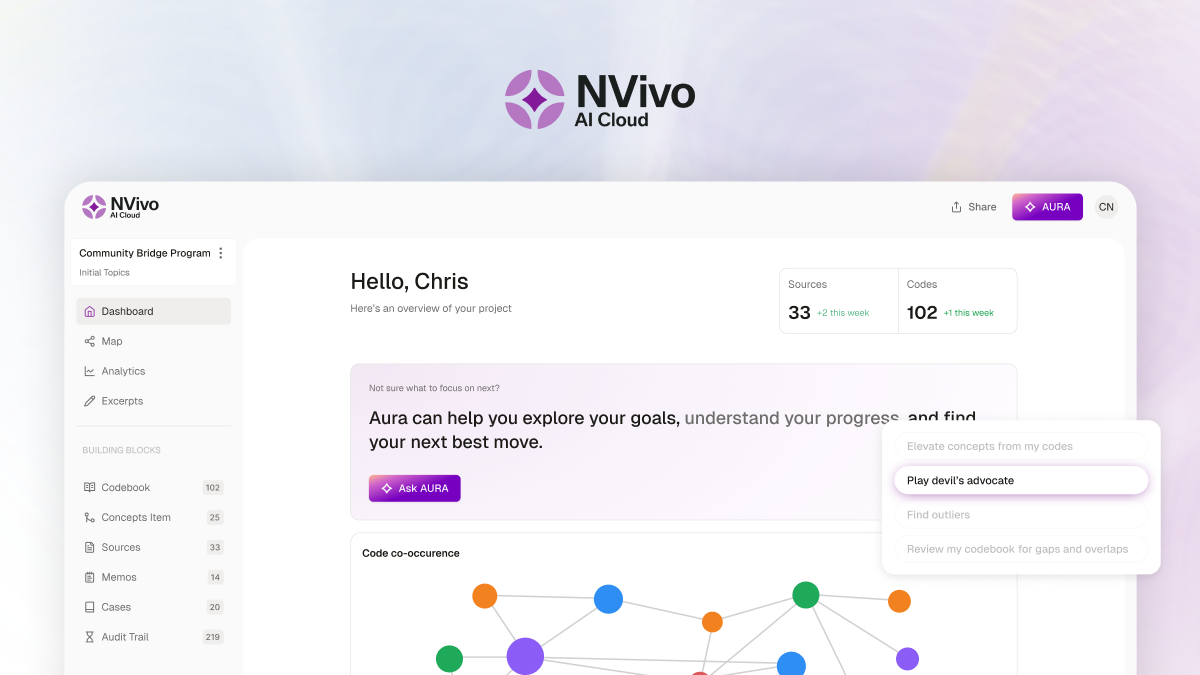
- NVivo is built for structured coding and powerful querying—crosstab and matrix coding queries in particular—along with framework matrices for organizing case-based comparisons. Its AI Assistant handles task-based work like summarization, coding suggestions, and sentiment analysis, with fuller access available as an add-on. NVivo tends to suit researchers managing large volumes of data, working across a team, or combining qualitative and quantitative sources within one project.
- ATLAS.ti takes a visual, network-based approach to analysis, which makes it a strong fit for exploratory work where mapping relationships between codes and concepts is central to your thinking, rather than a secondary step after coding is done. Its AI is included in the subscription and built around conversational, prompt-based interaction—useful if you'd rather talk through your data than run predefined tasks.
- Citavi isn't a coding tool, but it's worth a mention if your thematic analysis involves synthesizing a large body of literature first—its reference and knowledge management features support that earlier stage of the research process, before you ever open a transcript.
Neither NVivo nor ATLAS.ti will do the interpretive work for you—no software makes the leap from code to theme on its own. What they do is remove the friction around getting there: keeping thousands of coded excerpts organized, searchable, and traceable back to source, so your analytic judgment isn't competing with administrative overhead.
| Choose NVivo if… | Choose ATLAS.ti if… |
|---|---|
| You're managing large or mixed-methods datasets. | Your analysis centers on mapping relationships between concepts. |
| You need deep querying and framework matrices. | You prefer a visual, network-based way of working. |
| Your project combines qualitative and quantitative sources. | Your work is exploratory and relationship-driven. |
Strengthen your thematic analysis with the right tools
Whichever approach you take, rigorous thematic analysis depends on staying organized, keeping your interpretation traceable, and being able to show your work. NVivo is built to support exactly that—helping you manage coding unstructured qualitative data at scale, maintain the audit trail reviewers expect, and spend less time on administrative overhead and more time on the analysis itself.
Ready to bring more structure and confidence to your thematic analysis? Get started with NVivo or ATLAS.ti today!

Roehl Sybing, PhD
Research Associate, University of North Dakota
Roehl Sybing is a Research Associate in the College of Education and Human Development at the University of North Dakota and a content writer for Lumivero. His research interests include qualitative research methodology and dialogic interaction across languages and cultures. He has written extensively on qualitative research methods in scholarly and commercial publications, including several articles for ATLAS.ti's Research Hub.
Frequently asked questions
Thematic analysis is a method for finding, analyzing, and reporting patterns of meaning or broader themes in qualitative data from data collection methods such as interviews or open-ended survey responses. It's popular because it's flexible and isn't tied to a single theory.
Braun and Clarke's six phases are: familiarizing yourself with the raw data, generating initial codes, generating broader themes, reviewing themes, defining and naming themes, and writing up. The phases are recursive, not strictly linear.
Reflexive thematic analysis is Braun and Clarke's approach in which themes are actively generated through the researcher's engagement with the data, and the researcher's subjectivity is treated as a resource rather than a bias to eliminate. It doesn't use fixed codebooks or inter-rater reliability.
Thematic analysis is a qualitative method—it interprets meaning rather than counting frequencies. It can be applied to data gathered in mixed-methods studies, but the analysis itself is qualitative.
Thematic analysis interprets patterns of meaning and is fully qualitative; content analysis often quantifies the frequency of predefined categories. Choose TA for depth of meaning, content analysis for systematic counting.
Not always—small datasets can be coded manually. Software like NVivo or ATLAS.ti becomes especially valuable as datasets grow, when teams collaborate, or when you need an audit trail for publication.
Inductive thematic analysis derives codes and themes from the data itself; deductive thematic analysis applies codes from an existing theory or framework. Many studies combine both.
There's no single best tool. NVivo suits large or mixed-methods projects needing deep querying; ATLAS.ti suits visual, relationship-focused analysis. Choose based on your data, team, and workflow.