








Blogs
Explore insights, tips, and industry trends

Case studies
See how organizations achieve real results

eBooks and reports
Access in-depth research and expert analysis

Research
Discover original research and data-driven insights

Webinars
Join live and on-demand sessions with experts

Whitepapers
Access research and expert analysis

Academy
Build skills with structured courses and training

Certified trainers
Get expert training from certified professionals

International partners
Connect with trusted partners around the world

Knowledge center
Find guides, tutorials, and product documentation





Perfecting the art of coding qualitative data

Key takeaways
Qualitative coding organizes raw data into meaningful categories using methods like descriptive or thematic coding. Researchers may use inductive or deductive approaches, refining codes over time to build credible, theory-informed analysis. Tools and techniques like codebooks, QDA software, and intercoder checks help ensure rigor and reliability.
Introduction
Coding is one of the central practices in qualitative research, helping researchers make sense of complex and often unstructured data. It involves assigning labels to segments of text, audio, or visual material so that patterns and meanings can be identified and analyzed.
Far from being a mechanical task, coding requires careful interpretation and thoughtful decision-making at each step. By using systematic coding methods, researchers can move from raw data to clear insights through qualitative data analysis to support interpretation and reporting. This article introduces the process of qualitative coding, its methods, and strategies for ensuring rigor and reliability.
Looking for a structured way to turn qualitative data into real insight? Download "The Essential Guide to Qualitative Coding" to learn how to organize, analyze, and interpret qualitative data with clarity and confidence.
What is qualitative data coding?
Qualitative coding is the process of labeling segments of data with words or short phrases that capture their meaning. These labels, called codes, help organize raw information into manageable units for analysis. Coding is not just about marking text—it involves interpreting what participants have said or what is observed in documents, images, or video.
For example, a researcher analyzing interview transcripts might code a statement about feeling “overwhelmed at work” as stress or workplace pressure. Over time, individual codes can be grouped into categories or themes, forming the foundation of a broader analysis.
Coding is a flexible process that adapts to different research designs. In some studies, researchers begin with a set of predetermined codes linked to a theoretical framework. In others, they allow codes to emerge directly from the data. Either way, the act of coding makes patterns more visible and supports deeper interpretation.
By translating raw data into a structured set of codes, researchers create a pathway from individual experiences to collective insights, allowing for systematic analysis without losing the richness of qualitative evidence.
Types of qualitative codes
- Descriptive codes – Summarize the basic content of a passage with short labels (e.g., “daily routine,” “client feedback”)
- Interpretive codes – Highlight deeper meaning or inferred themes (e.g., “stress,” “power dynamics”)
- Theoretical codes – Connect data to established concepts or constructs from existing theories to support deeper analysis
- In vivo codes – Use participants' exact words as labels to preserve voice and authenticity
- Emergent codes – Arise directly from the data, rather than being pre-defined
Types of qualitative data
Qualitative data comes in many forms, depending on how information is collected and the focus of the study. One of the most common sources is text, including interview transcripts, focus group discussions, open-ended survey responses, diaries, or field notes. Text data provides detailed accounts of experiences and perspectives that can be examined closely through coding.
Common types of qualitative data
- Text – Interview transcripts, open-ended surveys, focus group discussions, diaries, field notes
- Audio – Voice recordings capturing tone, pauses, and verbal nuance
- Video – Recordings that include gesture, body language, and visual context
- Visuals – Photographs, social media content, advertisements, graphic media
- Documents and archives – Policy papers, meeting minutes, organizational reports, historical records
These formats all originate from different qualitative data collection methods, so it helps to plan collection and documentation early. Each type of qualitative data brings unique opportunities and challenges for coding. Researchers must consider the format, level of detail, and context of the material when deciding how to segment and label data for analysis.
Why is qualitative coding important?
Coding plays a central role in qualitative research because it transforms raw, often unstructured material into an organized framework that supports meaningful analysis. Without coding, researchers would struggle to track recurring ideas or identify themes across large datasets. Coding brings order, helps maintain consistency, and creates a basis for sharing findings with others.
Coding qualitative data is important for:
- Organizing data
- Rigor and consistency
- Improved communication
- Data reduction
Organizing data
Qualitative studies often generate large amounts of information. Coding allows researchers to break down interviews, documents, or observations into smaller, more manageable pieces. By tagging specific passages with codes, data can be retrieved efficiently and compared across participants or sources. This organization reduces the risk of overlooking important details.
Rigor and consistency
Systematic coding ensures that interpretations are not made haphazardly. When codes are applied consistently, researchers can show how conclusions are grounded in the data. Developing a codebook and refining it over the course of the project helps strengthen the rigor of the study and supports the credibility of its findings.
Improved communication
Codes and categories provide a shared language for discussing qualitative data. They make it easier to present findings to colleagues, stakeholders, or wider audiences. Instead of relying on lengthy transcripts, researchers can highlight themes or patterns supported by coded excerpts, offering a clearer account of the evidence behind interpretations.
Data reduction
Raw qualitative data can be overwhelming in its volume and complexity, making qualitative analysis equally challenging. Coding reduces this by distilling information into categories that highlight what is most relevant. This process does not remove meaning but helps focus attention on the aspects of the data that are most significant for answering the research questions.
Inductive vs. deductive coding in qualitative data
When coding qualitative data, researchers can choose between two coding approaches: inductive and deductive approaches, or combine them depending on the goals of the study. Both approaches structure the analysis but differ in how codes are generated and applied.
Inductive coding
Inductive coding is a bottom-up approach where codes are developed directly from the data. Instead of starting with a predetermined framework, the researcher reads through transcripts, documents, or recordings and identifies patterns as they appear. For example, if participants repeatedly describe feeling isolated when working remotely, a code such as remote work isolation might be created.
This approach is often used in exploratory research or when little is known about the topic beforehand. Inductive coding allows unexpected themes to surface and helps capture the language and perspectives of participants more closely. However, it can be time-intensive and requires careful attention to avoid personal biases shaping the codes.
Deductive coding
Deductive coding takes a top-down approach, beginning with a predefined set of codes drawn from theory, prior studies, or specific research questions. For instance, a study on healthcare experiences might start with codes like access, communication, and trust, which are then applied to the data.
Deductive coding is useful when the goal is to test or extend existing frameworks, as it ensures the analysis stays aligned with established concepts. The risk, however, is that strictly applying preset codes may overlook new insights or unique perspectives emerging from the data.
A related approach that combines deductive and inductive thinking is the framework analysis method, which uses a working thematic framework that can be refined during analysis.
Types of qualitative coding methods
Qualitative researchers can apply multiple coding schemes, each suited to different types of data and research goals. Some focus on describing the content, while others emphasize interpretation, process, or relationships. The following methods highlight common approaches used in qualitative studies.
Common types of qualitative coding methods include:
- Descriptive coding
- In vivo coding
- Process coding
- Open coding
- Values coding
- Structural coding
- Simultaneous coding
- Focused/selective coding
- Axial coding
- Pattern coding
- Thematic coding
- Longitudinal coding
- Elaborative coding
- Content analysis coding
Descriptive coding
Descriptive coding assigns a word or short phrase that summarizes the basic topic of a passage. It provides an overview of what the data is about without going into interpretation. This method works well in early stages of analysis or with datasets that need quick categorization.
In vivo coding
In vivo coding uses the participant’s own words as the code. This approach preserves the exact language used and is especially helpful when working with populations whose phrasing conveys unique meaning, such as children or cultural groups. It grounds the analysis closely in participants’ perspectives.
Process coding
Process coding highlights actions or sequences, often by using gerunds such as negotiating or adapting. This method is useful when examining change over time, interactions, or steps within a procedure. It is common in studies of organizational processes or social dynamics.
Open coding
Open coding involves breaking data into discrete parts and assigning codes without restricting them to a preset list. It encourages close reading and generates a wide range of categories. This method is typically the first stage of grounded theory analysis.
Values coding
Values coding captures participants’ beliefs, attitudes, or values. A code might represent ideals such as fairness or independence. This method is especially useful for research exploring identity, cultural norms, or motivations.
Structural coding
Structural coding applies a framework or set of questions to guide how passages are labeled. For example, all responses to a survey question about “barriers to healthcare” could be tagged with a single structural code. This method is effective for organizing large datasets collected around specific prompts.
Simultaneous coding
Simultaneous coding occurs when more than one code is applied to the same segment. This method acknowledges that data often carries multiple meanings. For example, a single comment about “juggling work and family” might be coded as both stress and work–life balance.
Focused / selective coding
Focused coding narrows attention to the most significant or frequent codes identified in earlier rounds. Selective coding is often used in grounded theory to integrate categories into a central storyline. Both approaches help refine analysis into more coherent themes.
Axial coding
Axial coding seeks to identify relationships between categories. It connects codes by asking how concepts relate to conditions, actions, or outcomes. For example, a study might link lack of resources with student disengagement to understand causal pathways.
Pattern coding
Pattern coding condenses data into more meaningful units by grouping similar codes into patterns or explanatory themes. It is particularly useful in later stages of analysis for building conceptual frameworks or generating findings that extend beyond description.
Thematic coding
Thematic analysis coding emphasizes the identification of recurring themes across the dataset. It moves beyond labeling to interpret the broader meaning behind participant accounts. This method is widely used in thematic analysis and is suitable across many research designs. Researchers can apply thematic coding through different types of thematic analysis, depending on whether the study uses an inductive, deductive, reflexive, codebook, or coding-reliability approach.
Longitudinal coding
Longitudinal coding tracks changes across time. Researchers may apply the same codes to data collected at multiple points and then compare how themes evolve. This method is common in studies of personal development, organizational change, or program evaluation.
Elaborative coding
Elaborative coding builds on existing theories or findings by applying and refining them in new contexts. It allows researchers to extend prior studies while remaining open to new variations that emerge in the data.
Content analysis coding
Content analysis coding involves systematically counting and categorizing data to identify frequencies and trends. While still qualitative, it incorporates quantitative elements by showing how often certain codes appear. This method is often used when analyzing large text datasets.
Process of coding qualitative data
Coding is rarely a one-time task. It is an iterative process that involves multiple rounds of reviewing and refining the data until a clear structure emerges. While the steps can vary depending on the study design, most researchers follow a similar progression from initial codes to final interpretations.
Here are the main steps in the process of coding qualitative data:
- Begin with initial round of coding
- Organize codes into categories and subcodes
- Perform additional rounds of coding
- Synthesize into final narratives or findings
Begin with initial round of coding
The first step is to conduct an initial or exploratory round of coding. At this stage, the goal is breadth rather than precision. Researchers read through transcripts, documents, or notes and assign labels to segments of data that appear meaningful. These may be descriptive, action-oriented, or in vivo codes that capture participants’ language. The emphasis is on capturing as much as possible without worrying about duplication or overlap.
Organize codes into categories and subcodes
Once an initial set of codes has been developed, the next step is to organize them. Similar codes are grouped together into categories, and subcodes may be added to provide detail.
For example, codes such as long work hours and tight deadlines might fall under the category workplace stress. Organizing codes in this way creates a framework that highlights patterns and prepares the data for deeper analysis.
Perform additional rounds of coding
Coding is usually repeated in multiple cycles. Later rounds focus on refining the code list, merging overlapping codes, and applying the categories more consistently across the dataset. Researchers may also test out higher-level coding strategies such as pattern coding or axial coding during this stage. These additional cycles bring greater clarity and ensure that interpretations are grounded in the data.
Synthesize into final narratives or findings
The final stage of coding involves synthesizing categories and themes into broader narratives or findings. Analyzing qualitative data in this way may include constructing models, writing analytic memos, or integrating codes into theoretical frameworks.
At this point, the codes serve as evidence to support the study’s interpretations and conclusions. The outcome is not just a list of codes but a structured account of how participants’ experiences or documents contribute to answering the research questions.
What to do after qualitative coding
Review and refine your coding framework
Initial coding rarely produces the final framework, so review the coding before interpretation begins. Read the content of each node in full and check that every excerpt fits the definition it was filed under. This shows whether the coding is accurate and whether the level of coding is appropriate: a node may contain only a fragment without enough context, or whole paragraphs where a single sentence carries the point.
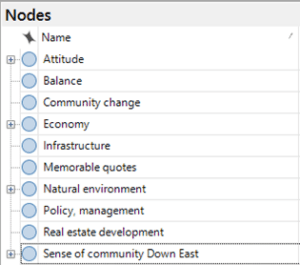
The number of coding references per code can show where the structure needs adjusting. Codes with very few references may describe closely related ideas, and combining them can create a broader category with enough material behind it. A code with a large number of references may cover several distinct concepts, so coding on from it (applying more specific subcodes to the material already filed there) can bring those distinctions into view.
Standalone codes also need review. If you find several that relate to one another, they can be grouped into a hierarchy that reflects the relationships in the data. This makes it easier to compare coded material and trace broader categories back to the excerpts that support them. Code definitions and categories can be revised as needed to keep the framework connected to the research questions.
Move beyond descriptive coding
Descriptive or low-level codes provide a useful starting point during initial coding as a rough label for content. From there, the analysis can move towards broader themes and interpretations.
Revisit your research questions before developing the codes further. It can be easy to lose sight of these, but research questions give codes a clear purpose. Consider what each code contributes to answering a question and how related codes might be developed into broader themes, interpretations, or explanations.
This step is crucial as it connects the coding framework to the purpose of the study. It also brings out the meaning behind recurring patterns that a set of descriptive labels may leave unstated. See Bazeley (2009), and Braun and Clarke (2006) for further guidance—full references provided below.
Use queries to identify patterns and gaps
Testing a coding framework against the data it was built from can help check the initial coding and bring out patterns or relationships that were not visible during a first pass through the material. Once the framework has been reviewed, the query tool in NVivo can support this part of the analysis.
A Word Frequency query shows which terms recur most often across the dataset. Reviewing the results may point to concepts that do not yet have a code. NVivo can display these results as a word cloud, with the most frequent terms appearing largest.

You can also run text searches for specific concepts that have been coded—these can be checked against manual coding to ensure that nothing has been left out.
In NVivo, Coding and Matrix Coding queries allow you to examine patterns across themes and break down coded material according to demographic or descriptive categories (e.g. what did different age groups say about aspects of the natural environment?). Together, these queries can bring out new ideas and relationships, giving you material to develop the analysis and a structure to build on in the write-up.
Use visualizations and coded extracts to support your analysis
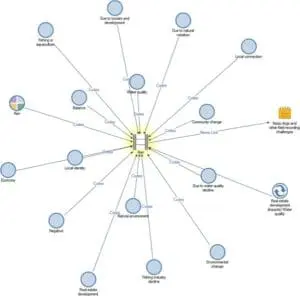
Visual outputs give researchers another way to look at coded data. NVivo’s Project Maps and Concept Maps, along with its Explore and Comparison Diagrams, show how codes and categories connect to broader themes. This can bring out relationships more easily than a list of codes.
A researcher might lay out the codes under one theme and see that two of them also link to a theme that had seemed unrelated. This kind of work supports analytical thinking, and the finished visuals can be exported for the write-up or a presentation.
Coded extracts do similar work at the writing stage. Exporting the content filed under a code puts the supporting material in one place. Reviewed alongside the research questions, those extracts become the evidence behind the findings and the final narrative. Selecting verbatim passages also keeps participants' own words in the account.
Allow time to reflect on the coding before the write-up. Reviewing the framework, visualizations, and selected extracts can reveal additional insights and relationships that may shape the analysis.
Qualitative coding techniques to ensure credibility, validity, and reliability
Because qualitative research involves interpretation, researchers must demonstrate that their coding is systematic and trustworthy. Several techniques can strengthen the rigor of the process and help others see how findings are supported by the data.
Common techniques to ensure reliability in qualitative coding:
- Intercoder reliability
- Codebook refinement
- QDA software
- Practice reflexivity
- Use triangulation
- Conduct peer debriefing
Intercoder reliability
When more than one researcher is coding the same dataset, intercoder reliability helps ensure consistency. This process involves independently coding the same material, then comparing results to check for agreement.
Discrepancies are discussed and resolved, which not only improves reliability but also clarifies the meaning of codes. Intercoder reliability is particularly important in team-based projects.
Codebook refinement
A codebook is a document that defines each code, provides examples, and explains how it should be applied. Refining the codebook throughout the project helps maintain consistency across the dataset.
As new insights emerge, definitions may be updated or redundant codes removed. Keeping a well-documented codebook also makes it easier for others to understand and evaluate the research process.
Conduct peer debriefing
Peer debriefing brings in colleagues who are not directly involved in the study to review coding decisions and interpretations. This external perspective can identify blind spots, challenge assumptions, and suggest alternative explanations. Documenting these discussions demonstrates that the coding process has been scrutinized beyond the research team, adding credibility to the analysis.
Manual coding vs. coding with software: Which one?
So should you rely on software to code your data, or should you break out the pens and highlighters on printouts of your transcripts and field notes? Neither approach is wrong, and both approaches have their pros and cons. Ultimately, the best approach to coding comes down to what you are most comfortable with and the volume of your data.
Manual coding
Scholars who teach qualitative coding will likely insist that newer researchers try to code by hand, at least at first. The analog approach to coding is often characterized as laying out pages of qualitative data across the floor, highlighting important segments of text or applying colored labels to pages, then seeing which colors representing main themes are more prevalent within the data set. This visual approach can feel more natural than entrusting the coding process to technology.
Manual coding, on the other hand, has limits in handling complex sets of data. What if you need to represent more themes than you have colors of highlighters? What if your data runs into hundreds or thousands of pages? How do you represent manual coding in a way that more quantitative researchers or researchers accustomed to software can understand?
Naturally, highlighters on paper are best for simple data sets, when you need to understand the main themes rather than think about complex patterns or combinations of codes.
Coding with software
Qualitative data analysis software such as NVivo and ATLAS.ti supports systematic coding by allowing researchers to store, organize, and retrieve coded segments. Software tools help maintain consistency across large datasets, provide ways to visualize connections between codes, and allow for more efficient handling of multiple coders. While software does not replace interpretation, it provides a clear structure for managing the coding process.
Like any research tool, QDA software may require some time to become familiar with—especially for researchers who are new to digital analysis workflows. Fortunately, both NVivo and ATLAS.ti offer extensive learning resources, including tutorials, training courses, webinars, and active user communities that help researchers quickly build confidence with the tools.
Once researchers become comfortable with the software, the benefits become clear—particularly when working with complex datasets or collaborating with a research team. NVivo and ATLAS.ti can help researchers explore coded data more deeply, visualize emerging themes, and identify meaningful patterns across interviews, documents, or survey responses.
While learning manual coding can be valuable early in the research process, many experienced qualitative and mixed methods researchers find that QDA software allows them to scale their analysis and tackle more complex research questions with greater clarity and efficiency.
Qualitative coding with NVivo and ATLAS.ti
Whichever qualitative research methods you use, qualitative research software can help you make sense of your data. Countless researchers rely on NVivo and ATLAS.ti QDA software to analyze textual data of all kinds—whether refining manual coding techniques or using our AI-powered tools to make analysis easier. Try out your qualitative data analysis strategy with research software today.
References
Bazeley, P. (2009). Analysing qualitative data: More than ‘identifying themes’. Malaysian Journal of Qualitative Research, 2(2), 6–22.
Braun, V., & Clarke, V. (2006). Using thematic analysis in psychology. Qualitative Research in Psychology, 3(2), 77–101. https://dx.doi.org/10.1191/1478088706qp063oa




How can we help you? Contact us.