






Blogs
Explore insights, tips, and industry trends

Case studies
See how organizations achieve real results

eBooks and reports
Access in-depth research and expert analysis

Research
Discover original research and data-driven insights

Webinars
Join live and on-demand sessions with experts

Whitepapers
Access research and expert analysis

Academy
Build skills with structured courses and training

Certified trainers
Get expert training from certified professionals

International partners
Connect with trusted partners around the world

Knowledge center
Find guides, tutorials, and product documentation




Qualitative data collection: methods, tools, and examples for researchers
By Abigail Jacobsen, Senior Content Marketing Manager, Lumivero
Reviewed by Roehl Sybing, PhD, Research Associate, University of North Dakota
Key takeaways
Qualitative data collection is the foundation of any study designed to understand experiences, behaviors, and meaning rather than simply measure them. The seven most widely used methods—interviews, focus groups, observations, open-ended surveys, document analysis, case studies, and ethnographic fieldwork—each serve distinct research purposes, and choosing the right one depends on your research question, available time, and access to participants.
Effective collection requires careful planning, clear ethical safeguards, and consistent recording practices throughout the process. Once data is gathered, software like NVivo AI Cloud and NVivo Desktop manages the full pipeline, from transcription through coding and theme development, helping researchers move from raw data to defensible insights with confidence.

Qualitative data collection is the systematic gathering of non-numerical information — interview transcripts, observation notes, focus group discussions, documents, and open-ended survey responses — used to understand experiences, behaviors, and meaning rather than to measure them. While quantitative methods count and measure, qualitative methods get at the why and the how behind human behavior, surfacing the context and nuance that numbers alone can't explain. The seven canonical qualitative data collection methods are interviews, focus groups, observations, open-ended surveys, document analysis, case studies, and ethnographic fieldwork.
This guide walks you through each method, when to use it, the best practices that keep your data credible, the tools and instruments that support collection, a worked example showing data moving from collection to coding in NVivo AI Cloud and NVivo Desktop, and an FAQ covering the most common questions researchers ask.
What is qualitative data collection?
Qualitative data collection is the systematic gathering of non-numerical information — interview transcripts, observation notes, focus group discussions, documents, and open-ended survey responses — used to understand experiences, behaviors, and meaning rather than to measure them. It is the foundation of qualitative research, answering questions about why and how rather than how many or how much.
Unlike quantitative data collection, which captures numerical data for statistical analysis, qualitative collection captures words, images, and behaviors. The goal is depth and context, not generalizability through large sample sizes. Qualitative researchers work inductively, building theory from data rather than testing pre-formed hypotheses. This makes it especially valuable in fields where meaning, culture, or lived experience is the unit of analysis — healthcare, education, social science, UX research, and organizational studies among them.
Qualitative vs. quantitative data collection: What's the difference?
The distinction comes down to what kind of question you're asking. Qualitative collection captures meaning; quantitative collection captures measurement. Most applied research sits somewhere between the two, and many studies use both in a mixed-methods design.
| Dimension | Qualitative | Quantitative |
|---|---|---|
| Type of data | Text, audio, video, images | Numbers, counts, measurements |
| Common methods | Interviews, focus groups, observation, document analysis | Surveys (closed-ended), experiments, structured observation |
| Sample size | Small — determined by saturation | Large — determined by statistical power |
| Type of analysis | Thematic, interpretive, narrative | Statistical, inferential |
| What it answers | Why and how | How many and how much |
Why does qualitative data collection matter?
Numbers describe what is happening. Qualitative data explains why. When a hospital sees rising staff turnover, a survey can confirm the scale of the problem — but only qualitative data can reveal whether the cause is leadership, workload, culture, or something no one thought to measure. That explanatory depth is qualitative research's most important contribution.
Qualitative collection also surfaces participant perspectives in their own words, preserving the texture of experience that gets smoothed over in quantitative analysis. It supports theory-building rather than only theory-testing, making it the right tool when you're entering unfamiliar territory, exploring complex social phenomena, or designing solutions for specific communities.
In practical terms in qualitative research, selecting the most appropriate methods are essential wherever meaning, behavior, or context is the unit of analysis: understanding patient experiences in healthcare, exploring student engagement in education, uncovering user pain points in product design, or tracing how policy is interpreted on the ground in public service settings.
What are the seven qualitative data collection methods?
The seven most widely used qualitative data collection methods are interviews, focus groups, observations, open-ended surveys, document analysis, case studies, and ethnographic fieldwork. Each is suited to different research questions, participant groups, and practical constraints. The table below gives you a quick comparison before the detailed sections that follow.
| Method | What it captures | Best for | Typical sample size | Primary instrument |
|---|---|---|---|---|
| Interviews | In-depth individual accounts | Complex experiences, sensitive topics | 8–20 participants | Interview protocol |
| Focus groups | Group dynamics, shared perspectives | Social norms, collective meaning | 3–6 groups of 6–10 | Moderator guide |
| Observations | Behavior in natural settings | Context, practice, non-verbal cues | 1 or more sites | Observation rubric |
| Open-ended surveys | Qualitative responses at scale | Large, dispersed samples | 50–500+ respondents | Survey instrument |
| Document analysis | Existing texts and records | Historical or archival research | Varies by corpus | Coding framework |
| Case studies | Holistic understanding of a bounded unit | Complex, context-rich phenomena | 1–5 cases | Multi-source protocol |
| Ethnographic fieldwork | Culture, meaning from inside a community | Long-term cultural or organizational study | 1 site, extended period | Field notes template |
Interviews
Qualitative interviews are guided conversations between a researcher and a participant designed to elicit detailed, first-person accounts of experiences, beliefs, or behaviors. They are the most widely used qualitative data collection method and the most direct route to understanding how individuals make sense of their world.
Interviews come in three main forms. Structured interviews follow a fixed set of questions in a fixed order, maximizing comparability across participants. Semi-structured interviews use a prepared protocol but allow the researcher to probe and follow unexpected threads — the most common format in qualitative research. Unstructured interviews are open-ended conversations guided by a broad topic rather than specific questions, suitable for exploratory work or life history research.
When to use interviews
Use interviews when:
- Your research question asks about individual experience, perspective, or decision-making
- The topic is sensitive, complex, or requires follow-up probing
- Participants are geographically accessible and willing to engage in depth
- You need rich, detailed data from a relatively small sample
- You are exploring a phenomenon for which little prior research exists
Best practices for interviews
- Pilot your protocol with at least two participants before fieldwork begins
- Record audio or video with informed consent — memory-based notes are unreliable
- Use open-ended questions that invite narrative ("Tell me about a time when...")
- Probe with neutral follow-ups: "Can you say more about that?" or "What did you mean by...?"
- Transcribe recordings promptly and check against the audio for accuracy
- Keep your own reflexive journal to track how your assumptions may be shaping the conversation
Get the guide: The Interview-to-Insight Playbook for Qualitative Researchers
Learn how to conduct interview research with greater confidence and clarity—from study design to final insight.
Focus groups
Focus groups are moderated discussions among 6–10 participants designed to surface shared perspectives, disagreements, and social dynamics around a topic. Unlike interviews, where individual accounts are the goal, focus groups are designed to observe how meaning is constructed collectively — how people agree, challenge each other, and negotiate shared understanding.
They are particularly powerful for understanding social norms, evaluating products or programs with defined user groups, and generating hypotheses that can be explored in subsequent individual interviews.
When to use focus groups
Use focus groups when:
- Your research question concerns shared attitudes, norms, or group-level meaning
- You want to observe how participants respond to each other's perspectives
- You're evaluating a concept, product, or program with a defined community
- You need to generate hypotheses quickly for a larger study
- Time and budget limit the number of individual interviews you can conduct
Best practices for focus groups
- Recruit 6–10 participants per group — fewer than 6 risks thin data; more than 10 makes facilitation difficult
- Use a trained moderator who can balance dominant voices and draw out quieter participants
- Keep the moderator guide to 5–7 core questions to allow sufficient depth per topic
- Record and transcribe all sessions; a co-facilitator should take field notes on non-verbal dynamics
- Run at least 3–4 groups to begin identifying patterns across sessions
- Debrief immediately after each session while impressions are fresh
Observations
Observations involve systematically watching and recording behavior in natural settings — either as a participant in the activity (participant observation) or as a detached observer (non-participant observation). Observation is the only qualitative method that captures what people actually do rather than what they say they do, making it invaluable when behavior and context are central to the research question.
Participant observation involves the researcher taking an active role in the setting being studied, often over an extended period. Non-participant observation means the researcher remains on the periphery, recording events without joining them. Both approaches produce rich, contextually grounded data, though each carries distinct trade-offs around access, bias, and researcher influence on the setting.
When to use observations
Use observations when:
- You want to capture behavior as it naturally occurs, rather than self-reported accounts
- The gap between what people say and what they do is a key concern
- The research setting is social, organizational, or environmental in nature
- You are studying practices, routines, or interactions that are hard to verbalize
- You want to contextualize findings from interviews or surveys
Best practices for observations
- Use a structured observation rubric to ensure consistent recording across sessions
- • Decide before entering the field whether you will be a participant or non-participant observer
- • Record field notes as soon as possible after each session — memory degrades quickly
- • Distinguish between descriptive notes (what you saw) and reflective notes (what you think it means)
- • Be transparent with participants about the research purpose to maintain ethical integrity
- • Acknowledge and document your own role and potential influence on the setting
Open-ended surveys
Open-ended surveys collect qualitative responses at scale by asking participants to answer in their own words rather than selecting from fixed options. They occupy a unique position in the methods toolkit: they provide the contextual depth of qualitative data while reaching the large, geographically dispersed samples more commonly associated with quantitative research.
Unlike structured surveys designed for statistical analysis, open-ended surveys produce textual data — short paragraphs, explanations, and first-person accounts — that is analyzed qualitatively through coding and thematic analysis. This makes them an efficient bridge between qualitative and quantitative approaches, especially in mixed-methods studies where open-text items complement closed-ended scale items.
For field-based and mobile data collection, platforms like SurveyToGo support offline open-ended surveys across diverse and hard-to-reach populations, ensuring data quality even in low-connectivity environments.
When to use open-ended surveys
Use open-ended surveys when:
- Your sample is too large or geographically dispersed for interviews or focus groups
- You need qualitative depth but with lower per-respondent time burden
- You are running a mixed-methods study and want qualitative and quantitative data from the same participants
- You want to pilot themes before committing to a full interview study
- Anonymity is important and a face-to-face method would inhibit honest responses
Best practices for open-ended surveys
- Write clear, neutral questions — avoid leading phrasing or double-barreled items
- Limit the number of open-text questions to reduce respondent fatigue; 3–5 is usually sufficient
- Pilot the survey with a small group before full launch to identify confusing wording
- Balance open-text items with a few closed-ended items to give context to qualitative responses
- Plan your analysis approach before collecting data — open-text responses still require systematic coding; see our qualitative content analysis guide for analytical techniques
Document analysis
Document analysis is the systematic examination of existing texts, records, and artifacts — meeting minutes, policy documents, news articles, organizational reports, diaries, or digital artifacts — to extract qualitative evidence about a phenomenon. Unlike methods that require recruiting participants, document analysis works with data from existing documents, making it especially useful for historical research, organizational studies, and contexts where access to people is limited.
The documents analyzed can be primary sources produced by participants (such as personal diaries or organizational memos) or secondary sources that describe or interpret events (such as news coverage or policy reviews). For analytical techniques applied to document and text data, see our qualitative content analysis guide.
When to use document analysis
Use document analysis when:
- Primary data collection from participants is not feasible or not necessary
- You are studying historical events, organizational change, or policy development
- Documents provide important context for understanding data gathered through other methods
- You want to triangulate findings from interviews or observations against official records
- You are conducting a systematic literature review or secondary analysis of existing qualitative data
Best practices for document analysis
- Define your corpus in advance — which documents, from which sources, covering which time period
- Assess the authenticity, credibility, and representativeness of each document before including it
- Develop a coding framework before analysis begins to ensure systematic treatment across documents
- Document your selection and exclusion criteria transparently for audit trail purposes
- Consider how documents were originally produced — their purpose, audience, and context shape how they should be interpreted
Case studies
Case studies are in-depth investigations of a single bounded unit — a person, group, organization, event, or setting — examined across multiple data sources to produce a holistic understanding. The defining feature of a case study is not a single method but the focus: one case, examined thoroughly, from multiple angles.
Case studies frequently combine other collection methods — interviews with key participants, observations of relevant settings, and analysis of documents and records — to build a rich, multi-layered picture of the phenomenon under study. This makes them one of the most comprehensive approaches available to qualitative researchers.
When to use case studies
Use case studies when:
- Your research question asks "how" or "why" about a specific, real-world phenomenon
- You need to understand complexity and context, not just patterns across cases
- The boundaries between the phenomenon and its context are not clearly defined in advance
- You are studying rare events, unique organizations, or exemplary programs
- Multiple data sources are available and can be triangulated to strengthen conclusions
Best practices for case studies
- Define the boundaries of your case explicitly before data collection begins — what is included and what is not
- Use at least two data sources to enable triangulation (e.g., interviews plus documents, or observation plus interviews)
- Develop a case study protocol that guides data collection consistently
- Maintain a case study database to store all evidence systematically
- Address the question of transferability — how far might your findings apply beyond this specific case?
Ethnographic fieldwork
Ethnographic fieldwork is the long-form study of a community, culture, or organizational setting through extended immersion — typically combining participant observation, field interviews, and document review over months or years. Where other qualitative methods take a cross-sectional snapshot, ethnography builds an understanding from the inside out, following the logic and meanings of the people being studied rather than imposing frameworks from outside.
Core practices include sustained field notes that capture the texture of daily life, thick description that contextualizes observed behavior within cultural meanings, and reflexivity — ongoing attention to how the researcher's presence and identity shape what is seen and recorded. Ethnography is especially suited to studying culture, organizational life, and settings where short-term methods would miss the patterns that only become visible over time.
When to use ethnographic fieldwork
Use ethnographic fieldwork when:
- Understanding a culture or community from the inside is central to the research question
- The research requires long-term engagement to capture change over time
- Short-term data collection methods would miss meaning that is embedded in everyday practice
- You are studying organizational culture, subcultures, or communities of practice
- The research question calls for holistic understanding rather than targeted data points
For a deeper treatment of ethnographic methodology, design, and ethics, see our guide to ethnographic research.
Other qualitative methods worth knowing
Beyond the seven core methods, several specialized approaches address specific research designs. These methods are well-established in particular fields but are less universally used than the canonical seven.
Diaries and journals
Diary and journal methods ask participants to record experiences, thoughts, or behaviors in their own words over an extended period — daily, weekly, or in response to specific events. Unlike interviews and focus groups, which capture retrospective accounts, diaries capture data in real time as experiences unfold, reducing the recall bias that affects most other methods.
Diary methods work well for studies of daily experience, health behaviors, emotional states, or workplace practices that change over time. They are also useful when frequent in-person contact with participants is not feasible. The main challenge is attrition — participants who begin a diary study don't always complete it — so clear instructions, regular check-ins, and modest expectations for entry length help maintain engagement. Data from diary studies is analyzed using the same qualitative techniques as interview data: transcription, coding, and thematic development.
How do you collect qualitative data?
Qualitative data collection follows six stages: plan the study, recruit and prepare participants, choose the right setting, record and manage data, ensure data quality, and address ethical considerations. Moving through each stage deliberately is what separates credible, defensible research from data that can't bear the weight of the conclusions drawn from it.
Planning the data collection process
Effective data collection starts before you speak to a single participant. Planning means translating your research question into a collection strategy: which method fits the question, how many participants or cases you'll need, what instruments you'll use, and how long the process will take.
Write out your data collection protocol in full before you begin. For interview-based studies this means a complete interview guide, including your opening and closing statements. For observational studies it means a structured field note template. For surveys it means a finalized instrument. Piloting your instruments with two to three people before full fieldwork reveals ambiguities you won't catch at your desk.
Recruiting and preparing participants
Recruitment in qualitative research is purposive rather than random. You're selecting participants because they have relevant experience, perspectives, or roles — not to achieve a statistically representative sample. Purposive sampling, snowball sampling, and maximum variation sampling are the most common approaches.
Once recruited, participants need clear, plain-language information about the study's purpose, what participation involves, how data will be used and stored, and how confidentiality is protected. This information is usually delivered via a participant information sheet and confirmed through written informed consent.
Choosing the right setting
Where you collect data shapes what data you get. This context is particularly important when using discourse analysis, because the meaning of language can change depending on who is speaking, where the interaction occurs and who the audience is. Interviews conducted in a participant's own workspace often produce richer, more relaxed accounts than those conducted in formal institutional settings. Focus groups need a neutral space where no participant holds obvious positional authority over the others. Observations should take place in the setting where the behavior naturally occurs.
For online data collection, platform choice matters: video interviews introduce different dynamics than phone interviews; asynchronous online focus groups can increase accessibility but reduce spontaneity. Be deliberate about setting choices and document your reasoning in your methods section.
Recording and managing data
Reliable recording is non-negotiable. For interviews and focus groups, audio recording with participant consent is standard — memory-based notes are too selective and too prone to interpretive bias. Video recording adds valuable non-verbal context where the research question warrants it.
Audio and video files should be transcribed promptly. NVivo Transcription converts recorded interviews and focus groups into time-stamped text, ready for import directly into NVivo for analysis — eliminating the manual transcription step and reducing the lag between data collection and coding. Field notes from observational studies should be written up in full as soon as possible after each session, while detail is still fresh.
Ensuring data quality and consistency
Data quality in qualitative research is maintained through consistency, not standardization. This means using the same interview protocol across participants, applying the same observation rubric across sites, and keeping a reflexive journal that tracks how your decisions and assumptions evolve over the course of fieldwork.
Member checking — sharing preliminary findings with participants for comment — is one of the most powerful quality assurance tools available to qualitative researchers. It surfaces misinterpretations early and strengthens the credibility of your conclusions. Peer debriefing, where a trusted colleague reviews your data and emerging interpretations, serves a similar function.
Addressing ethical considerations
Ethical research practice in qualitative studies centers on four principles: informed consent, confidentiality, minimizing harm, and transparency about the researcher's role and interests.
Informed consent must be genuinely voluntary — participants should feel free to withdraw at any time without penalty. Confidentiality requires that identifying details are anonymized in transcripts and reports. In sensitive topic areas (health, trauma, marginalized communities), researchers should have a plan for responding if a participant discloses distress. Data storage should be secure, and retention and deletion practices should be communicated clearly to participants in advance.
A worked example: Qualitative data from collection to coding
Seeing the full pipeline in action — from research question to coded transcript — makes the process concrete. The following example walks through a small interview study from start to finish.
Scenario
A hospital nursing director wants to understand why experienced ICU nurses are leaving the unit at higher rates than other departments. The research question is: What factors do ICU nurses identify as contributing to their decision to leave or consider leaving their role? The team selects semi-structured interviews as the method because the question asks about individual experience, the topic is sensitive enough to require one-on-one depth, and the nursing population is geographically concentrated and accessible.
Collection
The team develops an interview protocol with six open questions covering workload, team dynamics, leadership support, and emotional demands. Interviews run 45–60 minutes, are audio-recorded with written consent, and are supplemented with brief field notes capturing non-verbal observations and post-interview impressions. After seven interviews, themes begin repeating without new concepts emerging — theoretical saturation is reached, and the team concludes data collection at eight participants.
Transcript excerpt
Coding in NVivo
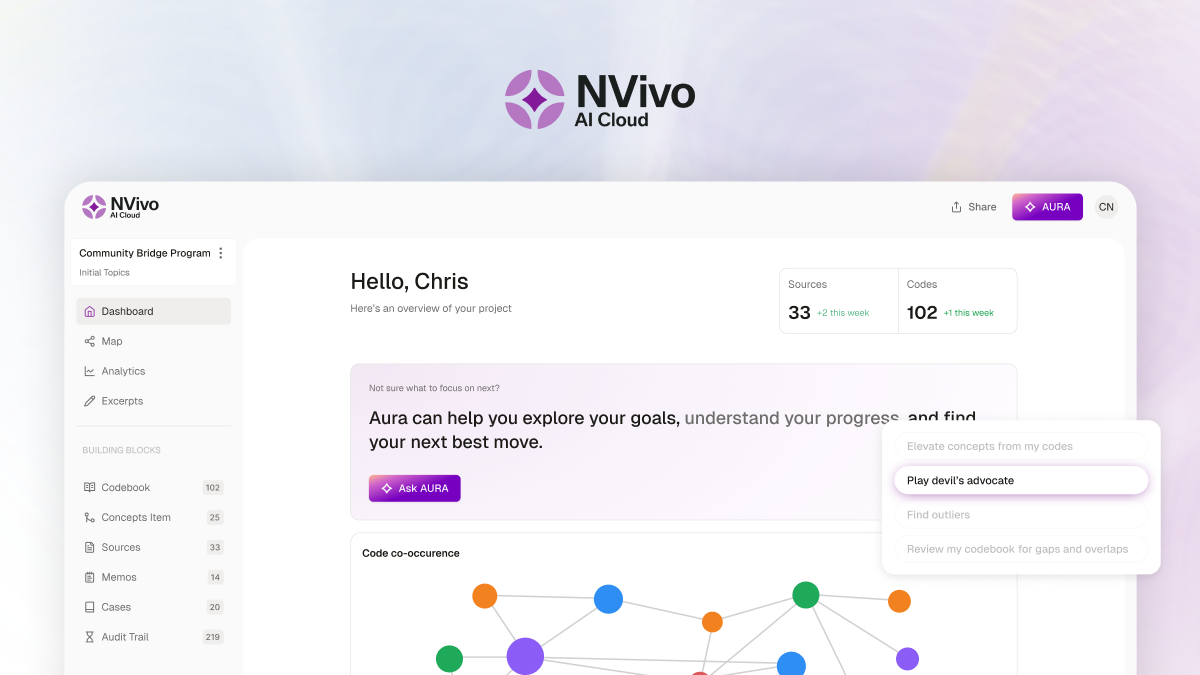
Imported into NVivo AI Cloud, AURA—NVivo AI Cloud's AI-powered Unified Research Assistant—reads the transcript against the study's research questions and proposes topics across the growing corpus, each with its supporting excerpts attached: candidates like emotional exhaustion and lack of recovery time surface for the researcher to confirm before they become codes. Every AI-suggested code still requires approval, so the coding scheme stays the researcher's own.
Imported into NVivo Desktop, the transcript excerpt above receives three initial codes: emotional exhaustion (the experience of depletion described in concrete terms), lack of recovery time (the pattern of insufficient rest between shifts), and social withdrawal (the impact on personal relationships). These codes are applied consistently across all eight transcripts using NVivo's coding panel, then refined into broader themes during the subsequent analysis phase.
The State of AI in Qualitative and Mixed Methods Research
Discover key findings on how researchers are adopting, trusting, and governing AI in their qualitative and mixed methods work.
Download report →What are the best practices for qualitative data collection?
Best practices for qualitative data collection focus on clear questioning, researcher reflexivity, rapport, triangulation, bias management, and documentation. Applied consistently, these practices are what make findings credible, defensible, and transferable to other contexts.
Developing clear research questions
The quality of your data depends on the quality of your research question. A well-formed qualitative research question is open (inviting exploration rather than a yes/no answer), focused (scoped to a manageable phenomenon), and researchable (addressable through the collection methods available to you). "How do ICU nurses experience emotional demands in their work?" is a stronger qualitative question than "Are ICU nurses stressed?" — it opens space for nuance rather than closing it down.
Your research question should directly shape your instrument design. Every interview question, observation category, and survey item should trace back to the core question. If it doesn't, cut it.
Maintaining reflexivity during data collection
Reflexivity is the practice of continuously examining how your own background, assumptions, and position as a researcher influence what you observe, how participants respond to you, and how you interpret what you hear. Reflexivity is an ongoing discipline throughout fieldwork that requires constant practice, especially when reporting qualitative research.
Keep a reflexive research journal throughout data collection. Record your assumptions before you enter the field, note moments where your reactions surprised you, and track how your interpretations shift as data accumulates. This journal becomes part of your audit trail and a resource when writing up your methods.
Building rapport with participants
Qualitative data quality depends on participant trust. People share richer, more honest accounts when they feel comfortable, heard, and confident that their words will be treated with care. Rapport-building starts before the first question: your participant information sheet, consent process, and opening conversation all signal what kind of researcher you are.
Practical rapport-building techniques include: arriving early and taking time for informal conversation, explaining the purpose of recording before asking consent, opening interviews with low-stakes warm-up questions before moving to complex topics, and actively listening — using minimal prompts, maintaining eye contact, and allowing pauses to develop without rushing to fill them.
Using triangulation to strengthen findings
Triangulation means cross-checking findings across multiple data sources, methods, or researchers to test whether conclusions hold up from different angles. An interview finding is stronger when it is corroborated by observations, supported by documents, or confirmed by a second researcher coding independently.
The most powerful form of triangulation combines qualitative and quantitative data in a mixed-methods research design — using qualitative depth to explain patterns identified in survey data, or using quantitative measurement to assess the prevalence of themes identified qualitatively.
Managing bias and subjectivity
All qualitative research involves interpretation — and interpretation is always shaped by the researcher's perspective. Managing bias doesn't mean eliminating it; it means being transparent about it and building in systematic checks.
Key bias management strategies include: using a structured protocol rather than free-form questions; having a second coder apply your coding framework to a subset of data and comparing results (inter-rater reliability); conducting member checks to verify your interpretation of participant accounts; and being explicit in your write-up about which choices were made and why.
Ensuring transparency and documentation
A credible qualitative study is one where another researcher could follow your decision trail and understand why you did what you did. This requires documenting everything: your sampling rationale, your instrument development process, your changes to the protocol mid-field, your coding decisions, and your emerging interpretations.
NVivo AI Cloud supports this documentation within the analysis environment itself: every memo and code carries a full, exportable audit trail, with AI-prompt inspection and AI/human attribution showing exactly who—or what—made each analytic decision.
NVivo Desktop also keeps memos, annotations, and audit logs in one place alongside your data. When it comes time to write up your methods section or respond to peer reviewer questions, the record is already there.
What tools and instruments are used in qualitative data collection?
A useful distinction: instruments are the research artifacts that guide collection — interview protocols, observation rubrics, focus group moderator guides, survey forms. Tools are the software and hardware that support collection — audio recorders, transcription platforms, survey platforms, and qualitative data analysis software. Both matter, and confusing the two leads to gaps in research planning. The sections below cover both.
Audio and video recording tools
For interviews and focus groups, reliable recording is essential. Digital voice recorders produce cleaner audio than smartphone apps in noisy environments, and dedicated devices reduce the risk of a notification or app crash interrupting a session. For video, a simple webcam or device camera is sufficient for most research purposes.
NVivo Transcription integrates directly with NVivo Desktop and converts audio and video recordings into time-stamped transcripts ready for analysis — eliminating the manual transcription step that has historically been one of the most time-consuming parts of qualitative research. Timestamps allow you to navigate back to the original recording at any point in the coding process.
Note-taking and transcription tools
Field notes are the primary instrument in observational and ethnographic research. Whether you take notes by hand or with a digital tool, the goal is the same: capture what you see and hear with enough specificity that the notes are analytically useful weeks or months later.
For transcription, NVivo Transcription converts recordings to text with speaker identification and timestamps. For researchers who transcribe manually, formatting conventions — speaker labels, time codes, notation for pauses and overlaps — should be established before transcription begins and applied consistently across all transcripts.
Qualitative data analysis software
NVivo AI Cloud pairs agentic AI workflows with the qualitative research methodology researchers already trust from NVivo: AURA identifies topics across your dataset with the supporting evidence attached, auto-codes against the topics you confirm, and keeps a full, exportable audit trail of every AI and human decision. It supports interview transcripts, focus group recordings, and documents today, including audio and video recordings you transcribe directly in the platform.
NVivo Desktop also manages the full analytical pipeline—transcription, coding, theme development, and reporting—for every method covered in this guide. Rather than managing transcripts in Word documents and codes in spreadsheets, QDA software keeps everything in one place: your data, your codes, your memos, and your analytical decisions.
NVivo Desktop supports every major qualitative collection method — interview transcripts, focus group recordings, observation field notes, open-ended survey responses, documents, and social media data — and includes AI-enhanced tools for auto-summarization and theme suggestions that accelerate early coding without replacing researcher judgment. These safeguards are important because the use of AI in qualitative research should accelerate routine tasks without removing the researcher from the analytical process. ATLAS.ti is another well-regarded QDA platform, particularly suited to multimedia-heavy projects and visual network mapping.
Survey and form-based tools
For open-ended survey data collection, the platform choice affects data quality, reach, and analysis workflow. Online survey platforms are the standard choice for web-accessible samples. For large-scale, multi-country, or mobile fieldwork — including populations in low-connectivity environments — SurveyToGo provides offline data capture, real-time quality controls, and seamless export into analysis platforms. It is the Lumivero ecosystem's purpose-built solution for field-based qualitative and mixed-methods survey collection.
Digital diaries and mobile apps
Digital diary tools allow participants to submit text, audio, image, or video entries from their own devices, often in response to scheduled prompts. They combine the longitudinal reach of diary methods with the accessibility of mobile platforms. Ecological momentary assessment (EMA) apps are a specialized variant used in health and behavioral research to capture real-time responses at random or event-contingent intervals.
Data storage and organization systems
Qualitative data requires secure, organized storage from the moment it is collected. All recordings, transcripts, field notes, and consent forms should be stored in a dedicated, password-protected location — either on encrypted local drives or institutional cloud storage compliant with your institution's data governance policies.
Within your analysis environment, folder structures, naming conventions, and source classification systems should be established before data collection begins. NVivo AI Cloud organizes your project around a codebook, cases, and variables that stay traceable as your dataset grows, supporting documents (PDF, Word, text) and audio/video recordings you transcribe directly in the platform today. NVivo Desktop supports structured import and organization of multiple data types — text, audio, video, PDFs, and survey responses — within a single project file, keeping your full dataset accessible and traceable throughout the research process.
A glossary of qualitative data collection terms
The following terms appear frequently in qualitative research methods literature. Definitions are offered in plain language for researchers at all stages.
Coding The process of labeling segments of qualitative data — words, phrases, sentences, or passages — with descriptive tags that capture concepts, themes, or behaviors relevant to the research question.
Field notes Written records created by a researcher during or immediately after an observational or ethnographic session, capturing what was seen, heard, and experienced in the research setting.
Focus group A moderated group discussion among 6–10 participants used to surface shared perspectives, social norms, and group dynamics around a specific topic.
Interview protocol The prepared set of questions and prompts that guides a research interview. In semi-structured interviews, the protocol provides structure while allowing the researcher to probe and follow emergent themes.
Member checking A credibility strategy in which the researcher shares preliminary findings or interpretations with study participants to verify accuracy and identify misrepresentations.
Observation (participant) A data collection approach in which the researcher actively participates in the setting or activity being studied while simultaneously observing and recording.
Observation (non-participant) A data collection approach in which the researcher observes a setting or activity from the periphery without actively participating in it.
Open-ended survey A survey instrument that invites research participants to answer questions in their own words rather than selecting from fixed response options, producing qualitative text data at scale.
Reflexivity The ongoing practice of examining how the researcher's background, assumptions, identity, and position influence data collection, interpretation, and representation of findings.
Saturation (theoretical) The point in data collection at which new participants or data sources stop producing new themes, categories, or insights — signaling that the dataset is sufficiently comprehensive for the research question.
Semi-structured interview An interview format that uses a prepared protocol with predetermined questions while allowing the researcher to probe, follow unexpected threads, and adapt the conversation to the participant's responses.
Snowball sampling A purposive recruitment strategy in which initial participants refer the researcher to additional participants with relevant experience, used when the target population is hard to identify or access.
Thick description Detailed, contextually rich description of observed behavior and its cultural or social meaning, associated with ethnographic research and the work of anthropologist Clifford Geertz.
Triangulation The use of multiple data sources, methods, researchers, or theoretical frameworks to cross-check and strengthen qualitative findings.
Turn qualitative data into insights with Lumivero
Lumivero's research tools support the full qualitative research pipeline — from collection through analysis to publication-ready outputs. NVivo AI Cloud, built on the foundations trusted by researchers for over 30 years, pairs AI-assisted topic identification and a fully auditable coding trail with that same qualitative rigor. NVivo Transcription converts your recordings into time-stamped transcripts ready for immediate analysis, removing the most time-consuming manual step in the workflow. For large-scale open-ended survey collection — including offline and mobile fieldwork across diverse or hard-to-reach populations — SurveyToGo provides field-ready data capture with built-in quality controls.

Roehl Sybing, PhD
Research Associate, University of North Dakota
Roehl Sybing is a Research Associate in the College of Education and Human Development at the University of North Dakota and a content writer for Lumivero. His research interests include qualitative research methodology and dialogic interaction across languages and cultures. He has written extensively on qualitative research methods in scholarly and commercial publications, including several articles for ATLAS.ti's Research Hub.
Frequently asked questions
Qualitative data collection is the systematic gathering of non-numerical information — interview transcripts, observation notes, focus group discussions, documents, and open-ended survey responses — used to understand experiences, behaviors, and meanings rather than to measure them. It is the foundation of qualitative research and answers questions about why and how, not how many.
The seven most widely used qualitative data collection methods are interviews, focus groups, observations, open-ended surveys, document analysis, case studies, and ethnographic fieldwork. The right method depends on the research question, the depth of insight needed, and practical constraints like time and access to participants.
Qualitative data is collected by selecting a method that fits the research question, recruiting participants who can speak to the topic, gathering data in a planned setting (interview, focus group, observation site, or survey platform), and recording responses through audio, video, or detailed notes. Collection continues until additional data no longer produces new themes — a point known as theoretical saturation.
Instruments are the research artifacts that guide collection — interview protocols, observation rubrics, survey forms, focus group moderator guides. Tools are the software and hardware that support collection — audio recorders, transcription platforms, survey platforms like SurveyToGo, and qualitative data analysis software like NVivo AI Cloud, NVivo Desktop, and ATLAS.ti.
Match the method to the research question. Use interviews for individual depth, focus groups for group dynamics, observations for behavior in context, open-ended surveys for scale, document analysis for existing records, case studies for holistic depth on a bounded unit, and ethnographic fieldwork for cultural immersion. Most studies use two or more methods together to triangulate findings.
Qualitative data collection gathers non-numerical information (text, audio, video, images) to understand meaning and context. Quantitative data collection gathers numerical information to measure, count, or test statistical relationships. Qualitative answers why and how; quantitative answers how many and how much. Many studies combine both in a mixed-methods design.
Yes. Mixed methods research combines qualitative and quantitative data collection in the same study to take advantage of both — using qualitative data to explore meaning and context, and quantitative data to test prevalence or relationships. Mixed methods studies typically follow a defined design such as sequential explanatory, sequential exploratory, or concurrent triangulation.
There is no fixed number. Sample sizes are determined by saturation — the point at which new participants stop producing new themes or insights. For interview studies, saturation is commonly reached at 12–20 participants; focus group studies typically use 3–6 groups; case studies may involve a single bounded case. Researchers should plan for the upper end of the expected range and stop when saturation is reached.
NVivo AI Cloud pairs AI-assisted topic identification, auto-coding, and a full audit trail with the qualitative rigor of NVivo Desktop, one of the most widely used qualitative data analysis platforms, supporting transcription, coding, theme development, and reporting across all major qualitative methods. SurveyToGo supports large-scale open-ended survey collection including offline and mobile fieldwork. NVivo Transcription converts recorded interviews and focus groups into time-stamped text. Other widely used tools include ATLAS.ti and MAXQDA.
The most common challenges are researcher bias (mitigated by reflexivity and member checking), participant access and recruitment, ensuring data quality across long collection periods, managing the volume of unstructured data, and protecting participant confidentiality through informed consent and secure data storage. Triangulation across multiple methods helps address most of these.
Qualitative data is typically transcribed and then coded — labeling segments of text with descriptive tags that capture concepts, themes, or behaviors. Codes are grouped into categories and themes, which form the basis of the findings. Common analytical approaches include thematic analysis, content analysis, grounded theory, and narrative analysis. QDA software like NVivo AI Cloud and NVivo Desktop manage this pipeline at scale.


How can we help you? Contact us.