









Key takeaways
AI has a real role to play in qualitative research, but it's easy to misjudge where that role begins and ends. Researchers often expect AI to interpret data instead of organize it, reach for general-purpose tools that can't preserve coding rigor, trust outputs without verifying them, misunderstand how data privacy actually works, or assume AI only pays off at scale. Purpose-built QDA software like NVivo and ATLAS.ti embeds AI inside the research process itself—so it supports your judgment instead of replacing it.
AI has moved from novelty to necessity in a lot of research workflows, but it's also brought a fair amount of confusion. Some researchers are hesitant to use it at all. Others expect it to do more than it should. Both instincts come from a common source: not knowing exactly where AI's role starts and where the researcher's expertise still has to take over.
The researcher is responsible for figuring out this balance. Used well, AI can save meaningful time on the mechanical parts of analysis—organizing, summarizing, orienting yourself to new data—while leaving the interpretation, judgment, and rigor squarely in your hands. Used carelessly, it can quietly erode the very things that make qualitative research credible.
Here are five misconceptions we hear often, what to do instead, and how purpose-built tools like NVivo and ATLAS.ti are designed to keep you in control.
1. "AI will do my analysis for me"
This is the big one. It's tempting to think that if you feed your transcripts into an AI tool without any scaffolding, it will hand back your themes, your findings, your conclusions. It won't—and it shouldn't.
AI is genuinely good at surfacing patterns in large volumes of text. It is not equipped to decide what those patterns mean in the context of your research question, your participants, or your field. That interpretive step is—and needs to remain—the researcher's job.
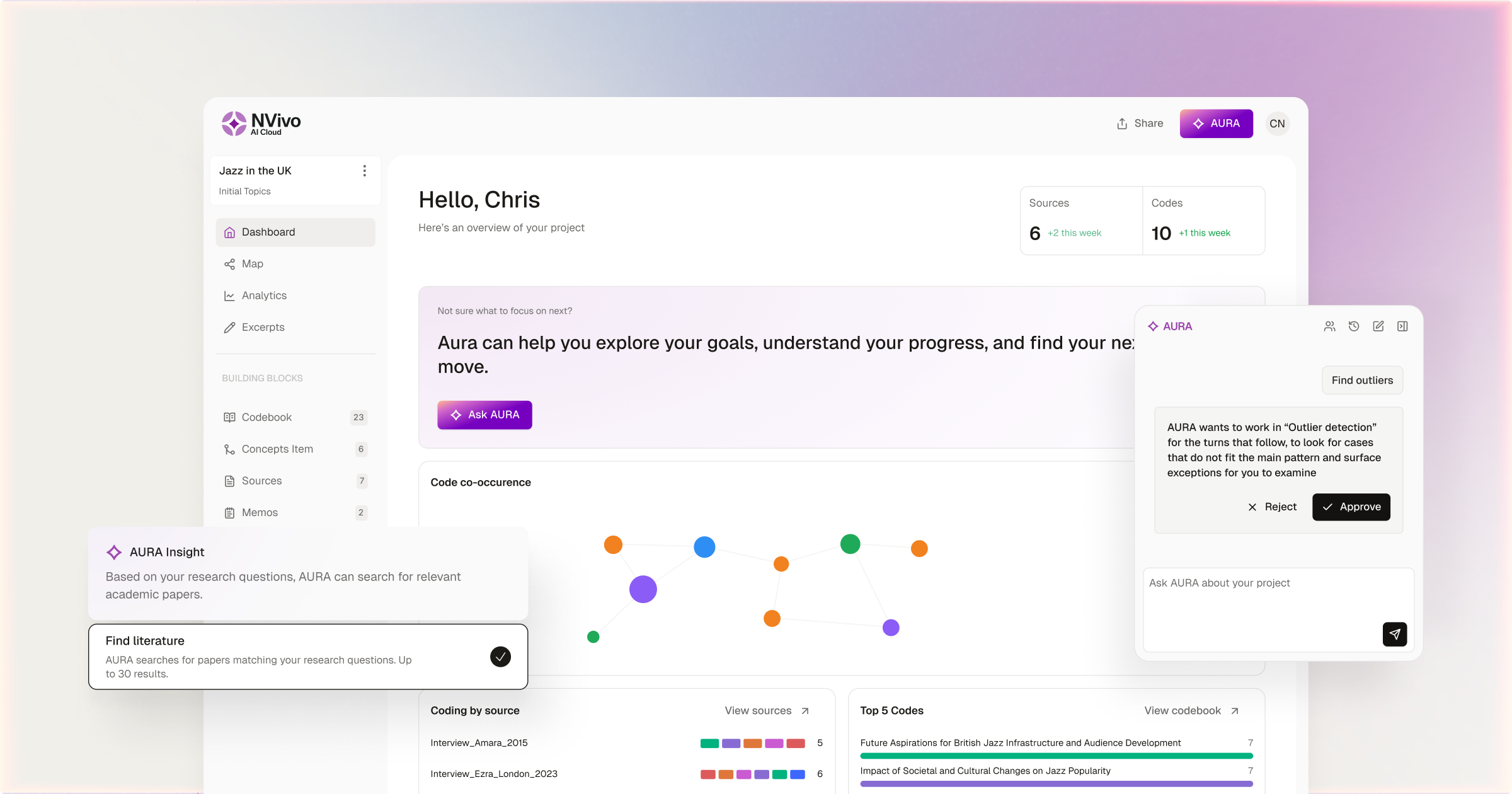
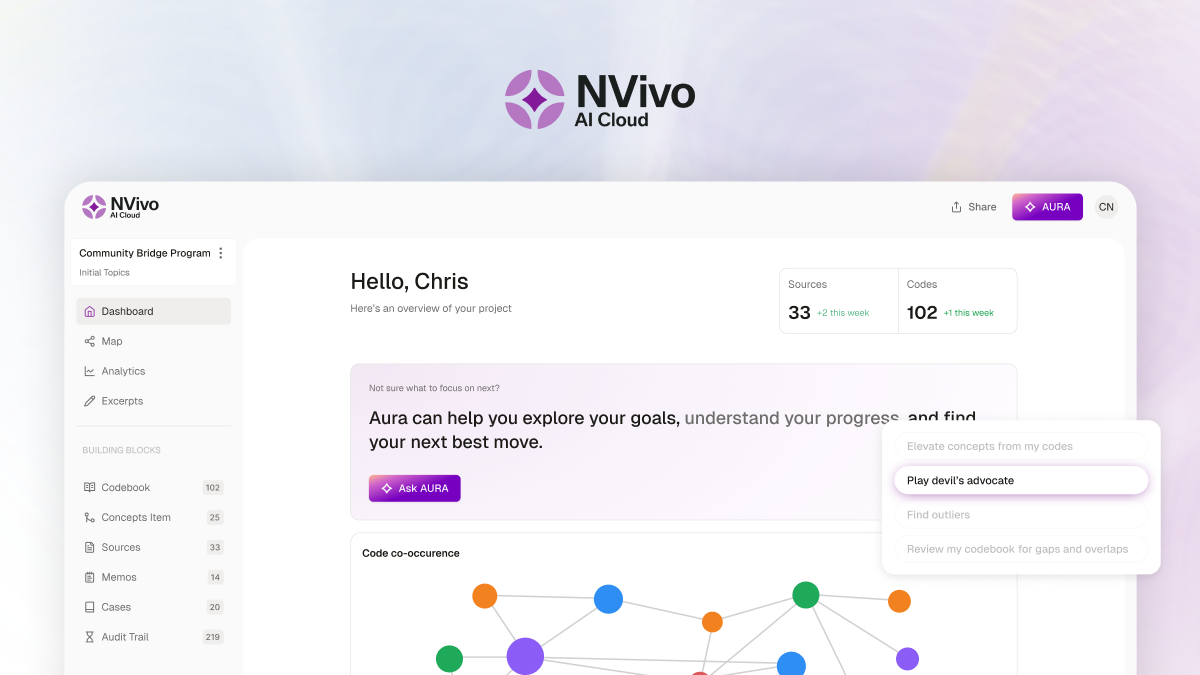
What to do instead: Use AI to accelerate the organizing work that used to eat up your early-stage analysis, then apply your own judgment to what it surfaces. In NVivo, the AI Assistant can generate coding suggestions as you work, and autocoding tools can extend your existing human coding patterns across uncoded material—learning from the decisions you've already made rather than inventing its own. The result is a faster first pass, which helps you with the analysis, but it doesn’t do it for you. You still decide what a code means and whether it belongs.
- AI accelerates organization; it doesn't replace interpretation
- Autocoding in NVivo learns from your existing human coding, rather than coding independently of it
- Every AI-suggested code still needs a researcher's judgment call before it means anything
2. "General-purpose AI tools are good enough"
ChatGPT, Claude, and other similar tools are useful for a lot of things. Rigorous qualitative analysis isn't really one of them—at least not on their own. Paste your transcripts into a general chat window and you'll get interesting output, but you'll also lose the coding hierarchy, the audit trail, and the structured project file that your methodology depends on. Copy something back into your analysis, and there's no link between that output and the original data it came from.
What to do instead: Keep AI inside your analysis environment, not outside it. ATLAS.ti's AI Coding feature works directly inside your project: it reads your documents and proposes codes that attach to specific quotations, sit alongside your existing coding scheme, and feed straight into your networks, memos, and queries. Nothing gets lost in translation between a chat window and your project file, because there's no translation step at all.
- General-purpose AI tools can't preserve coding hierarchies or audit trails
- Purpose-built QDA software keeps AI-generated codes linked to source quotations
- ATLAS.ti's AI Coding operates inside your project, not in a separate chat interface
Learn more about using general-purpose AI tools for QDA in "Can you use ChatGPT for qualitative research?"
3. "AI outputs can be trusted at face value"
Hallucinations are real. So is training data bias, and so is the simple fact that AI can miss nuance that a human researcher, familiar with the data, would catch immediately. None of that makes AI unusable—but it does mean AI output is a starting point, never a conclusion.
What to do instead: Treat every AI-generated suggestion as something to verify, not something to accept. In NVivo, AI Assistant suggestions and summaries stay connected to the original source text, so you can click through and check a suggested code, or a generated summary, against the actual transcript before you accept it into your project. Verify the outputs for yourself to ensure your analysis still has a human touch. That verification step keeps your analysis defensible.
- Hallucinations, bias, and missed nuance are real risks with any AI output
- AI suggestions should be treated as a starting point, not a finding
- NVivo keeps AI Assistant suggestions linked to source material so you can verify before accepting
Interested in how NVivo stacks up against general-purpose AI for QDA? Read "NVivo vs. AI: Which is better for qualitative data analysis?"
4. "Using AI means sacrificing data privacy"
This concern is legitimate—it just depends entirely on which tool you're using and how it handles your data. Uploading sensitive interview data to a general consumer AI platform is a different proposition than using AI embedded in an enterprise research software with contractual data protections in place.
What to do instead: Look past the marketing and check the actual data handling policy before you upload anything. ATLAS.ti's AI Coding requires your explicit consent before any document content is sent for processing, and its enterprise agreement with OpenAI specifies that your data is never used to train OpenAI's models. Similarly, NVivo's enterprise agreement with a third-party AI service provider ensures that your data is not retained, and remains private, secure, and fully under your control when using NVivo's AI capabilities. That's a very different arrangement than pasting a transcript into a free public chatbot with no such guarantee.
When evaluating any tool, look for:
- Explicit consent required before your data is uploaded or processed
- A contractual guarantee that your data won't be used for model training
- A clear data retention and deletion policy
- Admin-level controls to disable AI features entirely, if your institution requires it
5. "AI is only useful for big datasets"
It's easy to assume AI-powered tools exist for teams drowning in hundreds of interviews. But the time savings show up at any scale—they just look different in a smaller project.
What to do instead: Use AI for the mechanical tasks that slow down any project, regardless of size: transcription, orientation to new data, and quick summary memos. In NVivo, the AI Assistant's summarize feature can condense a lengthy interview into a workable memo in moments, and autocode sentiment can give you a fast read on tone across even a modest set of documents. For a ten-interview thesis project as much as a five-hundred-interview enterprise study, that adds up to less time on mechanics and more time on insight.
- Time savings from AI compound even in small or modest-scale projects
- Summarization and sentiment tools help you orient to new data faster, at any scale
- AI reduces the mechanical burden of analysis so you can focus on interpretation
Put AI to work—responsibly
AI isn't a replacement for the researcher. It's a tool that, used inside the right environment, can take on the repetitive work and leave you more time for the thinking that actually requires you. NVivo and ATLAS.ti are both built to keep AI embedded in a structured, verifiable research process—so you get the speed of automation without giving up the rigor your work depends on.
Ready to bring responsible AI into your next project? Buy NVivo or ATLAS.ti today.

Roehl Sybing
Research Associate, University of North Dakota
Roehl Sybing is a Research Associate in the College of Education and Human Development at the University of North Dakota and a content writer for Lumivero. His research interests include qualitative research methodology and dialogic interaction across languages and cultures. He has written extensively on qualitative research methods in scholarly and commercial publications, including several articles for ATLAS.ti's Research Hub.