






Blogs
Explore insights, tips, and industry trends

Case studies
See how organizations achieve real results

eBooks and reports
Access in-depth research and expert analysis

Research
Discover original research and data-driven insights

Webinars
Join live and on-demand sessions with experts

Whitepapers
Access research and expert analysis

Academy
Build skills with structured courses and training

Certified trainers
Get expert training from certified professionals

International partners
Connect with trusted partners around the world

Knowledge center
Find guides, tutorials, and product documentation




NVivo AI Cloud vs. generic AI: Which is better for qualitative data analysis?

By Roehl Sybing, PhD, Research Associate, University of North Dakota
Edited by Abigail Jacobsen, Senior Content Marketing Manager, Lumivero
Key takeaways
NVivo AI Cloud is purpose-built for qualitative data analysis, offering transparent coding, documentation, and interpretation features that general AI tools cannot match. AI tools like ChatGPT can assist with summarizing or organizing text but lack the transparency, contextual awareness, and methodological rigor required for credible qualitative research. NVivo AI Cloud brings AI, grounded in qualitative methodology and rigor, into the research environment so researchers can move away from disparate tools and streamline preparation and analysis while maintaining analytical depth and validity.
Tools built on artificial intelligence like ChatGPT have changed how people approach text analysis, but qualitative research requires more than summarizing or pattern detection. Researchers need transparency, methodological rigor, and tools that support organizing, coding, and interpreting data systematically. For this reason, researchers rely on a variety of qualitative data analysis methods to systematically interpret their data and ensure credible results.
NVivo AI Cloud is a QDA platform designed specifically for these tasks, offering structure and flexibility for in-depth qualitative work. This article compares it with general AI tools, examining their capabilities, limitations, and how each supports the analysis process. It also shows how NVivo AI Cloud lets researchers move away from disparate tools and work with AI grounded in methodology and rigor, so efficiency gains don't cost the depth and validity that qualitative analysis demands.
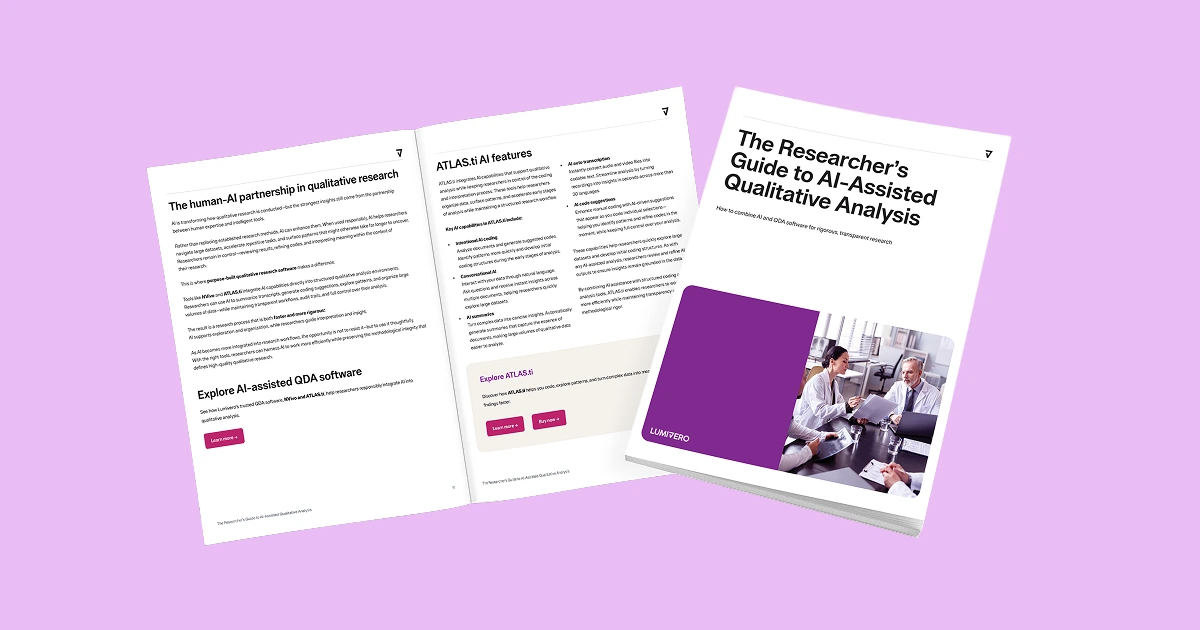
The State of AI in Qualitative and Mixed Methods Research
Discover key findings on how researchers are adopting, trusting, and governing AI in their qualitative and mixed methods work.
Download report →What is NVivo AI Cloud?
NVivo AI Cloud is Lumivero's AI-native, cloud-based qualitative data analysis (QDA) software, built on the foundations trusted by researchers for over 30 years. It is designed to help researchers manage, organize, and interpret complex data from interviews, focus groups, and documents. It provides a structured environment for coding data, identifying themes, and linking findings to research questions. Unlike general-purpose AI tools, it is built specifically for qualitative inquiry, offering transparency in how codes and categories are created, refined, and analyzed.
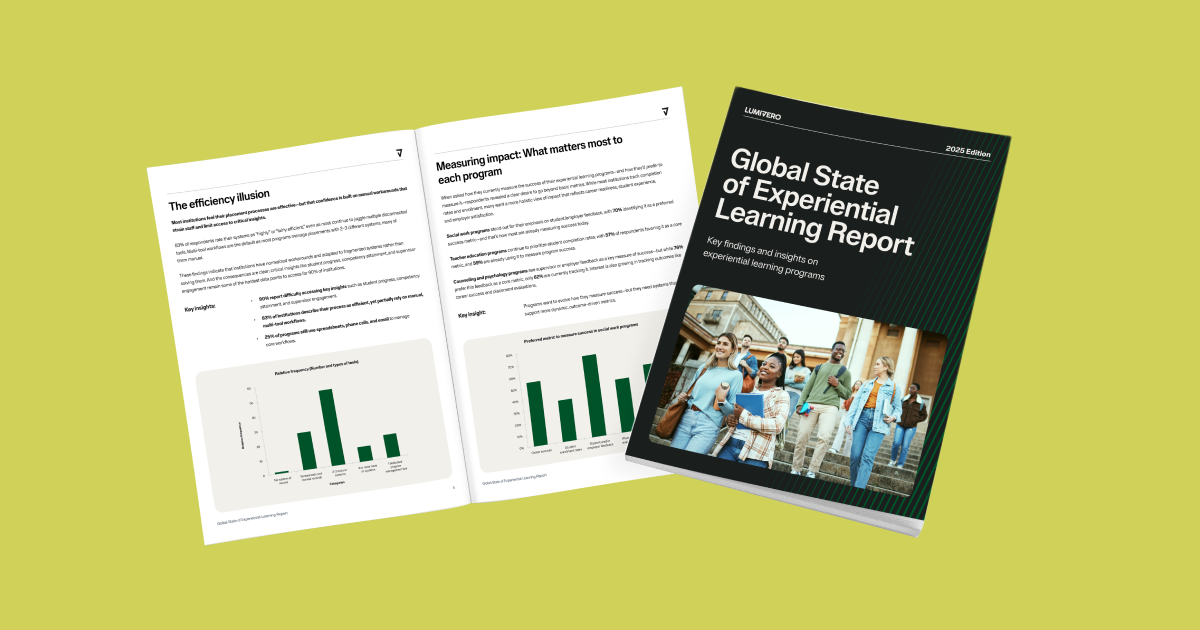
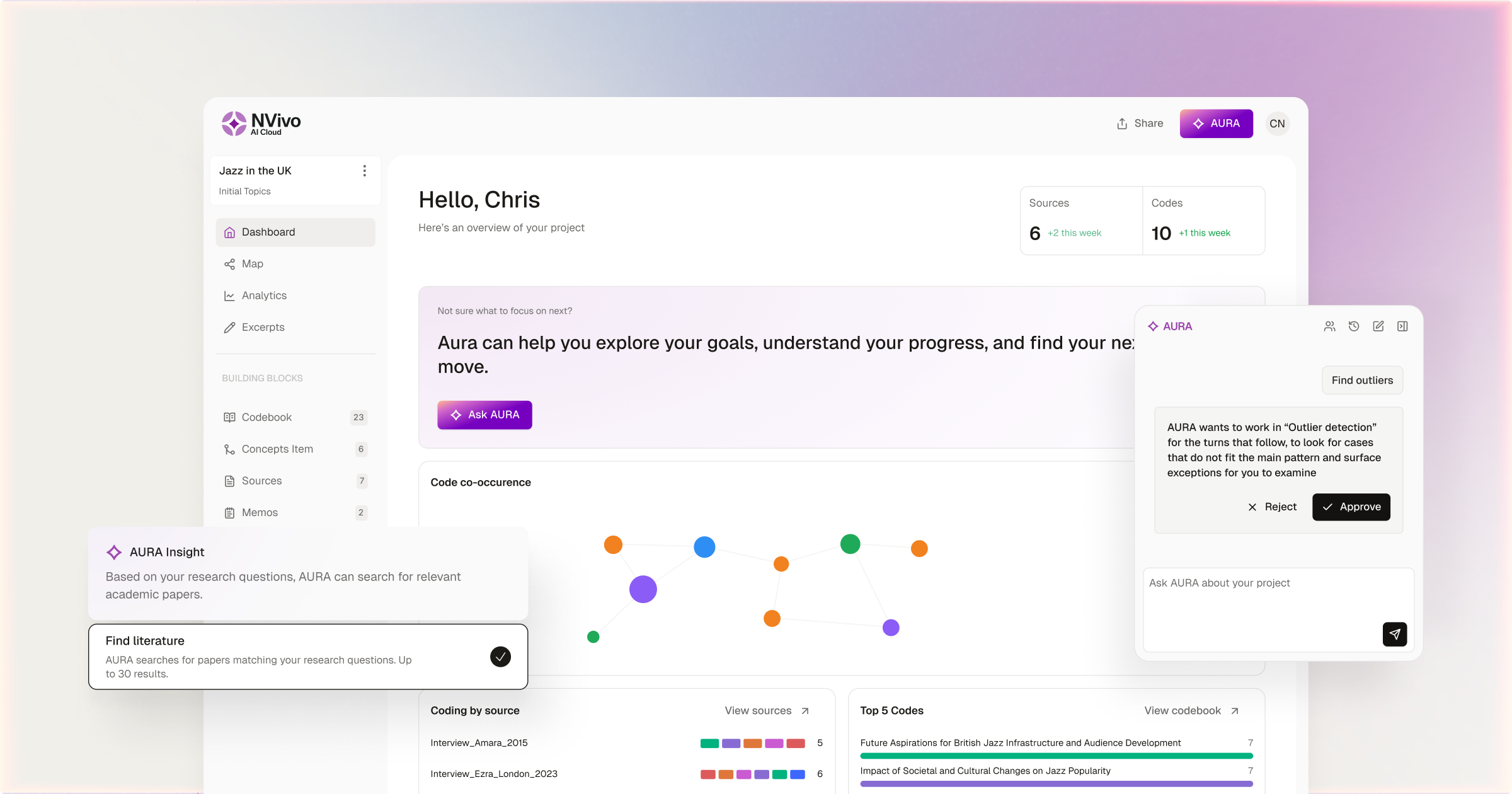
AURA—NVivo AI Cloud's AI-powered Unified Research Assistant—guides project setup with AI-suggested research questions, identifies topics across your sources with the supporting excerpts attached, and auto-codes against the topics you confirm. You approve every AI suggestion, and you can still create and apply your own codes alongside them.
That workflow runs in one place. Literature discovery, transcription, summarization, topic identification, coding, memos, and chat with your project all happen inside the same project, so you don't have to carry your data between separate tools. Your research data is never used to train AI models and never leaves Microsoft Azure.
Discover how to build stronger, more complete insights from your research questions with, “The Essential Guide to Mixed Methods."
Another advantage of NVivo AI Cloud is its ability to maintain a clear audit trail. Every step (from initial coding to final analysis) can be documented, ensuring that interpretations are traceable and reproducible, and every action is attributed to a researcher or to AURA. You can invite team members to a shared project, each with their own license.
Overall, NVivo AI Cloud provides an environment that aligns with qualitative research standards, supporting researchers whether they work inductively or deductively. It allows researchers to focus on meaning-making rather than manual data management, creating an organized workflow that facilitates deeper analysis and more credible results.
Can ChatGPT be used for qualitative data analysis?
AI use is already mainstream in research: 57% of researchers use AI regularly (21%) or occasionally (36%), according to Lumivero’s “State of AI in Qualitative and Mixed Methods Research.”
ChatGPT and other large language models can assist with parts of qualitative analysis, but they are not substitutes for dedicated research software. These models can summarize text, identify repeated phrases, or propose potential themes based on prompts, which may seem similar to what researchers do when coding data. However, qualitative analysis involves a deeper process of interpretation, reflexivity, and theoretical grounding that an AI assistant is not specifically designed to handle independently.
Researchers may use ChatGPT to support early stages of analysis, such as brainstorming coding categories or comparing interpretations of text segments. It can help clarify ideas, rephrase codes for readability, or generate summaries that highlight surface-level patterns in the data. Some researchers also use AI tools to clean and standardize text by removing unnecessary information, fix formatting, and separate speakers. They may also use AI to group similar responses at a high level to get a quick sense of patterns or overlap before doing deeper analysis or importing the material into a QDA software. That workflow spreads one analysis across several tools. NVivo AI Cloud brings those early steps into the project itself: AURA summarizes your transcripts, identifies initial topics with the supporting excerpts attached, and suggests codes for your approval.
Despite these uses, ChatGPT operates as a generative system rather than an analytical one. It predicts text patterns based on probabilities, not on the researcher’s methodological framework or data context. Because it lacks transparency in how responses are generated, researchers cannot trace its analytical process or verify how certain patterns or conclusions were produced. This lack of traceability makes it unsuitable for rigorous qualitative research that depends on verifiable reasoning and reproducibility.
Moreover, AI-assisted tools have limitations applicable to all potential tasks that create significant pitfalls for qualitative researchers. Hallucinations inherent to extensive use of artificial intelligence can generate inaccurate findings that, if unchecked by human intuition and judgment, can place the trustworthiness of the research in jeopardy. Researchers have expressed this concern: 87% are concerned or very concerned about accuracy and hallucination risk, the field's top-ranked concern in Lumivero’s “State of AI in Qualitative and Mixed Methods Research.”
In short, while ChatGPT can automate small tasks or offer language-based insights, it cannot replace the interpretive work that depends on context, nuance, and lived or local knowledge and methodological functions required in qualitative research. NVivo AI Cloud keeps that work in one environment, with structured coding, transparent analysis, and an audit trail that reflects how meaning is derived from data.
Explore the current landscape of AI in research, emerging uses in academia and industry, and practical applications in “The State of AI in Qualitative Research."
Limitations of general AI tools for qualitative data analysis
While AI-assisted tools like ChatGPT offer speed and convenience, they are not designed to meet the methodological and interpretive demands of qualitative research. Even though they can generate summaries, identify recurring terms, or assist with initial data familiarization, they fall short when deeper analysis and verification are required.
Four key limitations underpin the challenges of using general AI tools in qualitative research:
- Lack of human judgment and lived experience
AI can recognize patterns but cannot draw on embodied knowledge, cultural understanding, or interpretive reasoning. Meaning-making in qualitative work depends on positionality, reflexivity, and theoretical insight—capacities AI does not possess. - Shallow or decontextualized interpretations
Although AI can detect surface-level similarities, it often misinterprets nuance, tone, irony, slang, or symbolic language. It struggles to place statements within participants’ lived contexts. For example, in analyzing students’ reasons for enrolling in a real estate class, an AI tool may fail to see that references to “cheddar,” “bread,” luxury cars, or designer bags all point to financial motivation and status aspirations. - Susceptibility to bias in data and prompts
AI outputs reflect patterns in its training data and are highly sensitive to the wording and framing of user prompts. These hidden biases can distort interpretations without the researcher being able to detect, control, or correct them. - Inability to support reflexivity, ethics, and methodological quality control
AI cannot document its assumptions, explain its decision pathways, or engage in reflexive reasoning. It cannot ensure consent-related considerations, protect participant meaning, or uphold qualitative standards such as triangulation, iterative coding, or thick description. Without these elements, AI-generated interpretations lack analytic grounding.
When comparing LLMs like ChatGPT with dedicated qualitative data analysis software, additional limitations emerge. NVivo AI Cloud is built to support systematic, transparent, and auditable analysis—capabilities that general AI tools cannot replicate. In summary, general AI tools fall short in:
- A lack of methodological transparency
- Limited contextual understanding
- The inability to ensure validity and rigor
Lack of methodological transparency
LLMs operate as black boxes: they generate outputs without showing how interpretations were derived or which parts of the dataset influenced them. This opacity prevents researchers from demonstrating how they moved from raw data to codes, categories, and themes—an essential expectation in qualitative inquiry.
In contrast, NVivo AI Cloud records every coding action, memo, and analytic step — whether a researcher's or AURA's — creating a verifiable audit trail that supports methodological justification, peer review, and reproducibility.
Limited contextual understanding
AI models analyze linguistic patterns rather than meanings situated in context. They cannot reliably interpret how tone, setting, power dynamics, or participant identity shape meaning. Nuance that emerges through iterative reading and theory-informed reflection is frequently overlooked or misinterpreted.
NVivo AI Cloud, by contrast, provides the structural environment that allows researchers to code iteratively, compare cases, memo reflections, and build interpretation over time. AURA can also play devil's advocate and look for outliers, but the interpretation stays with you.
Qualitative researchers must interpret these contextual layers through iterative reading, reflection, and theory-driven analysis—processes that require human judgment. While ChatGPT can process text efficiently, it lacks the epistemological awareness to interpret qualitative data in a way that aligns with a study’s design or research questions.
Inability to ensure research validity and rigor
Qualitative rigor requires systematic coding, transparency, triangulation, and reflexive documentation. AI-generated results cannot be reproduced, audited, or verified using established qualitative methods such as intercoder reliability checks or systematic queries. They may reinforce hidden biases and lack the evidential chain needed to justify claims.
NVivo AI Cloud supports coding structure, data retrieval, analytic queries, and transparent linkage between evidence and interpretation—critical components of defensible qualitative analysis. Every AI-suggested topic links back to its supporting excerpts, and every AI write action needs your approval.
Additionally, AI systems can introduce bias through their training data or prompt structures. If a model’s responses reflect skewed language patterns or cultural assumptions, those biases may influence how data are interpreted. Researchers have limited control over these underlying influences, making it risky to rely on AI-generated insights as analytical evidence.
Maintaining rigor also involves reflexivity—acknowledging the researcher’s role and perspective in shaping interpretations. AI cannot engage in reflexive reasoning or articulate how its own assumptions shape its outputs. Without that awareness, qualitative analysis becomes mechanical rather than interpretive.
Researchers applying these tools to theme development can also follow a structured workflow for AI-assisted thematic analysis.
NVivo AI Cloud's strengths in qualitative data analysis
NVivo AI Cloud is designed specifically to support the depth and rigor of qualitative research. Unlike general AI-driven tools, it provides a transparent, structured environment where every analytical step can be documented, reviewed, and refined. NVivo AI Cloud's strengths lie in its traceable workflow, ability to support nuanced interpretation, and integration of multiple data sources within a single research project.
NVivo AI Cloud adds AI to that process while keeping you in charge. AURA summarizes your transcripts and documents against your research questions for a quick overview, suggests codes for your approval, and surfaces cross-case patterns and outliers, and you can still create and apply your own codes at whatever level of detail your study needs. These features help you move more efficiently while still relying on your own interpretation and decision making.
Transparent and traceable analysis process
One of NVivo AI Cloud's primary strengths is its ability to document the researcher's decisions throughout the project. Each code, excerpt, and memo is stored in a structured framework, and every action is recorded in an audit trail you can export, so you can revisit your process and demonstrate how findings were reached. That traceability aligns with the expectations of academic and applied research, where transparency is essential for credibility.
The same standard applies to AI. Prompt inspection lets you review the prompts behind AI-generated content, no AI-suggested code becomes final until you approve it, and you can always see who coded what, AURA or a researcher.
The codebook lets you organize excerpts from your sources into codes that represent themes or concepts, then rename, move, merge, or refine them as the analysis evolves.
An interactive topic map, with codes sized by frequency and lines showing where they occur together, helps you see relationships among codes. Memos linked to codes let you record your analysis and cite exact excerpts, and exporting a memo carries those citations into Word as numbered footnotes.
Deep contextual and thematic interpretation
NVivo AI Cloud facilitates rich interpretation by enabling close engagement with data. Researchers can review text line by line, code specific passages as excerpts, link memos to codes, and cross-reference themes across interviews or focus groups. This hands-on approach supports researcher-led analysis while allowing researchers to remain grounded in participants’ words and perspectives.
AURA supports that engagement too. Each AI-suggested topic arrives with its supporting excerpts, so you check it against participants' own words before it becomes a code, and you can ask AURA questions about your project in plain language, with answers drawn only from your own data and cited back to the excerpts used.
Unlike general AI tools that rely on pattern recognition, NVivo AI Cloud encourages iterative, reflective engagement. Researchers can adjust the codebook as new insights emerge, group codes into concepts that give the project a thematic vocabulary, and keep every decision in their own hands. This flexibility lets researchers connect their data to their research questions without losing sight of context. This flexibility supports both inductive and deductive approaches, helping users connect their data to broader research questions or theoretical perspectives without losing sight of context.
NVivo AI Cloud's search, filters, and Code × Variable and Code × Code matrices also extend analysis beyond reading and coding. These tools help researchers explore relationships among codes or compare themes across demographic groups, while retaining control over how patterns are defined and interpreted.
Integration of diverse data sources and research methods
Another major advantage of NVivo AI Cloud is its capacity to bring different sources into one environment. Researchers can import and analyze transcripts from interviews or focus groups, and documents (Word, PDF, and text files) in a unified project, including audio and video they upload and transcribe directly in the platform.
Cases and variables organize participants for comparison across groups, so researchers can connect qualitative codes with participant characteristics. Matrices and the topic map help communicate findings to varied audiences, bridging the gap between narrative interpretation and measurable patterns, and matrices export when you're ready to report.
From a patchwork of tools to one grounded environment
NVivo AI Cloud pairs agentic AI workflows with the methodological rigor research findings need to stand up to scrutiny. It allows users to code systematically, link data to research questions, and maintain a transparent record of analytical decisions, with the AI working inside that structure rather than beside it.
The most effective approach is not to stitch general AI tools onto a separate analysis tool, but to work where the AI is built around the research. In NVivo AI Cloud, AI supports data preparation and organization, while you anchor the interpretive process: every suggestion links back to its supporting excerpts, needs your approval, and is recorded in the audit trail.
Start your next project with NVivo AI Cloud
NVivo AI Cloud provides the framework to manage, code, and interpret your data with confidence, with AI built into the workflow and grounded in the methodology and rigor your findings need to stand up to scrutiny.
Ready to discover more from your qualitative and mixed methods data? Buy NVivo AI Cloud today.

Roehl Sybing, PhD
Research Associate, University of North Dakota
Roehl Sybing is a Research Associate in the College of Education and Human Development at the University of North Dakota and a content writer for Lumivero. His research interests include qualitative research methodology and dialogic interaction across languages and cultures. He has written extensively on qualitative research methods in scholarly and commercial publications, including several articles for ATLAS.ti's Research Hub.
Frequently asked questions
Yes. NVivo AI Cloud is built so your research data stays in your project, rather than moving between separate tools:
- Your data is never used to train AI models.
- Your data is not shared across projects.
- Your data is never sent to a model provider outside Microsoft Azure, where NVivo AI Cloud runs.
- Your research content stays in the data region assigned to your account.
These safeguards keep your data private and under your control when you use AURA. However, if you just use ChatGPT on its own, you do not have those guarantees.
*(Scopus Database, 2010-2024)


How can we help you? Contact us.