









Key takeaways
NVivo AI Cloud speeds up qualitative analysis while keeping the researcher in the lead. For academic researchers running qualitative or mixed-methods studies, it surfaces deeper patterns and helps you publish findings you can defend: every AI write action needs your approval, and an exportable audit trail shows how each result was generated. If you prefer a more traditional QDA approach to coding, NVivo Desktop may be a better fit. This article follows one researcher’s workflow, from organizing data to writing up, and shows where each tool fits.
As a qualitative researcher interested in ethnography and positionality, I’ve written extensively on how important the human element is to the research process. Where interpretation of the social world is involved, the perspective of the person interpreting the data is just as important as the perspectives of the people under study.
Many understand the role of human judgement in all things, research-related or otherwise, which is why some hesitate to use artificial intelligence in their work. In qualitative data analysis, the fear is that something valuable is lost when the researcher relinquishes control to an algorithm.
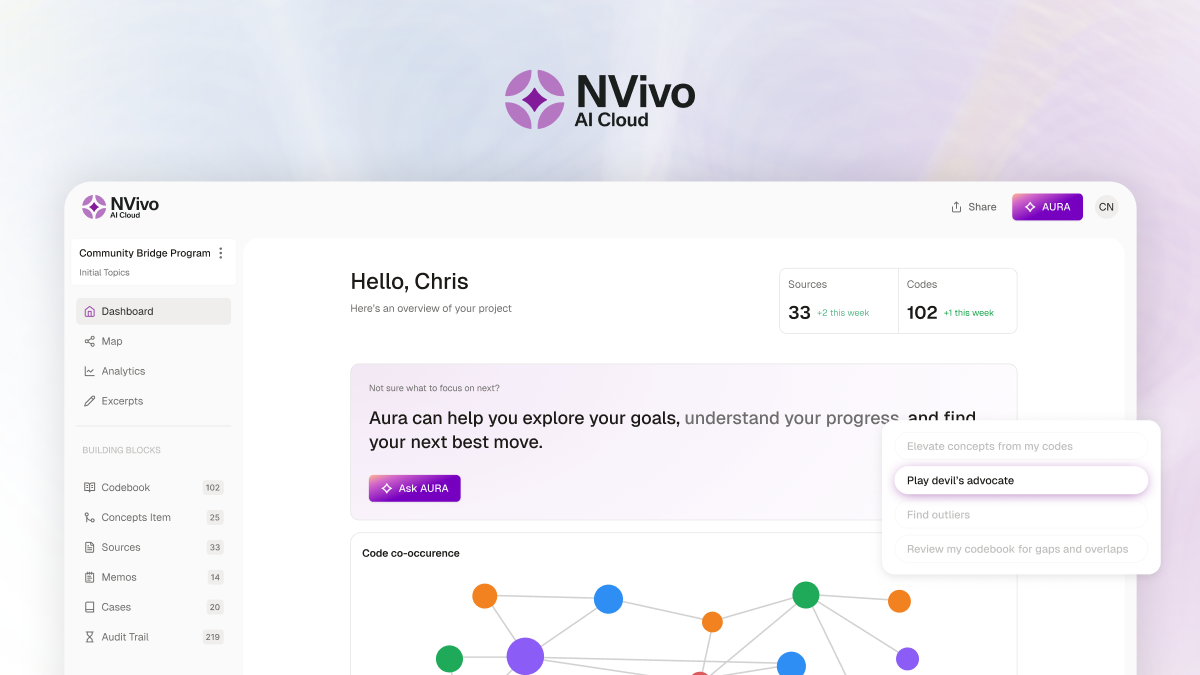
That’s not the case with NVivo AI Cloud, an AI-native, cloud-based QDA solution with an AI-assisted guide for project setup. Powered by AURA, it supports importing, summarizing, coding, and analyzing first- and third-party sources. Transparent audit trails show how AI-assisted results were generated, helping researchers keep findings traceable and defensible.
Having been one of the first people to try out Lumivero’s latest AI-powered data analysis platform, I’ve been able to see for myself how AI can make qualitative research faster, easier, and more insightful without removing the human contribution to coding and data analysis. Simply put, NVivo AI Cloud can make my job easier, not do it for me.
Of course, there are more than a few research-oriented tools that can claim AI capabilities these days. So why do I recommend NVivo AI Cloud? How does it differ from NVivo Desktop, and how do I decide which to use for my research? To answer these questions, let me walk you through my research process.
Organizing the data
Even the simplest qualitative research project can contain hundreds of pages of literature, transcripts, notes, and other forms of textual data. Ask the old-school qualitative researchers, and you will hear stories involving a handful of highlighters and dozens of papers spread across a bedroom floor as a prelude to coding. Qualitative research has gone digital in the decades since, but the challenge of keeping a project organized and easily accessible remains. Without a strategy to organize project files, finding the right information right away can become all but impossible.
NVivo AI Cloud separates the two kinds of material a study depends on. I import interview transcripts and field notes into Data, and I keep prevailing theories and previous studies in the Research Library, a dedicated place that informs the theoretical background of my study. AURA then reads my data and suggests variables such as gender, role, and location, which I confirm, edit, or delete before they shape my comparisons. From study design to actionable findings, every part of the research process lives in one project.
NVivo Desktop also holds large volumes of mixed project data and lets you categorize files by attribute. That suits projects where I want to define the categories myself. When I work with ethnographic data in NVivo Desktop, I can have a couple dozen transcripts ready to analyze by attributes such as gender, age, and education level, among other things.
Either way, my research data is ready for analysis—the difference is how I get it organized. NVivo AI Cloud guides me with AURA-suggested variables and a separate Research Library, while NVivo Desktop gives me attributes I define myself.
Where the analysis meets methodological rigor
General-purpose AI tools have no research methodology built in, and generic, large language models offer no persistent memory of a researcher’s codebook or project structure between sessions. This is where any old AI tool is insufficient for research.
Researchers don’t just need the right answer. They need to know how it was reached.
I’ve worked on enough qualitative projects to know the same data can yield different findings depending on the methodological approach, and those findings are only as reliable as the discipline behind that approach. NVivo AI Cloud is grounded in established research methodology, so the AI supports the way researchers actually work instead of replacing it. When rigor is the priority, I don’t want a generic LLM wrapper retrofitted for research or a speed-first tool that treats coding as a shortcut. I want AI that shows its work and leaves the interpretation to me. Unlike general-purpose AI tools, NVivo AI Cloud’s AI analysis is grounded in the research materials uploaded to the project. It doesn’t search the internet or pull from external sources when analyzing project data.
Of course, NVivo Desktop is ideal when I want to work through the data directly and build my codes from my own reading, with my chosen methodology guiding every step. Emerging and expert researchers alike can make full use of NVivo Desktop’s capabilities, if they are willing to explore and experiment.
That said, any researcher who needs to save time and effort at the start of analysis can turn to NVivo AI Cloud, which surfaces broad initial topics across their documents, with the evidence behind each one. From there, they bring their own methodological approach, review every suggestion, and create and apply their own codes alongside the AI’s. Either way, the methodology and the interpretation stay with the researcher.
Asking the right questions
Before I look at data in a field I am unfamiliar with, I always want to survey the latest research and current theories so I can get a sense of what my analytical lens should be. Simply reading the data without any context or direction isn’t going to help me understand that data. I can use any data coding platform to apply keywords and annotations to the data, but are they the right keywords and annotations? If I don’t have a north star in a research question, probably not.
Exploratory research matters, but coding without a set research objective tends to yield less than desirable results. This is why researchers are always encouraged to have a research question to answer before they even put their data to work. Learning what the data means is one thing, but understanding how the data is relevant to your research goals can be a far more rewarding task.
NVivo Desktop works well when you have decided your research questions in advance. Even a methodology like grounded theory, where analysis is generated directly from the data, is more productive when the research question can guide the researcher on what to look for in the data. But what if you need some help determining what those questions are?
NVivo AI Cloud can give me a head start by suggesting research questions for me based on how I describe my project. Guided project setup with AI-suggested research questions and methodology gets studies off on rigorous footing from day one. Even if I never use those research questions when coding the data, I can at least get some useful inspiration for coming up with research questions of my own or defining my own research goals.
Chatting with the data
As an academic, I’ve spent entire summers in my office hardly talking to any colleagues or fellow scholars. That solitude is a challenge in social science research, which thrives on dialogue and collaboration. Actively and critically thinking about the research relies a great deal on bouncing ideas off others, gathering feedback about our assumptions, hypotheses, initial interpretations, and co-constructing meaning with other voices.
Sometimes, though, it’s just me, a windowless office, and my data. In NVivo Desktop, I can keep my thinking fresh and documented through writing memos of my reflections, a core component of any qualitative research project. That can help a great deal, but when I need another voice to push back on my thinking, I can turn to AURA, NVivo AI Cloud's AI-powered Unified Research Assistant.
AURA Chat answers questions with click-through citations, saves memos, and includes a ‘Devil’s Advocate’ mode for disconfirming or negative case analysis. With chat capabilities that act like an expert of my qualitative data, I can have an approximation of the kind of conversations I have with fellow scholars that can serve as useful motivation to pursue unexplored avenues in my research.
Keeping the human touch
Critics of artificial intelligence all too often turn to “AI detectors” to point to canned and predictable writing indicative of AI chatbots. The worry here is that the thought process AI users employ may not be their own. As a researcher and educator, I’m more interested in whether someone who uses AI does not merely know what the answers are but knows how those answers are supported by evidence. That’s what separates those who use AI as a genuine tool from those who use it as a crutch.
As a teacher, I want to know why an answer is what it is. NVivo AI Cloud is built for that kind of scrutiny:
- Every AI write action requires human sign-off
- A full, exportable audit trail shows how each result was generated
- AI prompt inspection makes findings as citable as manual coding,
With the audit trail, I can see for myself how the AI reached its results and decide how to make sense of the data. Without that, all I’m doing is parroting answers and never really understanding them.
See deeper patterns, publish with confidence
NVivo AI Cloud doesn’t take control of your research. It gives you the control you need to take your data analysis further. Built for academic social science researchers, this AI-native research environment pairs agentic workflows with the methodological rigor your findings need to withstand scrutiny, so you can see patterns and depth you might otherwise miss, with every finding traceable to your source data.
Learn more about NVivo AI Cloud or get started today.

Roehl Sybing, PhD
Research Associate, University of North Dakota
Roehl Sybing is a Research Associate in the College of Education and Human Development at the University of North Dakota and a content writer for Lumivero. His research interests include qualitative research methodology and dialogic interaction across languages and cultures. He has written extensively on qualitative research methods in scholarly and commercial publications, including several articles for ATLAS.ti's Research Hub.
Frequently asked questions
NVivo AI Cloud is Lumivero’s new AI-native, cloud-based solution for qualitative and mixed-methods research, with a built-in AI guide for setting up a research project. Powered by AURA (AI Unified Research Assistant), it helps researchers import, transcribe, summarize, code, and analyze first - and third-party sources. Every AI-assisted step includes a transparent audit trail, so researchers can review how results were generated and keep their findings defensible.
NVivo Desktop is Lumivero's established qualitative data analysis platform installed on your computer, offering comprehensive tools for organizing, coding, and analyzing qualitative data. NVivo AI Cloud is a separate, browser-based platform that integrates AI-guided assistance throughout the research process, from setting up a project and developing research questions to exploring and analyzing data.
AURA is NVivo AI Cloud's agentic AI chat feature. It answers questions grounded in your project data, provides click-through citations back to source material, and can save answers as memos. Its Devil's Advocate mode is designed to surface disconfirming evidence or negative cases so you can challenge your interpretation, pressure test findings, and explore alternative explanations before reaching a conclusion.