








Blogs
Explore insights, tips, and industry trends

Case studies
See how organizations achieve real results

eBooks and reports
Access in-depth research and expert analysis

Research
Discover original research and data-driven insights

Webinars
Join live and on-demand sessions with experts

Whitepapers
Access research and expert analysis

Academy
Build skills with structured courses and training

Certified trainers
Get expert training from certified professionals

International partners
Connect with trusted partners around the world

Knowledge center
Find guides, tutorials, and product documentation





What is ethnographic research? Definition, methods, examples, and best practices
Key takeaways
Ethnography is a research approach aimed at studying cultures and social behavior. Ethnographers conduct observations, interviews, and artifact collection in the field. NVivo AI Cloud, NVivo Desktop, and ATLAS.ti are key qualitative data analysis software packages for analyzing ethnographic data.

Introduction
Read enough qualitative research in anthropology and sociology and you will come across the word “ethnography.” It’s a broad methodological approach that encompasses many different strategies for data collection and analysis. Ethnographic fieldwork is one of the types of qualitative data collection methods that works best when context matters as much as the response itself. But what is ethnographic research exactly? What makes ethnography rigorous and not another buzzword?
In this article, we’ll look broadly at ethnographic research, its defining features, and the methods used to collect and analyze data.
What is ethnographic research?
Ethnographic research is the study of cultures and interpersonal relationships. The differences between cultures, communities, and groups of people are countless and complex, requiring equally complex research to identify key insights and develop theories about the social world. Experiments and strictly quantitative approaches are often inadequate for understanding such questions.
Ethnography seeks to describe and interpret social life from the perspectives of participants. Researchers immerse themselves in the natural settings of the people they study, aiming to understand how meaning is constructed through everyday interactions. This immersion distinguishes ethnography from other qualitative methods that rely more heavily on interviews or textual data alone.
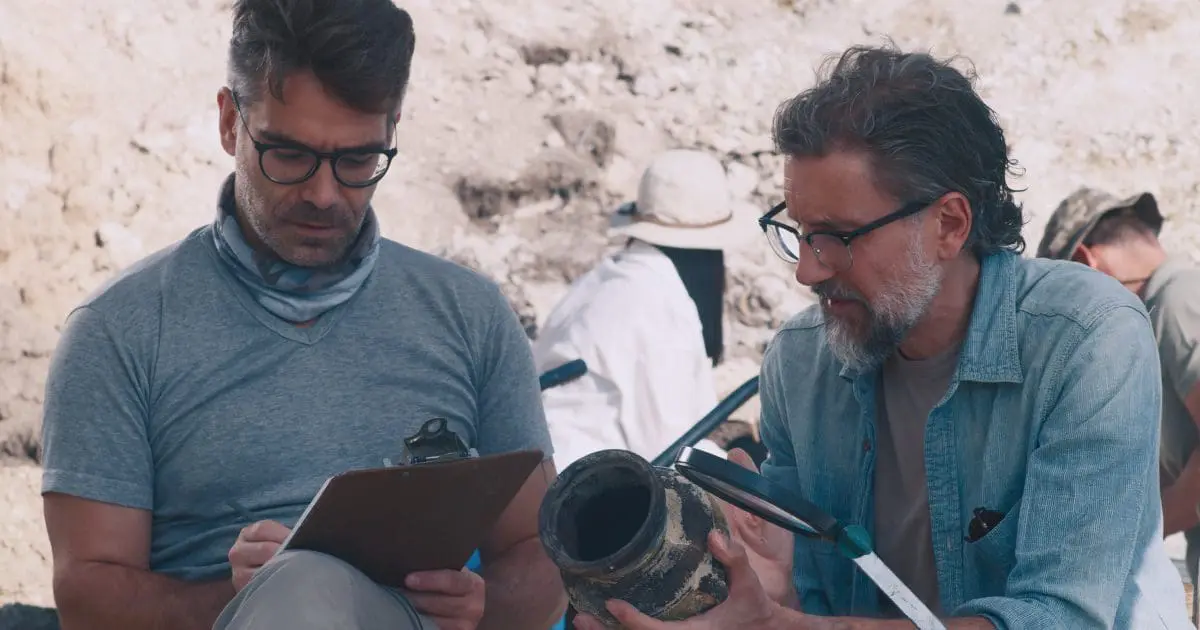
Ethnographers typically gather data through extended engagement in the field. They may live or work alongside participants, observe social practices, conduct interviews, and collect artifacts or texts relevant to community life. This approach emphasizes depth, context, and the lived experience of participants rather than generalizability.
As a result, ethnographic research provides a detailed picture of how social realities are formed and maintained through cultural norms, institutional practices, and patterns of communication.

The State of AI in Qualitative and Mixed Methods Research
Discover key findings on how researchers are adopting, trusting, and governing AI in their qualitative and mixed methods work.
Download report →How to conduct ethnographic research
Conducting ethnographic research involves long-term engagement, careful planning, and ethical reflection. The process usually begins with defining a research question that benefits from in-depth contextual understanding, such as how organizational cultures develop or how communities manage shared resources.
Ethnographers then select a site or group that best represents the phenomenon of interest. Gaining access often requires negotiation with gatekeepers and establishing trust with participants. Once in the field, the researcher balances participation and observation—taking part in activities while maintaining enough distance to record what happens and reflect analytically.
Data collection occurs through multiple methods including observation, interviews, and artifact collection. Fieldnotes serve as a core record of events, impressions, and interpretations, capturing both what is observed and what it might mean.
Ethical considerations are central to the process. Because ethnography often involves close personal contact and prolonged interaction, researchers must obtain informed consent, maintain confidentiality, and be transparent about their role.
Observations
Observation is the foundation of ethnographic research. It involves watching participants in their natural settings to understand behaviors, routines, and social interactions. The ethnographer identifies patterns that reveal how people make sense of their environment. Observations can be structured—guided by specific research questions—or unstructured, allowing themes to emerge organically through immersion.
The value of observation lies in its ability to capture behavior as it unfolds, rather than as participants might describe it later. This helps uncover discrepancies between stated beliefs and actual practices.
Interviews and focus groups
Interviews and focus groups provide opportunities to explore participants’ perspectives directly. They complement observation by allowing participants to explain meanings, motives, and interpretations of events. Ethnographic interviews are often informal, conversational, and conducted repeatedly over time as trust develops.
Focus groups can help researchers examine how people collectively negotiate shared understandings or disagreements within their community. Both methods rely on active listening, open-ended questioning, and sensitivity to cultural norms of communication.
Collecting artifacts
Artifacts in ethnography include documents, photographs, tools, digital posts, and other materials that reflect the culture being studied. These items provide evidence of shared values, practices, and historical change. Collecting artifacts allows researchers to analyze how material and symbolic aspects of culture reinforce social structures.
Artifacts are interpreted in relation to the contexts in which they are created and used. For example, a set of workplace memos might illustrate organizational hierarchies or informal communication styles that complement findings from observations and interviews.
Data analysis
Ethnographic data analysis is iterative and interpretive. Researchers begin analyzing data while still in the field, noting emerging themes and relationships between observations, interviews, and artifacts. After fieldwork, data are organized, coded, and compared to identify recurring patterns and differences.
Coding qualitative data often begins with descriptive categories based on fieldnotes and gradually moves toward more abstract, conceptual themes. Researchers develop memos that connect data segments and refine interpretations. The goal is not to impose external theories but to build explanations grounded in participants’ perspectives.
Analysis in ethnography also relies heavily on reflexivity. Researchers examine how their own background, assumptions, and interactions influence what they observe and how they interpret it. Transparency about the researcher’s role strengthens the credibility of ethnographic findings.
Examples and applications of ethnographic research
Ethnographic methods are applied in a wide range of disciplines and settings. In anthropology and sociology, they are used to understand cultural practices, social hierarchies, and identity formation. In education, ethnography provides insight into classroom interactions, learning environments, and institutional culture. Public health researchers use ethnography to study how cultural beliefs shape health behaviors, access to care, and community resilience.
Ethnography is also central to organizational and business research. Studies of workplace culture, consumer behavior, and product design rely on ethnographic observation to reveal how people actually use systems and interact with products. For example, researchers studying hospital workflows have used ethnography to identify how communication patterns affect patient safety.
In digital and media research, ethnography helps explain online communities, social networks, and the blending of virtual and physical social life. Across these fields, ethnography provides a flexible framework for understanding lived experience in context.
Advantages of ethnographic research
Ethnographic research offers depth, context, and insight that other methods often cannot provide. By studying people in their natural environments, researchers can see how beliefs, values, and behaviors interact in real situations. This approach uncovers the implicit rules and shared meanings that shape everyday life, making it especially useful for understanding complex social systems.
The extended engagement of ethnography fosters trust and richer data, as participants become more comfortable sharing their perspectives. It also allows for the discovery of unanticipated findings—patterns or practices that might not emerge from surveys or experiments.
Ethnography’s flexibility is another strength. Researchers can adapt their focus as new questions arise during fieldwork, refining hypotheses in response to what they observe. This iterative process supports a more nuanced interpretation of human experience, particularly in cross-cultural or organizational contexts.
Challenges and limitations of ethnographic research
Despite its strengths, ethnographic research poses several challenges. Fieldwork requires substantial time and effort, often spanning months or years of data collection. The depth that makes ethnography valuable can also make it resource-intensive and difficult to replicate.
Subjectivity is another concern. Because ethnographers interpret social interactions through their own perspectives, maintaining reflexivity and transparency is essential to ensure credibility. Findings may be rich in context but limited in generalizability, since they often describe a specific community or setting.
Access can also be difficult. Building trust with participants, navigating cultural differences, and managing expectations all take careful negotiation. In addition, researchers must balance participation with observation to avoid influencing the behaviors they are studying.
Finally, data management and analysis can be overwhelming. Ethnographic research generates large volumes of field notes, interviews, and artifacts that require systematic organization to support rigorous interpretation. Qualitative data analysis software, like NVivo AI Cloud, NVivo Desktop or ATLAS.ti, can help streamline this process and uncover deeper insights from large volumes of data.
Ethical considerations in ethnographic studies
Ethical practice in ethnography extends beyond obtaining informed consent. Because ethnographic research involves close and sustained engagement with participants, it requires ongoing attention to privacy, power dynamics, and researcher impact.
Confidentiality must be maintained even when describing detailed settings or events. Researchers often use pseudonyms or alter identifying details to protect participants while preserving analytical accuracy. Transparency about the researcher’s role and purpose helps establish trust and avoid misrepresentation.
Ethnographers must also be aware of how their presence influences the field. Reflexivity—acknowledging one’s own position, assumptions, and potential biases—is key to maintaining ethical integrity.
When studying vulnerable or marginalized groups, additional care is needed to ensure participation is voluntary and that findings do not reinforce stereotypes or harm communities. Ethical ethnography emphasizes respect, reciprocity, and accountability throughout all stages of the research process.
Tools and techniques for ethnographic analysis
Digital tools such as NVivo AI Cloud, NVivo Desktop, and ATLAS.ti support the organization and analysis of ethnographic data. These qualitative data analysis solutions allow researchers to store field notes, interview transcripts, and artifact records in one workspace. Coding features make it easier to tag data by theme, track connections across sources, and retrieve relevant passages efficiently.
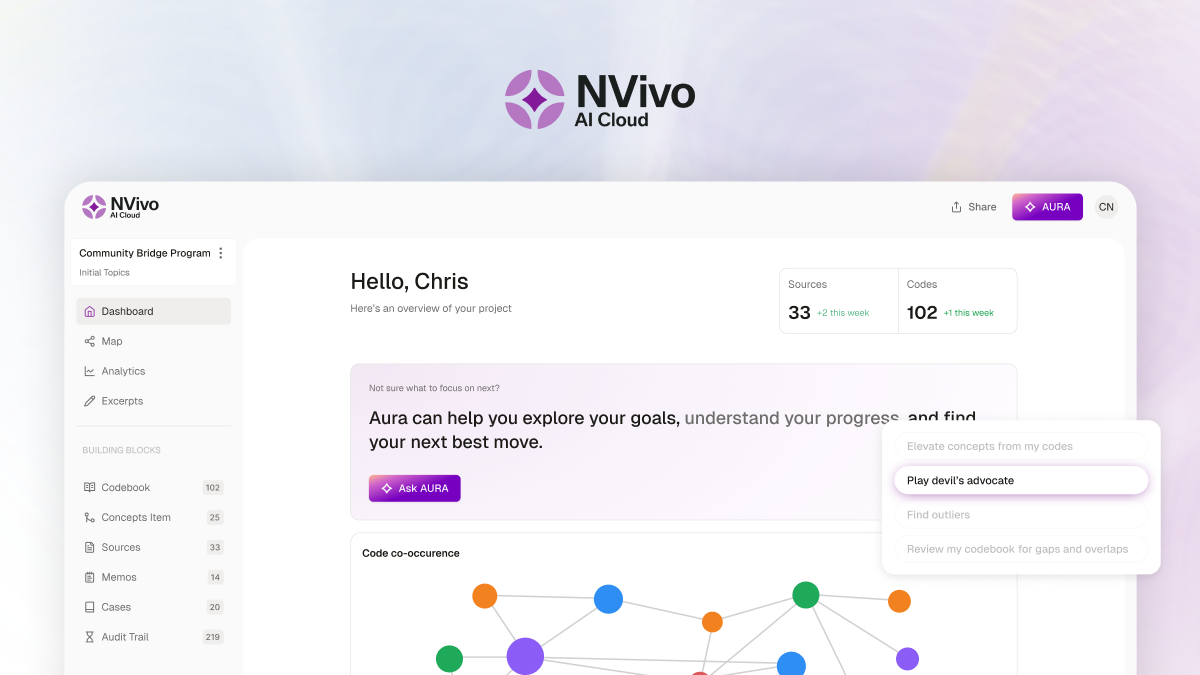
With NVivo AI Cloud, field notes and interview transcripts—including recordings you transcribe directly in the platform—live alongside your coding in one workspace, and AURA—NVivo AI Cloud's AI-powered Unified Research Assistant—identifies topics across the corpus with the supporting evidence attached, auto-coding against the topics you confirm.
NVivo AI Cloud's automatically generated Code × Variable and Code × Code matrices show relationships between cultural concepts or social groups too, alongside an interactive topic map that visualizes codes by frequency and co-occurrence.
NVivo Desktop and ATLAS.ti also support visualizations such as word clouds, coding matrices, and network maps that help researchers identify relationships between cultural concepts or social groups. These tools do not replace interpretation but enhance the rigor and transparency of the analytical process.
NVivo AI Cloud's full audit trail, with AI-prompt inspection and AI/human attribution, documents every analytic decision automatically and exports for a reviewer—valuable when multiple researchers contribute to the same ethnographic project.
For large or collaborative ethnographic projects, software tools also simplify version control, inter-coder reliability checks, and documentation of analytic decisions. This ensures that qualitative rigor is maintained even when multiple researchers contribute to the same dataset.
Get deeper insights in ethnographic research with Lumivero
Ethnographic research provides a powerful way to understand how people create and share meaning in everyday life. With tools like NVivo AI Cloud, NVivo Desktop and ATLAS.ti, researchers can manage complex qualitative data efficiently and conduct deeper analysis that reflects the richness of human experience. Buy now to get started today.
FAQs about ethnographic research
Recent articles




How can we help you? Contact us.