












Key takeaways
Qualitative research methods are the systematic approaches researchers use to collect and interpret non-numerical data—text, audio, video, images, and observation—in order to understand how and why people experience something. The main methodologies are phenomenology, grounded theory, ethnography, narrative inquiry, case study, and discourse analysis. These are frequently confused with data collection techniques such as interviews, focus groups, and document analysis, which are the tools a methodology uses rather than methodologies themselves.
- Methodology, research design, and data collection technique are three separate layers, and conflating them is the source of most methodological errors.
- Six core methodologies — phenomenology, grounded theory, ethnography, narrative inquiry, case study, and discourse analysis — each answer a distinct type of research question.
- Your research question's grammatical form predicts which methodology fits: questions about lived experience point toward phenomenology, questions about process and theory-building point toward grounded theory, and questions about culture in context point toward ethnography.
- Your choice of methodology determines your entire analysis strategy, including whether your codebook is emergent or set in advance and what your audit trail must demonstrate.
- Method choice must be defensible in a methods chapter, which means aligning both your research question and your methodological tradition with what your discipline expects.
Qualitative research sits at the heart of understanding how and why people experience something. But choosing the right approach feels overwhelming when every framework lists eight types, conflates methodology with qualitative data collection technique, and leaves you wondering whether you're supposed to be doing phenomenology or just conducting interviews.
The real issue is that most resources flatten three distinct layers of research design into one list. Once you separate those layers and understand what question each one answers, the choice becomes clear.
This guide walks you through how to think about qualitative research methods, where each one fits, and how to match your research question to the right approach.
What are qualitative research methods?
Qualitative research methods are the systematic, intentional approaches you use to collect and interpret non-numerical data in order to answer research questions about how people experience something, what meaning they make of it, or why something happens the way it does. Unlike quantitative methods and statistical analysis, which count and measure phenomena, qualitative research works with words, images, sounds, and observations to uncover patterns, relationships, and deeper understanding.
One student guide to research notes the range of different epistemological traditions, or ways of knowing, that vary from study to study. This matters because different research questions and disciplinary contexts call for different qualitative research approaches. The methodological tradition you choose shapes what counts as evidence, what your data will look like, how you will analyze it, and what a defensible finding means.
This is where most resources go wrong. They list various qualitative research methods without distinguishing between the logic of inquiry you choose (the methodology), the structure of your study design (whether you follow a cross-sectional or longitudinal approach), and the specific tools you use to gather information (such as interviews or focus groups). Once you understand the difference, selecting an approach becomes a decision-making process rather than picking from a flat list.
Qualitative research methodology vs. research design vs. data collection methods
The most common mistake in qualitative research methods resources is treating these three layers as if they were interchangeable. They are not. Understanding the difference between them is what separates a well-aligned study from one that will send a reviewer back with concerns about methodological coherence.
The three layers work together, but each answers a different question:
Three layers of a qualitative study
| Layer | What it answers | Examples | What it determines |
|---|---|---|---|
| Methodology | What is my logic of inquiry and what counts as evidence? | Phenomenology, grounded theory, ethnography, narrative inquiry, case study, discourse analysis | Your sampling strategy, your audit trail, what a defensible finding looks like, your analysis approach |
| Research design | What is the structure and timeframe of my study? | Cross-sectional, longitudinal, single-case, comparative, exploratory | When you collect data, from how many sites or participants, and how the timeline unfolds |
| Data collection technique | What tools do I use to generate information? | Semi-structured interviews, focus groups, observation, document analysis, surveys | Who you recruit, what you ask, the format of your data, and how you record it |
Here is what these layers look like in a single study:
A phenomenological study (methodology) using a cross-sectional design (timeframe), where researchers gather data via semi-structured interviews with 10 participants (technique), then analyzed thematically and through narrative description would report research findings about the lived experience of something at a single point in time.
A grounded theory study (methodology) using an iterative, longitudinal design (timeframe), collecting data through interviews and observations across multiple visits (technique), then analyzed through initial coding and constant comparison would report findings about how a process unfolds and what theory emerges from the data.
Types of qualitative research methods: 6 core methodologies
The six core qualitative methodologies each answer a distinct type of research question. Understanding what each one does, what kind of data it works with, and where qualitative researchers typically run into trouble will help you recognize which one fits your study.
Phenomenological research: Understanding lived experience
Phenomenology answers the question of what it is like to experience something from the inside. Rather than explaining why something happens, phenomenology describes the texture of human experience. Your data will be rich, detailed accounts of lived experience, usually collected through conducting in-depth interviews or documenting written reflections. Typical sample sizes range from 6 to 15 participants, conducted intensively over weeks to months. A phenomenological finding reads like a description of the essence of the experience.
The most common trouble spot is drift toward psychology or counseling rather than phenomenological philosophy. Phenomenology is not therapy reflection, and a phenomenological analysis is not a thematic one, even though both produce themes. If you are interested in the psychological processes behind experience rather than the structure of the experience itself, you may have chosen the wrong methodology.
Grounded theory research: Building theory from data
Grounded theory answers the question of how something works or what process unfolds. Instead of starting with a theory and testing it, you begin with data and build theory from patterns in it. Your data will typically include interview transcripts, observational notes, or both, collected iteratively as your understanding develops. Sample sizes typically range from 20 to 40 participants, recruited until no new concepts emerge. A grounded theory finding is a conceptual model that explains how something happens.
The most common error is treating grounded theory as a general approach to coding qualitative data. Grounded theory requires iterative data collection and constant comparison, not batch analysis of all data at the end. If you collect all your interviews first and then code them, you are not doing grounded theory. For more detail, see our overview of grounded theory research.
Ethnographic research: Studying culture in context
Ethnography answers the question of what culture or community looks like from the inside and how it makes sense to the people who inhabit it. Your data will include prolonged participant observation, fieldnotes, interviews, and often participation in the setting itself. Ethnographic studies typically last months to years and involve immersion in a bounded community or institution. A finding from ethnography reads as a rich description of cultural practice, belief, or structure. For more detail, see our overview of ethnographic research.
Narrative research: Analyzing personal accounts
Narrative inquiry answers the question of how people make sense of their lives through the stories they tell. Your data will be personal narratives, autobiographies, life histories, or the stories people construct about their experience. Sample sizes are typically small, often just a handful of individuals, because the depth of a single narrative can be substantial. A narrative finding is an interpretation of how someone constructs meaning through the stories they tell or how narrative structure reveals identity or change.
The most common trouble is confusing narrative inquiry with collecting stories. In narrative research, researchers start by gathering stories and finding patterns across them. This is their foundation for then understanding how narrative itself is a sense-making process.
Case study research: Examining a bounded instance
Case study methodology answers the question of how or why something works the way it does within a specific, bounded context. Your data might include interviews, observations, documents, or all three, all focused on a single case or a small number of cases. A case study might be a single organization, a school, a program, a decision, or an event. Sample sizes range from one to a handful of cases, with data collection spanning weeks to months depending on complexity. A case study finding explains something about how that particular case works or what it illuminates about a broader phenomenon.
Discourse analysis: How meaning is built through language
Discourse analysis answers the question of how meaning is constructed and negotiated through language, text, or communication. Your data will be talk, text, interviews, or media artifacts, examined for how they construct meaning, position people, or reflect power relationships. Discourse studies typically involve rich analysis of smaller volumes of data, rather than large samples. A finding from discourse analysis explains how something is talked about, what language choices reveal about power or identity, or how meaning is constructed.
The most common mistake is treating discourse analysis as a simplified coding exercise rather than a deep linguistic or textual analysis. Discourse analysis works at the level of language and meaning-making, and findings should reflect that depth rather than general thematic summaries. For detailed guidance, see our article on qualitative content analysis and discourse analysis.
Action research and participatory qualitative methods
Action research and participatory approaches represent a stance toward research rather than a fixed methodology. In action research, you study a problem in your own setting in order to improve practice or change something. In participatory research, your participants are active collaborators in defining the research question, collecting data, and interpreting findings.
These approaches often pair with one of the above methodologies, but they carry a different orientation toward the researcher's role and the purpose of the research. When you encounter qualitative research frameworks that list eight types, they often include action research and participatory approaches alongside methodologies like grounded theory, which is why those lists seem to mix categories. Understanding that these are stances rather than discrete methodologies helps explain why the eight-type list is confusing.
How to choose a qualitative research method for your study
The starting point for choosing a methodology is the grammatical form of your research question. Not all research questions fit all methodologies. A question that asks "what is it like to..." points toward phenomenology. A question that asks "how does... develop or change" points toward grounded theory. A question that asks "what is the culture or worldview of..." points toward ethnography. A question that asks "how and why does this specific case work the way it does" points toward case study. Questions about how meaning is constructed through language point toward discourse analysis, while questions about how people make sense of experience through narrative point toward narrative inquiry.
Once you have identified which methodology best matches your question, you face the real constraints that shape methodology choice in practice. These constraints matter as much as fit.
First, access and timeline.
Some methodologies require longer engagement than others. Ethnography and grounded theory both require iterative data collection and extended time. Phenomenology and narrative inquiry can be completed within a doctoral timeline because they do not require prolonged immersion, though the analysis is deep. Case study timelines depend on case complexity.
Be honest about how much time you have and whether your access to participants or sites allows the engagement your chosen methodology requires. A well-designed phenomenological study is more defensible than an underfunded ethnography that had to rush its fieldwork.
Second, sample availability and ethics.
Some methodologies require particular sample characteristics. Grounded theory typically requires large enough samples to reach saturation, which usually means 20 to 40 interviews or more. Phenomenology works with smaller samples, typically 6 to 15. Ethnography requires ongoing access to a bounded community.
If your participant pool is small or hard to access repeatedly, choose a methodology that aligns with what is realistic. Your ethics approval also shapes what you can do. If your protocol was approved for interviews only, you cannot pivot to observation.
Third, disciplinary and committee expectation.
This is not a weakness in methodology as a concept, it is a reality of research practice. Different disciplines have different traditions. Education, psychology, and nursing may expect phenomenology. Sociology and organizational studies may expect grounded theory or ethnography. Business research may expect case study. Your discipline has epistemological roots that shape what counts as rigorous. A doctoral committee will expect you to know those traditions and to position your choice within them. Your methods chapter should name the tradition explicitly. This is how you signal that you understand the stakes of your choice.
| Matching your research question to a methodology | |||
|---|---|---|---|
| If your research question asks… | Consider | Typical data | You'll likely analyze with |
| What is it like to experience X? | Phenomenology | In-depth interviews | Thematic / interpretive phenomenological analysis |
| How does X happen, and why? | Grounded theory | Interviews or focus groups conducted iteratively | Open → focused → theoretical coding |
| How does this group live, interact, and make meaning? | Ethnography | Field notes, observations, interviews, artifacts | Thematic analysis + narrative interpretation |
| How does this person make sense of their life? | Narrative inquiry | Life history interviews | Narrative / structural analysis |
| What is happening in this bounded instance? | Case study | Mixed: interviews, docs, records | Within- and cross-case analysis |
| How is meaning constructed through language? | Discourse analysis | Transcripts, texts, media | Discourse analysis |
| How is meaning conveyed through speech? | Conversation analysis | Transcripts of interviews and media | Conversation analysis |
How your qualitative research method shapes data analysis
Your choice of methodology determines everything that comes after it. Once you choose phenomenology, grounded theory, ethnography, narrative inquiry, case study, or discourse analysis, you have committed to a particular way of analyzing your data. This is not a flexible choice. It is a pipeline that runs from methodology through coding strategy through final interpretation.
- Phenomenological analysis focuses on the structure and essence of lived experience. Your coding will work toward capturing themes that describe the phenomenon.
- Grounded theory analysis works through open coding, then focused coding, then theoretical coding, building concepts and categories that explain a process.
- Ethnographic analysis synthesizes observation, interviews, and cultural context into thick description.
- Narrative analysis focuses on how stories are structured, what they reveal about identity or meaning-making.
- Case study analysis works toward understanding why the case looks the way it does.
- Discourse analysis examines how language and text construct meaning.
Whether your codes come first or emerge from your data depends on your methodology. Content analysis and thematic analysis can work with both a priori codebooks (codes you create before analysis begins) and emergent codebooks (codes that emerge as you analyze). Grounded theory, by contrast, requires emergent coding. Your methodology determines whether you can justify a predetermined set of codes. It determines whether your audit trail must show constant comparison between codes and data, or whether a single pass through the data is defensible. It determines what a finding looks like, what makes it persuasive, and what you have to prove.
This is where qualitative data analysis software becomes especially valuable. Once you understand your methodology and what analysis strategy it requires, software like NVivo AI Cloud, NVivo Desktop, and ATLAS.ti helps you execute it with rigor and transparency.
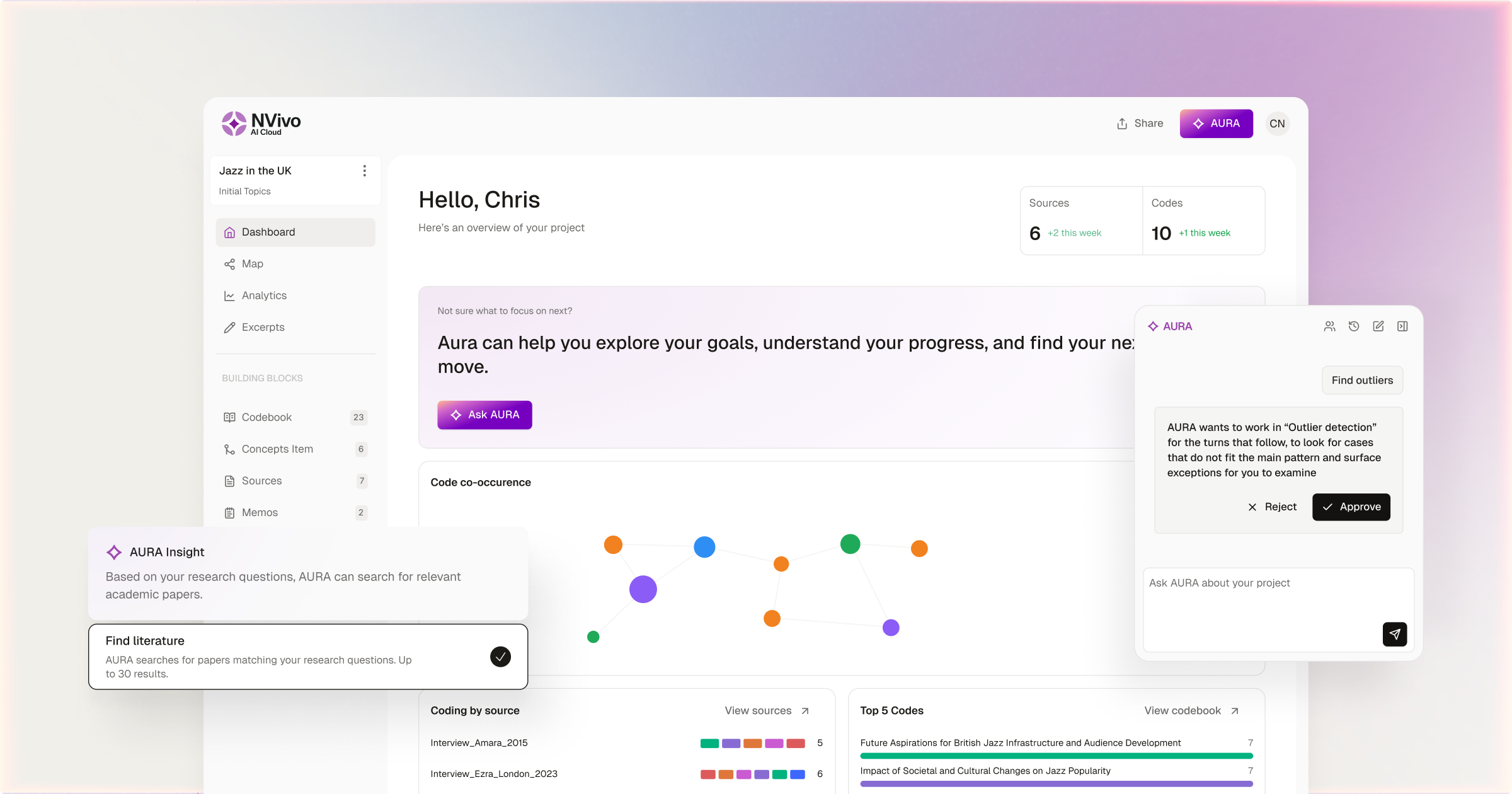
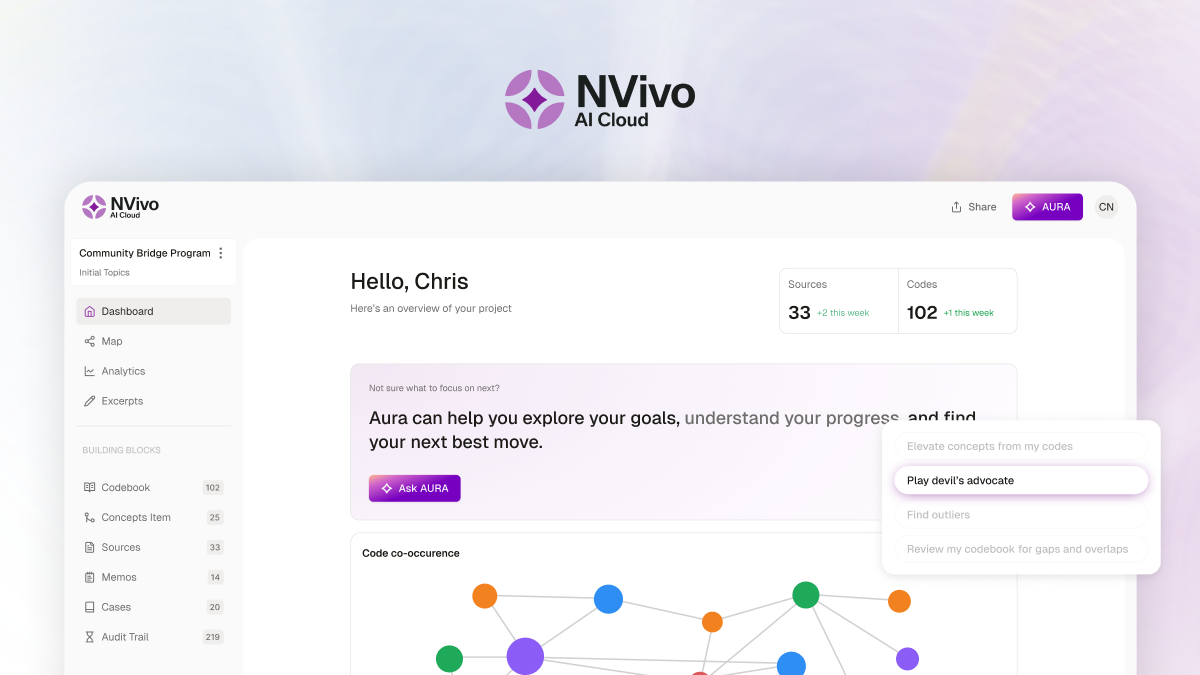
NVivo AI Cloud, Lumivero's AI-native, cloud-based research environment, pairs agentic AI workflows with the qualitative research methodology researchers already trust from NVivo. It guides project setup with AI-suggested research questions, imports your literature and documents, surfaces topics across the corpus with per-topic evidence, auto-codes against confirmed topics, and answers grounded questions through AURA—NVivo AI Cloud's AI-powered Unified Research Assistant—including a "Devil's Advocate" mode for disconfirming analysis. Every AI write action requires your approval, and a full, exportable audit trail keeps AI-assisted coding as citable as manual coding, so you remain the researcher even as the software accelerates the mechanical first pass. Treat AI output as a draft to be checked against your data, not as the interpretation itself., Lumivero's AI-native, cloud-based research environment, pairs agentic AI workflows with the qualitative research methodology researchers already trust from NVivo. It guides project setup with AI-suggested research questions, imports your literature and documents, surfaces topics across the corpus with per-topic evidence, auto-codes against confirmed topics, and answers grounded questions through AURA—NVivo AI Cloud's AI-powered Unified Research Assistant—including a "Devil's Advocate" mode for disconfirming analysis. Every AI write action requires your approval, and a full, exportable audit trail keeps AI-assisted coding as citable as manual coding, so you remain the researcher even as the software accelerates the mechanical first pass. Treat AI output as a draft to be checked against your data, not as the interpretation itself.
NVivo Desktop carries that same rigor forward through its own legacy: named query tools like Text Search and Word Frequency, Coding Comparison Queries for checking inter-coder consistency, and hands-on coding workflows with a full audit trail, for researchers who want that level of manual control. The most cited qualitative and mixed-methods analysis software globally* is built around the principle that methodology matters and that researchers choose their tools, not the other way around.
ATLAS.ti is the other major platform in this space, with its own established tools for coding, querying, and visualizing analyses of unstructured and numerical data, plus native support for team workflows and multilingual corpora—a strong option if collaborative or multilingual research is a priority for your team.

The State of AI in Qualitative and Mixed Methods Research
Discover key findings on how researchers are adopting, trusting, and governing AI in their qualitative and mixed methods work.
Download report →Combining qualitative and quantitative research methods
Your choice of methodology is not a binary one. Many research questions benefit from both qualitative and quantitative insight. This is mixed-methods research, and it is a legitimate design choice, not a fallback position or a way to soften a weak question.
In mixed-methods research, you intentionally combine qualitative and quantitative data collection and analysis to answer research questions that require both types of insight. You might collect qualitative data first to build instruments, then use quantitative data to test whether the constructs you identified hold across a broader sample. You might collect quantitative data first to identify a phenomenon, then use qualitative data to explain it. You might collect both simultaneously with equal weight.
Lumivero's research software supports mixed-methods workflows by allowing you to work with both text data and numerical data in a single project, so your analysis can move fluidly between qualitative codes and quantitative queries.
For detailed guidance on mixed-methods design, see our article on mixed-methods research.
Choosing the right qualitative research method
The logic is straightforward. Your research question suggests a methodology. That methodology determines your design and your data collection approach. Your methodology also determines your analysis strategy and what a defensible finding looks like.
Everything flows from that initial choice. The methodology you choose must align with your question, must be realistic within your constraints, and must be defensible within your disciplinary tradition. Once you have that alignment, the rest follows.
Ready to move from planning to analysis?
Take your study design and put it to work. Explore Lumivero’s research software to see how they support your research from data organization through analysis and writing.
* (Scopus Database, 2010-2025)

Roehl Sybing, PhD
Research Associate, University of North Dakota
Roehl Sybing is a Research Associate in the College of Education and Human Development at the University of North Dakota and a content writer for Lumivero. His research interests include qualitative research methodology and dialogic interaction across languages and cultures. He has written extensively on qualitative research methods in scholarly and commercial publications, including several articles for ATLAS.ti's Research Hub.
Frequently asked questions
The five most commonly taught qualitative methodologies are phenomenology, grounded theory, ethnography, narrative inquiry, and case study research. Some frameworks add discourse analysis as a sixth core methodology. When you encounter lists of eight types, they usually expand the set by including data collection techniques such as focus groups or research designs such as historical research, which sit at a different layer of the research process. That is why the eight-type list feels confusing. You are not looking at eight equally ranked categories, you are looking at methodologies mixed together with techniques and designs.
A methodology is your overall logic of inquiry. It defines what counts as evidence and what counts as a finding. Phenomenology is a methodology. Grounded theory is a methodology. A method, used in its strict sense, is a technique for generating or analyzing data, such as a semi-structured interview or thematic coding. One methodology can use several methods. This is why interviews are a method but not a methodology. You could conduct interviews within a phenomenological methodology, a grounded theory methodology, an ethnographic methodology, or others. The methodology determines how you sample, what you ask, how you follow up, and how you interpret the resulting transcripts.
Choosing the right qualitative method from other qualitative methods requires a disciplined approach to the research process. Start from the form of your research question. Questions about what it is like to experience something suit phenomenology. Questions about how a process unfolds or what develops suit grounded theory. Questions about what a culture or community looks like suit ethnography. Then check three constraints: the access and time you actually have, whether your participants or sites are available for the depth that method requires, and what your discipline and committee expect. The decision framework in the section on choosing a method walks through this process step by step.
There is no fixed number, and validity does not depend on sample size the way it does in quantitative research. Typical ranges differ by methodology. Phenomenology usually involves 6 to 15 participants. Grounded theory typically involves 20 to 40 participants recruited iteratively until no new concepts emerge. Case study and narrative work can involve one to a handful of participants because the depth of analysis is substantial. What matters is depth of methodological engagement, not participant count. A well-executed phenomenological study with 8 participants is more defensible than a shallow grounded theory study with 50 participants.
Yes. This is called mixed-methods research, and it is a legitimate design choice when your research question requires both types of insight. The design choice involves deciding on sequence and priority: whether the qualitative strand runs first to build instruments, second to explain results, or concurrently with equal weight. For detailed guidance on mixed-methods design, download "The Essential Guide to Mixed Methods."
AI can accelerate mechanical steps. AI tools can transcribe interviews, suggest first-pass codes, or retrieve passages across large corpora much faster than manual work alone. What AI cannot do is supply interpretation. The methodology itself, the code definitions that make sense within your question, and the decisions about what findings mean remain distinctly human work. Treat AI output as a draft to be checked against the data rather than as the interpretation itself. Methodological responsibility stays with you.