









Key takeaways
Discourse analysis is a qualitative method that studies how language is used in social context—not just what is said, but how it constructs meaning, identity, and power. It differs from content analysis, which counts and categorizes, by focusing on how and why language works. The four main types are critical discourse analysis, conversation analysis, narrative analysis, and rhetorical analysis. A typical workflow moves from defining your research question through establishing context, coding discursive features, and identifying patterns, to interpreting and writing up your findings. QDA software like NVivo AI Cloud, NVivo Desktop, and ATLAS.ti supports the process with AI-assisted coding, text-search and matrix queries, and visualization.
What is discourse analysis?
Discourse analysis is:
- A qualitative method for studying how language is used in real social contexts
- Focused on how and why language works, not just what was said
- Concerned with meaning, identity, and power—not word frequency
- Interdisciplinary, drawing on linguistics, sociology, anthropology, and communications
Discourse analysis is a qualitative research approach to examining how language is used in real social contexts to construct meaning, identity, and power—not just what people say, but how and why they say it. This helps researchers to explain interpersonal relations, cultural norms, and political discourse.
Rather than treating language as a neutral container for facts, discourse analysts explore every text, conversation, or speech for both their linguistic content and their role as a social act. Whereas a narrow linguistic analysis looks at the structure of language alone, a linguistic discourse analysis presumes that word choice, framing, pronouns, and sentence structure all carry meaning beyond their literal content, which is why the method draws on multiple disciplines: linguistics for the mechanics of language, sociology and anthropology for social structure and cultural context, and communications for how messages are built and received.
What separates a discourse-analytic reading from a straightforward summary is attention to function. A thematic summary might note that a topic came up; discourse analysis asks what work that language is doing, and for whom.
Here's a concrete example of what discourse analysis aims to do:
A hospital discharge note might say the patient "failed to comply with treatment," or that the patient "was unable to access follow-up care." Both describe the same event, but the framing assigns responsibility differently—the first implicates the patient, the second implicates the system. That shift in agency is exactly what discourse analysis is built to surface.
This makes discourse analysis especially valuable in fields where language shapes real outcomes:
- How policy documents assign blame
- How media coverage frames who counts as a victim or a threat
- How institutional forms quietly encode assumptions about who the "normal" user or patient is
Because the method treats language as action rather than as a transparent report of events, it's well suited to research questions about power, identity, and social change—the kinds of questions that a simple word count can't answer.
Discourse analysis vs. content analysis
Discourse analysis and content analysis are both used to study text and talk, but they ask fundamentally different questions: content analysis counts and categorizes, while discourse analysis interprets how language functions.
| Method | Core question | What you analyze | Quantitative or interpretive | Best for |
|---|---|---|---|---|
| Discourse analysis | How and why is language used? | Language in social and power context | Interpretive | Studying meaning-making, identity, and power |
| Content analysis | What is said, and how often? | Frequency of words and concepts | More quantitative | Counting and systematic categorization |
Choose content analysis when you need a systematic count of themes or terms across a large corpus—for example, tracking how often certain topics appear in news coverage. Discourse analysis helps when you want to understand how language constructs meaning or power, such as how a policy document frames responsibility. Many mixed-methods researchers use both together: content analysis to map frequency, discourse analysis to interpret function.
The two methods also differ in what counts as a finding. A content analysis result might report that a term appeared in 40% of documents in a sample. A discourse analysis result describes how that term is used, what assumptions it carries, and what it accomplishes socially—for instance, whether the same term is used differently depending on who is speaking or who is being described. Neither result is more rigorous than the other; they answer different questions, which is why the choice should follow directly from your research question rather than from convenience or familiarity with a particular tool.
What about thematic analysis?
If, however, you are looking to identify patterns in the data (e.g., what topics are explored, the main considerations behind a practice or process), then thematic analysis may be more appropriate for your research.
Rather than count words or determine the intent behind language, thematic analysis provides researchers with the flexibility in interpretation to organize transcript data around certain themes or categories. If you aren’t looking at language or power dynamics and just want to get a sense of the meaning of what people say, thematic analysis can be a useful analytical strategy for your research.
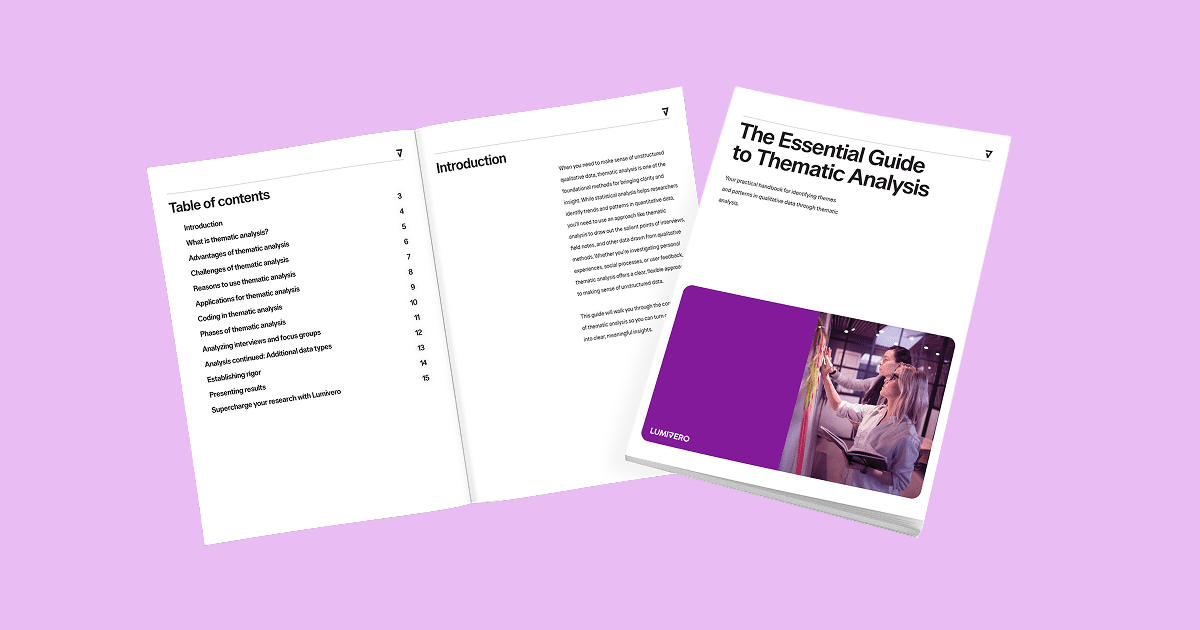
Dig deeper into thematic analysis
Discover your practical handbook for finding patterns and meaning in qualitative data. Download "The Essential Guide to Thematic Analysis" today.
Download eBook →
Types of discourse analysis
Discourse analysis isn't one method but a family of related approaches, each suited to a different kind of question.
The four types of discourse analysis are:
- Critical discourse analysis (CDA) — how language reproduces or challenges power and inequality
- Conversation analysis — the structure of talk-in-interaction: turn-taking, pauses, repair
- Narrative analysis — how people structure experience into stories
- Rhetorical analysis — how language persuades through ethos, pathos, and logos
Critical discourse analysis (CDA)
Critical discourse analysis focuses on how language reproduces or challenges power, ideology, and social inequality. Grounded in the work of linguist Norman Fairclough, CDA treats texts—political speeches, media coverage, institutional policy—as sites where power relations are built, maintained, or contested. It's the most-searched sub-type of discourse analysis, and for good reason: CDA is often the right lens whenever a research question touches on who benefits from a particular way of describing an issue, and who is left out.
CDA typically looks beyond a single text to ask how patterns of language use explain underlying power dynamics and connect to the broader social and cultural context. That might mean using a critical analysis for tracing how a word's meaning shifts across a set of related documents, or comparing how the same event is described by sources with different stakes in the outcome.
Because many forms of CDA like Foucauldian discourse analysis are explicitly concerned with power, researchers using it are also expected to be transparent about their own theoretical stance rather than presenting their reading as a neutral, objective account.
Example of critical discourse analysis: analyzing how immigration policy documents frame "migrants" versus "workers" to naturalize particular political positions.
Conversation analysis
Conversation analysis studies the fine-grained structure of talk-in-interaction—turn-taking, pauses, overlaps, and repair. Building on the work of sociologist Harvey Sacks, it treats ordinary conversation as an orderly, rule-governed social activity, even when that order isn't consciously noticed by the people speaking. Because it works at the level of individual utterances, conversation analysis often relies on detailed transcription conventions that capture pauses, overlapping speech, and even intonation, rather than a clean, edited transcript.
Example of conversation analysis: examining how doctors and patients negotiate turns during a diagnosis to see where patient concerns get cut off.
Narrative analysis
Narrative analysis looks at how people structure their experiences into stories—plot, characters, chronology, and moral stance—to make sense of their lives. Rather than breaking a transcript into isolated codes, narrative analysis often keeps stories intact, examining how a person sequences events, who they cast as protagonist or obstacle, and what turning points they emphasize.
Example of narrative analysis: analyzing how cancer survivors narrate their diagnosis to understand how identity is reconstructed through illness.
Rhetorical analysis
Rhetorical analysis examines how language persuades—the appeals, framing, and stylistic choices speakers use to move an audience. It draws on classical rhetorical concepts like ethos, pathos, and logos to ask not just what a speaker argues, but how they build credibility, appeal to emotion, or lean on logic to make their case land.
Example of rhetorical analysis: analyzing a CEO's earnings-call language to see how blame or credit gets distributed across "the market," "the team," and "leadership."
A quick way to choose your discourse analysis method:
If your question is about power and ideology, start with CDA. If it's about the mechanics of interaction, use conversation analysis. If it's about identity and meaning-making over time, use narrative analysis. If it's about persuasion, use rhetorical analysis. Many studies blend more than one.
How to do discourse analysis: A step-by-step guide
Discourse analysis follows a broadly consistent process, whether you're studying a handful of speeches or hundreds of interview transcripts. Each step below builds on the last, and most researchers move back and forth between steps rather than proceeding in a single straight line.
- Define your research question and select material. Be specific about what kind of language use you're studying and why.
- Establish social and historical context. Note who produced the text, for what audience, and when and where it was produced—context shapes meaning as much as the words themselves.
- Prepare and organize your data. Clean transcripts, and if relevant, note pauses, emphasis, or non-verbal cues.
- Read closely and get familiar with your material. Read it multiple times before you begin formal coding.
- Code language features. Look for framing, metaphor, pronoun use, modality, identity positioning, and rhetorical devices.
- Identify patterns across the discourse. Look for recurring linguistic choices and where they cluster or shift.
- Interpret against your theoretical framework and write up your findings. Support your interpretation with short illustrative quotes and be explicit about the analytic lens you brought to the reading.
The most common mistake beginners make is treating discourse analysis like theme-counting—cataloguing that a word like "trust" appeared a dozen times, rather than analyzing how trust is constructed through specific linguistic choices. Coding a word's presence isn't discourse analysis; interpreting its function is.
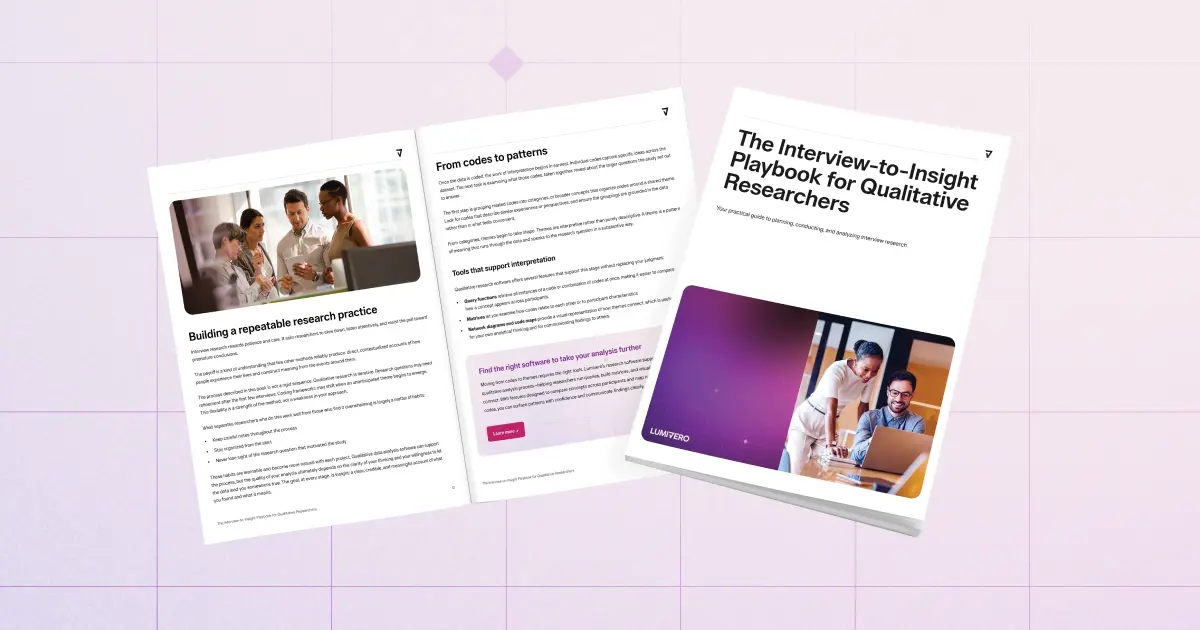
Get the guide: The Interview-to-Insight Playbook for Qualitative Researchers
Learn how to conduct interview research with greater confidence and clarity—from study design to final insight.
Download eBook →
Discourse analysis examples
Seeing discourse analysis applied across different domains makes the method easier to picture. Here are three brief examples of discourse analysis:
- Media framing: Two outlets cover the same protest, one describing participants as "activists" and the other as "rioters." Comparing the two shows how naming choices shape audience perception of the same event, and how a single incident can be turned into two very different stories depending on which words carry it.
- Political speech: Analyzing a politician's use of "we" versus "they" across a campaign speech traces how language builds in-group and out-group identity—often signaling who the speaker considers part of the audience's community and who they position as an outside threat.
- Healthcare interaction: Analyzing a clinician's use of hedging language—"might," "could," "we'll see"—during a difficult diagnosis shows how word choice shapes patient understanding and trust, and can reveal where clinical caution unintentionally reads to patients as uncertainty or evasiveness.
Discourse analysis software: What to use and why
You can conduct discourse analysis with transcripts, a highlighter, and a notebook. But once a corpus grows past a handful of interviews or documents, doing it entirely by hand becomes unwieldy—organizing codes, retrieving passages, and comparing patterns across sources all get harder to track manually.
Qualitative data analysis (QDA) software shouldn't replace the researcher's interpretation—it accelerates the mechanics: importing and organizing data, coding consistently, and retrieving and visualizing patterns at scale. The interpretation stays with you; the software just helps you get there faster and keep track of your work.
The QDA category includes several established platforms—NVivo AI Cloud, NVivo Desktop, ATLAS.ti, and MAXQDA among them—each built around the same core idea: import your material, apply codes, then query and visualize what you've coded. Where they differ is in the depth of their query tools, how they handle multimedia and multilingual data, collaboration features for research teams, and how their AI-assisted coding is implemented.
For discourse analysis specifically, look for a platform that lets you retrieve coded passages by more than one variable at once—for example, by discursive feature and by speaker attribute together—since that's what lets you trace how language use shifts across groups, not just within a single transcript.
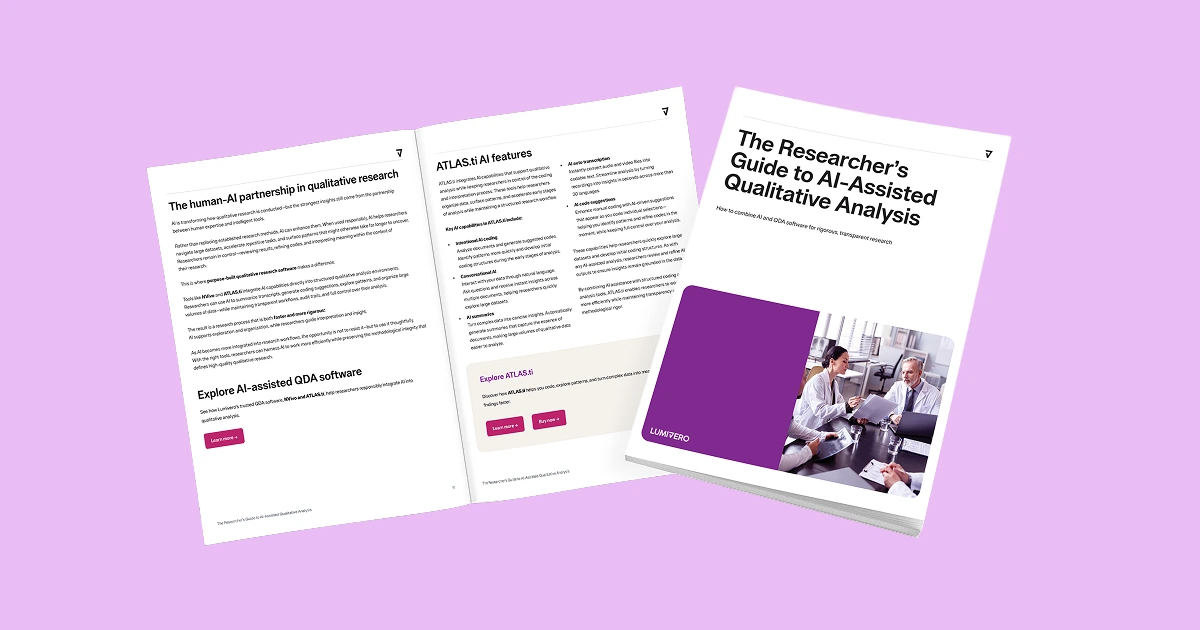
Get the guide: The Researcher’s Guide to AI-Assisted Qualitative Analysis
Learn how to combine AI and QDA software for rigorous, transparent research.
Download eBook →
How Lumivero research software supports discourse analysis
Lumivero offers three top-rated, QDA platforms built to support discourse-level analysis: NVivo AI Cloud, NVivo Desktop and ATLAS.ti. All support the workflow above, from import through visualization, so you can choose the tool that best fits your team, your data types, and your research design.
NVivo AI Cloud
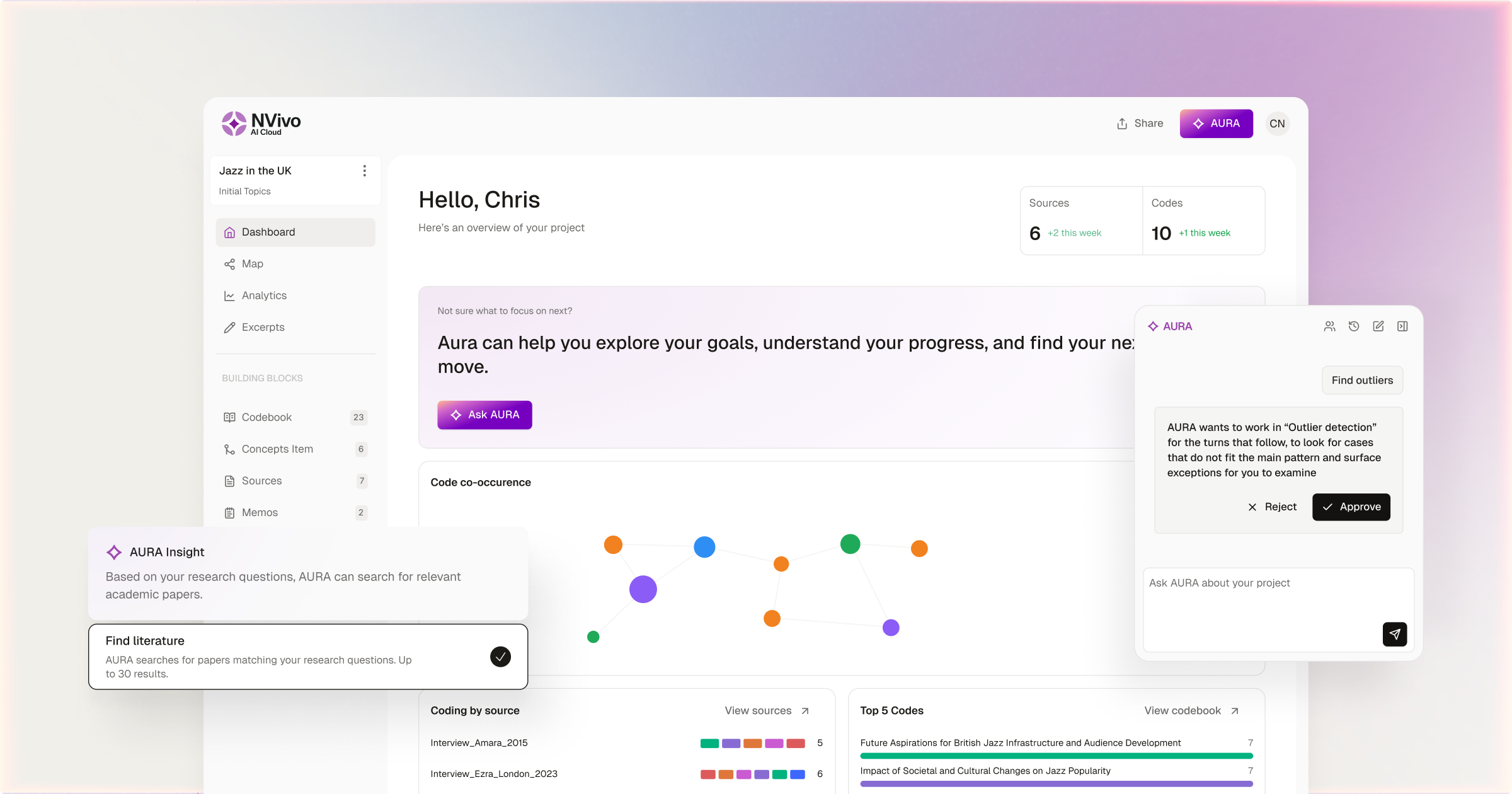
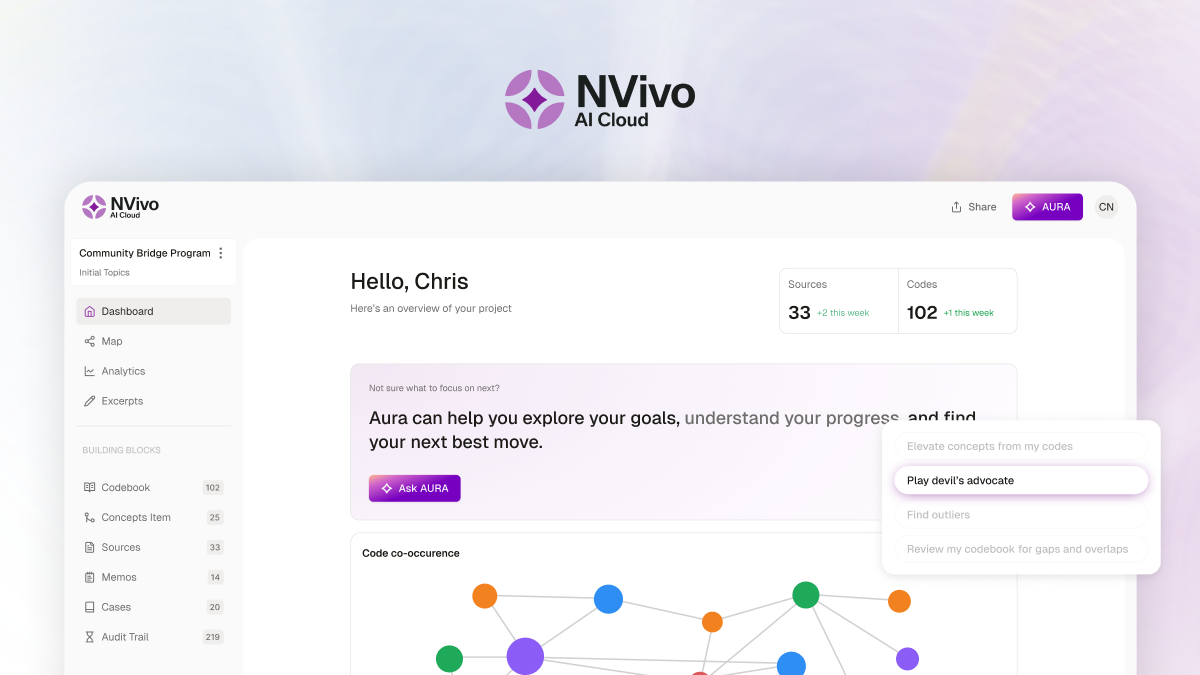
NVivo AI Cloud, Lumivero's AI-native, cloud-based research environment, brings AI into discourse analysis. AURA—NVivo AI Cloud's AI-powered Unified Research Assistant—can trace a word or phrase across your sources with exact-text search, returning verbatim snippets with counts by source, and crosstab your codes against case variables such as speaker role. It can also play devil's advocate against your reading, looking for disconfirming evidence and outliers, and its AI-suggested initial topics orient you in a large corpus. Code × Variable and Code × Code matrices show how discourse varies by group, and audio and video you upload are transcribed in the platform, with speaker labels you can review and correct. The analysis itself stays yours: you code discursive features like framing, pronouns, and modality, create and apply your own codes alongside AURA's suggestions, and approve every AI suggestion.
In the healthcare example above, a researcher studying clinicians' hedging language might ask AURA to find every use of phrases like "might" and "we'll see" across the transcripts, with counts by source, code the instances that matter, then view those codes against speaker role in a Code × Variable matrix. Memos linked to those codes and excerpts, whose citations export to Word as numbered footnotes, record the interpretation for the write-up.
NVivo Desktop
NVivo Desktop supports discourse analysis with manual coding of discursive features like framing, pronouns, and modality; text-search and word-frequency queries to trace recurring language patterns; and matrix and coding queries that let you see how discourse varies by group, such as by speaker role or demographic. Framework matrices help you organize findings across cases, import brings interview and focus group audio and video directly, and visualization tools map relationships and patterns across your coded data.
For a project tracing CDA-style power dynamics, for example, a researcher might code transcripts for framing and identity positioning, then run a matrix query crossing those codes against speaker role—clinician versus patient, or interviewer versus interviewee—to see at a glance where the discourse diverges by group, without manually sorting through every transcript by hand.
NVivo Desktop is the most cited qualitative and mixed-methods research software worldwide, according to Scopus publication data*—a strong signal of the credibility researchers expect for methodologically rigorous discourse work. For mixed-methods studies that pair discourse analysis with quantitative measures, NVivo's output can complement statistical analysis in XLSTAT.
While NVivo Desktop does come with an initial learning curve, most researchers find that investment pays off quickly, though—once the project structure is in place, NVivo Desktop's querying and organizational tools support far greater analytical depth and efficiency on complex, large-scale discourse work. The Lumivero Community and expert webinars also give researchers a direct path to peer support and hands-on guidance while getting up to speed.
ATLAS.ti
ATLAS.ti supports discourse analysis with its own AI-enhanced coding and memoing tools, alongside interactive network visualizations that map relationships between discursive codes. It handles text, audio, video, and image data, which is useful for multimodal discourse work—for example, combining spoken interview data with accompanying documents or images. Its collaborative workspace lets research teams code and discuss discourse features together in real time, which can help when multiple coders need to reach consensus on how a discursive feature, like a particular framing device, should be applied across a shared project.
Ready to analyze your discourse data with the world's most cited QDA platform? Buy Lumivero research software today.
*Most cited QDA software tool in publications worldwide
(Scopus Database, 2010-2025)

Roehl Sybing
Research Associate, University of North Dakota
Roehl Sybing is a Research Associate in the College of Education and Human Development at the University of North Dakota and a content writer for Lumivero. His research interests include qualitative research methodology and dialogic interaction across languages and cultures. He has written extensively on qualitative research methods in scholarly and commercial publications, including several articles for ATLAS.ti's Research Hub.
Frequently asked questions
Discourse analysis is a way of studying language that looks at how words and conversations create meaning and reflect social relationships and power—not just what is said, but how and why it is said.
Critical discourse analysis (CDA) is a form of discourse analysis focused on how language reproduces or challenges power, ideology, and social inequality. It's commonly applied to political speech, media coverage, and institutional policy documents.
Thematic analysis identifies recurring patterns, or themes, in what people say. Discourse analysis goes further to examine how language itself constructs meaning, identity, and power. See our thematic analysis guide for a closer look at that method.
Discourse analysis is a qualitative, interpretive method, though it can be combined with quantitative measures in mixed-methods designs. Learn more in our mixed-methods research guide.
Interviews, focus groups, speeches, news articles, policy documents, social media posts, and any recorded natural conversation can all serve as data for discourse analysis. What matters more than the format is that the material reflects language used in a real social context, rather than isolated words or numbers stripped of that context.
Yes. NVivo AI Cloud supports discourse analysis with manual coding, a codebook with definitions, wording-sensitive search through AURA, and cross-case matrices. NVivo Desktop supports it with coding, text-search and matrix queries, and visualization tools, and works across research designs. Visit NVivo AI Cloud or NVivo Desktop to learn more.
It varies with corpus size and depth, but discourse analysis is generally more time-intensive than counting-based methods because interpretation is iterative—you'll typically move back through your material several times as your understanding develops. QDA software speeds up coding and retrieval, but the interpretive work still takes time, and that time is part of what makes the resulting insight defensible.