






Blogs
Explore insights, tips, and industry trends

Case studies
See how organizations achieve real results

eBooks and reports
Access in-depth research and expert analysis

Research
Discover original research and data-driven insights

Webinars
Join live and on-demand sessions with experts

Whitepapers
Access research and expert analysis

Academy
Build skills with structured courses and training

Certified trainers
Get expert training from certified professionals

International partners
Connect with trusted partners around the world

Knowledge center
Find guides, tutorials, and product documentation




What is mixed methods research? Definition, types, benefits, and challenges

Key takeaways
Mixed methods research combines quantitative and qualitative approaches to address the same objectives through planned points of interface. Use it when you need both magnitude and explanation, such as measuring impact and understanding context. Key challenges—like design complexity, resource demands, and integration—can be managed with explicit plans for quality, ethics, and transparency.

Introduction
Mixed methods research combines qualitative and quantitative research in a single study to answer complex questions with both breadth and depth. By integrating numeric trends with participants’ perspectives, it helps researchers cross-check results, explain unexpected findings, and build stronger evidence. Mixed methods can be concurrent or sequential, with each component informing the other at different stages of a project.
This article defines mixed methods research, outlines when it is most appropriate, reviews benefits and common challenges, and summarizes the main designs used in practice. It also provides a step-by-step guide to planning, conducting, and reporting a mixed methods study.
Download “The Essential Guide to Mixed Methods” to start building stronger, more complete insights from your research questions.
What is mixed methods research?
A mixed methods approach collects, analyzes, and purposefully integrates quantitative and qualitative methods within a single study or a coordinated series of studies to address the same research objectives. The defining feature is integration, meaning quantitative and qualitative data are linked to produce interpretations that neither dataset could yield alone.
Integration can occur at several points. At the design stage, researchers plan how the different forms of analyses relate to each other. During sampling and data collection, one part of the study can inform who or what to study next. During analysis, results can be brought together to compare patterns, explain outliers, or build cases. At interpretation, the study produces meta-inferences that draw on both strands (i.e., the different components of the broader research design).
Researchers specify three core features: timing, priority, and points of interface.
- Timing indicates whether strands run concurrently or sequentially.
- Priority indicates whether the study gives equal weight to both strands or emphasizes one.
- Points of interface are the moments when data, findings, or procedures connect.
Quantitative components often use experiments, surveys, or administrative records to estimate magnitudes and relationships. Qualitative components often use interviews, focus groups, observations, or document analysis to examine processes, meanings, and contexts. Data can be transformed across strands, for example by turning coded themes into counts or by building narrative cases to illuminate statistical trends.
Many mixed methods studies adopt a pragmatic stance that focuses on the methods best suited to the question. A clear mixed methods plan states how each strand addresses the same aim, how and when findings will be integrated, and how the study will handle convergence or divergence between results.
When to use mixed methods research
Use mixed methods when the research question needs both numerical estimates and contextual understanding. For instance, if you are examining people’s spending habits, you may want to survey them about their weekly or monthly budgets to determine trends among different groups of people. At the same time, you may also consider interviewing them about what purchases they consider the most important and why. It is also helpful when quantitative results are inconclusive, show unexpected patterns, or mask important subgroup differences that require follow-up interviews or observations.
Mixed methods supports studies that aim to develop or refine measures. Qualitative work can generate constructs and items, then quantitative testing can assess reliability and validity. It is also appropriate when you need to test a theory and examine whether mechanisms operate as expected in real settings.
Program and policy evaluations benefit from mixed methods because outcomes, implementation, and user experience matter at the same time. Trials and quasi-experiments can estimate impact, while fieldwork documents fidelity, adaptations, and barriers. Community and stakeholder-driven projects often require multiple forms of evidence to answer practical questions and build trust.
Consider mixed methods when the unit of analysis is complex, such as organizations, systems, or multi-site initiatives. It is suitable for research on sensitive topics or hard-to-reach groups, where qualitative entry points can inform survey design and sampling. Use it when triangulation, expansion, or explanation of findings will make conclusions more credible and useful.
Benefits of mixed methods research
Key benefits of mixed methods research are:
- Combines quantitative and qualitative approaches in a holistic design
- Uses triangulation to confirm and explain findings through multiple approaches
- Improves measurement by generating constructs and testing reliability and validity
- Supports applied decisions by linking impact with implementation
- Strengthens stakeholder engagement and produces timely metrics for reporting
Mixed methods offers stronger evidence by combining quantitative and qualitative approaches in an intentional, holistic research design. Triangulation can confirm findings across sources, while complementarity helps clarify mechanisms behind statistical patterns. When numbers raise questions, qualitative follow up can explain outliers, subgroup differences, and implementation barriers. When qualitative themes suggest hypotheses, quantitative tests can assess scope and magnitude.
The approach improves measurement. Qualitative work can generate constructs, refine survey items, and surface culturally specific meanings. Quantitative analysis can then test reliability and validity, and identify which items perform well across groups.
Mixed methods supports better decisions in applied settings. Impact estimates show whether a program works, and fieldwork documents how it was delivered, what adaptations occurred, and how participants experienced it. This combination helps practitioners adjust interventions and monitor fidelity.
It also strengthens stakeholder engagement. Interviews, focus groups, and participatory activities can inform study priorities and ensure results are relevant to communities and decision makers. Parallel quantitative components provide timely metrics for reporting.
Finally, integration of qualitative and quantitative approaches produces meta-inferences that are clearer and more actionable. By planning when and how strands will connect, researchers can address complex questions, handle contradictory results, and present conclusions that reflect both context and general patterns.
Challenges and limitations of mixed methods research
Mixed methods studies are complex to design and manage. Researchers must align questions, sampling, instruments, and timelines across strands. This coordination takes time and skilled project management. Costs are often higher because teams need expertise in both qualitative and quantitative methods, along with added effort for integration.
Integration is the hardest step. Many studies collect two datasets but fail to connect them meaningfully. Without an explicit plan for when and how findings will interface, results can become parallel stories that do not inform each other. Conflicting findings are common and require transparent rules for adjudication, such as prioritizing certain outcomes or using follow‐up analyses.
Sampling can be difficult. Decisions about whether to use the same participants across strands or different samples affect inference. Small qualitative samples may not align well with large surveys, which complicates linking cases and variables.
Analytic burden is high. Teams need to manage different software, file types, and coding frameworks. Data management plans must cover transcription quality, variable documentation, and clear provenance trails. Validity threats include instrumentation drift, respondent burden, and sequencing effects when one strand influences responses in the other.
Publishing can be harder due to word limits and reviewer expectations. Clear reporting of integration procedures helps address these constraints.
Discover how Lumivero’s research solutions help streamline mixed methods research in our on-demand webinar, “5 Ways to Maximize Insights and Efficiency in Mixed Methods Research,” —part of our Supercharge Your Research Workflow series.
Common mixed methods research designs
Mixed methods designs structure how qualitative and quantitative strands relate in timing, priority, and integration. The four designs below are widely used and can be adapted to fit different questions, samples, and settings. For each, specify how the strands connect, which strand has priority, and what products will be integrated.
Common mixed methods research designs include:
- Convergent parallel design
- Sequential exploratory design
- Sequential explanatory design
- Embedded design
Convergent parallel design
In a convergent design, qualitative and quantitative data are collected during the same timeframe from the same population or comparable samples. Each strand is analyzed separately using methods suited to its data type. The core step is integration at interpretation, where results are merged to compare areas of agreement, partial agreement, and divergence. Researchers often use joint displays that align themes with variables, effect sizes, or model estimates to make comparison explicit.
Use this design when you need a comprehensive view of a phenomenon and have access to participants once. It suits needs assessments, cross-sectional studies, and program evaluations with fixed timelines. Plan for measurement alignment in advance so constructs map across strands.
Typical challenges include sample mismatch, unequal data quality, and difficulty reconciling conflicting findings. Address these by predefining decision rules, such as conducting targeted follow up or privileging direct measures for specific outcomes.
Sequential exploratory design
Sequential exploratory studies begin with a qualitative strand to generate concepts, taxonomies, or hypotheses. Findings guide the development of instruments or sampling for the subsequent quantitative strand.
For example, interviews may identify dimensions of a construct that inform survey items or experimental manipulations. Integration occurs when qualitative insights shape the quantitative design and again when quantitative results confirm, refine, or bound the initial typology.
Choose this design when the construct is poorly defined, measures are weak, or the context is unfamiliar. It is common in scale development and pilot work that precedes a larger study. Key planning tasks include translating codes into measurable indicators, pretesting items, and deciding which qualitative categories warrant quantitative confirmation.
Risks include losing nuance in the translation from themes to variables and overfitting survey content to the initial sample. Mitigate these risks with cognitive interviewing, validation with independent samples, and clear documentation of item derivation.
Sequential explanatory design
Sequential explanatory studies start with a quantitative strand that estimates relationships or effects. The qualitative strand follows to explain patterns, outliers, or subgroup differences. Sampling for the qualitative phase is often purposive and is informed by the quantitative results.
For instance, cases with extreme scores or sites with different implementation levels may be selected for interviews or observations. Integration occurs by linking the explanatory narratives to specific estimates, models, or comparison groups.
Use this design when decision makers first need numeric evidence of magnitude, impact, or prevalence, followed by explanations of how and why. It is well suited for trials, quasi-experiments, and large surveys that reveal unexpected findings. Plan in advance how quantitative outputs will trigger qualitative sampling criteria and what evidence will count as an explanation.
Challenges include time lag between strands, respondent attrition, and the risk that initial measures do not capture key mechanisms. Address these by reserving resources for follow up and by including open-ended fields in the first phase to flag candidate mechanisms.
Embedded design
An embedded design places one data strand within another as a supportive component. The primary strand, either qualitative or quantitative, drives the study’s aims and timing. The embedded strand serves a focused role, such as documenting implementation during a trial, checking assumptions behind a model, or adding user feedback in a technology study. Integration happens where the supportive evidence informs design choices, interprets anomalies, or contextualizes primary outcomes.
Select this design when one method must lead, yet supplemental evidence will improve inference or utility. Common applications include process evaluations embedded in impact studies, or short surveys embedded in ethnographic projects to characterize samples. Clarity about the role of the embedded strand is critical. Without that clarity, the supportive data can become an afterthought.
Risks include inadequate sample size for the embedded component, weak alignment with primary measures, and limited space in reports to show how the strands relate. Plan protocols, instruments, and joint displays that explicitly tie embedded findings to key outcomes, decision points, or theoretical propositions.
How to conduct a mixed methods research study
Start the research process by stating the problem, the audience for the results, and why a single method would be insufficient. Specify how qualitative and quantitative evidence will address the same aim and when results will come together. A clear plan up front reduces drift during data collection and makes integration feasible.
Steps to conducting a mixed methods research study include:
- Define objectives and choose a design
- Plan timing, priority, and integration
- Develop sampling and instruments
- Collect and analyze data
- Ensure ethics, quality, and transparent reporting
Define objectives and choose a design
Write precise research questions that require both magnitude and meaning. Map each question to a qualitative or quantitative contribution and note where they overlap.
Select a design that fits the purpose and constraints:
- Convergent designs suit cross-sectional projects with one access point to participants.
- Sequential exploratory designs fit measure development or work in unfamiliar contexts.
- Sequential explanatory designs fit trials or surveys where numeric results will be collected first and then explained.
- Embedded designs fit studies where one method must lead but supportive evidence would strengthen interpretation.
Document why the selected design is the best fit and what products each strand will deliver.
Plan timing, priority, and integration
Decide whether strands will run at the same time or in sequence. Set the priority of strands as equal, quan-driven, or qual-driven. Specify points of interface, such as using interviews to build a survey, using survey results to sample interviewees, or merging independent results in a joint display.
Choose integration techniques suited to the design. Options include side-by-side comparisons in the results, matrices that align themes with variables, data transformation that turns codes into counts or cases into narratives tied to estimates, and follow up analyses that reconcile disagreement. Predefine decision rules for convergence and divergence, including criteria for additional sampling or analyses.
Develop sampling and instruments
Decide whether to recruit a single sample that participates in both strands or separate samples that are comparable on key characteristics. Linked samples ease case-level integration but can raise respondent burden and sequencing effects. Separate samples reduce burden and protect independence but complicate case linkage. Write sampling frames, inclusion criteria, and recruitment plans for each strand.
Build instruments that reflect the same constructs:
- Use qualitative piloting to refine survey language and response options.
- Use cognitive interviewing to check item interpretation.
- Prepare interview or observation guides that target mechanisms suggested by theory or prior data.
- Plan secure consent, tracking, and deidentification procedures that work across file types, including transcripts, audio, and quantitative datasets.
Collect and analyze data
Mixed methods research doesn't have to be overwhelming. There are numerous tips for analyzing mixed methods data and collecting qualitative data. Align fieldwork schedules, team roles, and milestones so strands do not block each other. Train staff on both protocols, including how to handle cross-over questions from participants. Monitor fidelity to instruments and interview guides.
For quantitative data and statistical analysis, document variable definitions, missing data plans, and model specifications before analysis. For qualitative data analysis, create a coding framework with definitions, inclusion and exclusion rules, and example excerpts. Calibrate coders, track inter-coder agreement where appropriate, and record memos that link emerging interpretations to specific evidence.
Use mixed methods research software that supports your workflows, like Lumivero’s NVivo AI Cloud, NVivo Desktop, ATLAS.ti, and XLSTAT, but keep a shared codebook and a master data inventory so both teams can see what exists, what is in progress, and what is final. Throughout analysis, create interim products designed for integration such as effect tables with confidence intervals, code summaries with exemplary quotes, site profiles, and case series.
Ensure ethics, quality, and transparent reporting
Address ethics at design, not only at review. Sequence questions to reduce contamination across strands and to avoid prompting responses that bias later measures. Set respondent burden limits, incentives, and referral plans for sensitive topics.
Write a data management plan that covers storage, access rights, versioning, audit trails, and retention schedules for transcripts, notes, and datasets. Use quality checks that match each method, such as attention checks in surveys and periodic debriefs for interviewers.
Plan validity strategies across strands, including triangulation across sources, member checking where feasible, sensitivity analyses for model assumptions, and negative case analysis for qualitative claims.
In reporting, describe the design, timing, priority, and integration procedures, not just method details. Present joint displays that align qualitative themes with quantitative estimates and note where findings converge, partially converge, or diverge. Explain how discrepancies were handled, what additional analyses were triggered, and what each strand contributes to the final interpretation.
Provide access to instruments, codebooks, and analysis scripts when possible, and document any departures from the original plan with reasons tied to field conditions or data quality.
Do more with your data using Lumivero
Mixed methods research combines quantitative estimates with qualitative context to address questions that neither approach can answer alone. When planned and executed well, mixed methods provides evidence that is both interpretable and useful for decisions. For specific strategies to get more out of your mixed-methods study, check out our article on ways to maximize insights and efficiency in mixed methods research.
Whether conducting mixed methods research or focusing on qualitative or quantitative methods, turn to Lumivero for all your research needs. Discover how NVivo AI Cloud, NVivo Desktop, ATLAS.ti, and XLSTAT can help you uncover powerful mixed methods insights and streamline the research process.
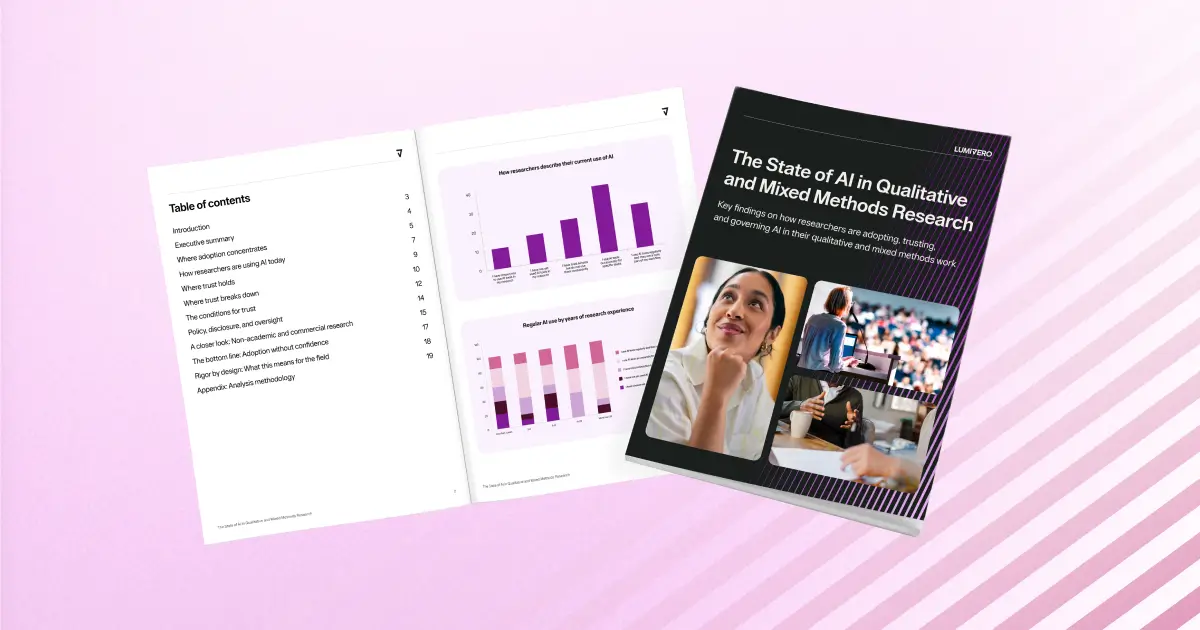
The State of AI in Qualitative and Mixed Methods Research
Discover key findings on how researchers are adopting, trusting, and governing AI in their qualitative and mixed methods work.
Download report →Mixed Method Research FAQs
Recent articles



How can we help you? Contact us.