










Key takeaways
NVivo AI Cloud, launching Oct. 6, 2026, pairs agentic AI with the qualitative research methodology researchers already trust from NVivo—guiding project setup, coding, and querying without cutting methodological corners. Ahead of launch, we asked experienced qualitative researchers to put the platform to work in beta. Their feedback converged on one point: AI can speed up the mechanical parts of qualitative research (setup, topic identification, case organization)—while the interpretive work that makes a finding defensible stays with the researcher: reviewed, approved, and on the record. That division of labor is what separates NVivo AI Cloud from a general-purpose AI tool.
Artificial intelligence is changing how qualitative analysis gets done—making it faster and, in the right hands, more insightful. But interpretation—understanding what data from interviews, focus groups, and other human-centered methods actually means—belongs to the researcher. AI's edge shows up earlier in the process: surfacing patterns across a large or messy dataset that a human coder working alone might not catch until much later, if at all.
Generic AI tools can summarize a transcript, but summarizing isn't analyzing—there's no way to tell a genuine theme from a topic that just came up a lot, and the interpretive rigor a real qualitative study needs gets lost in the shortcut.
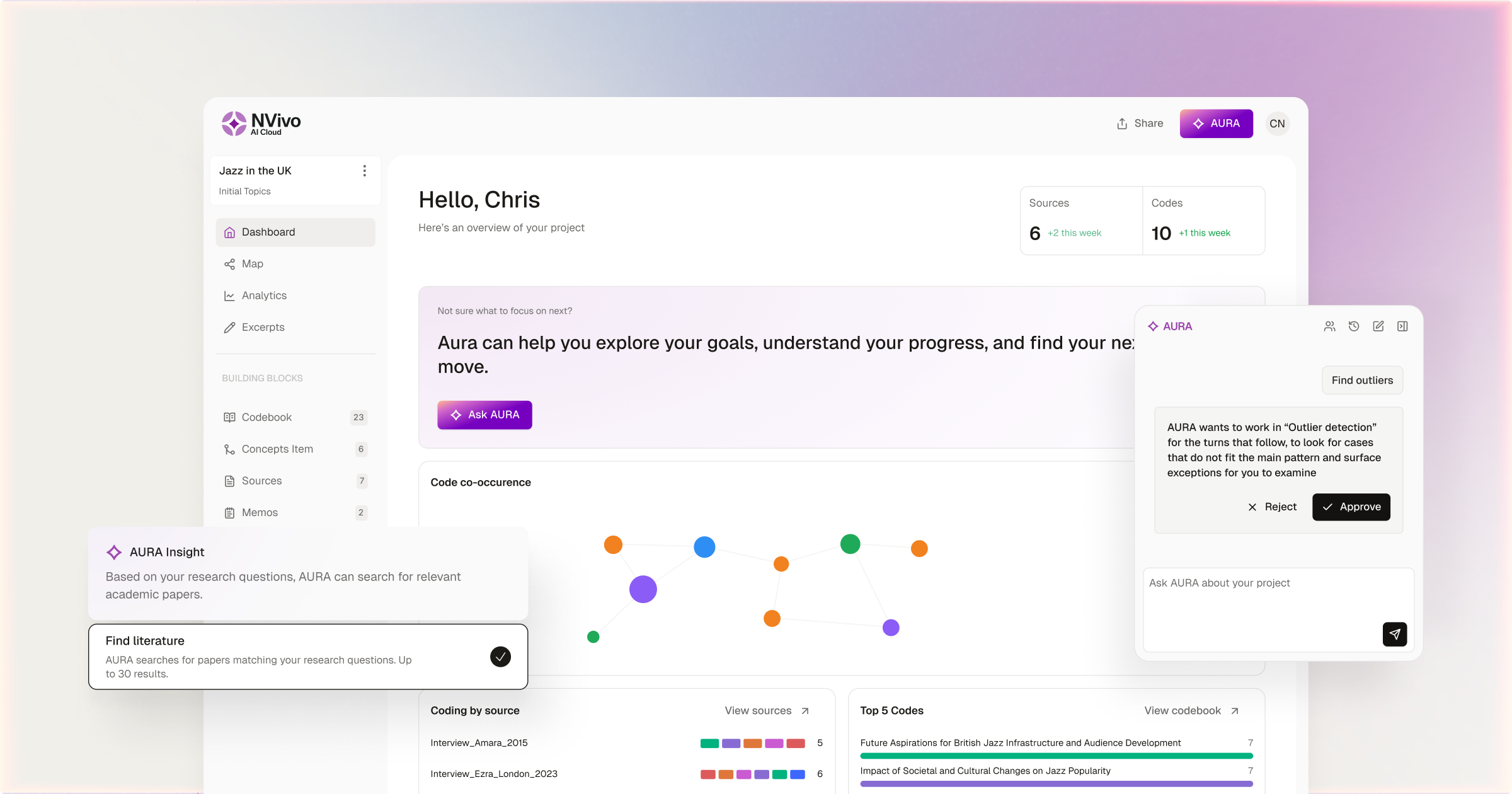
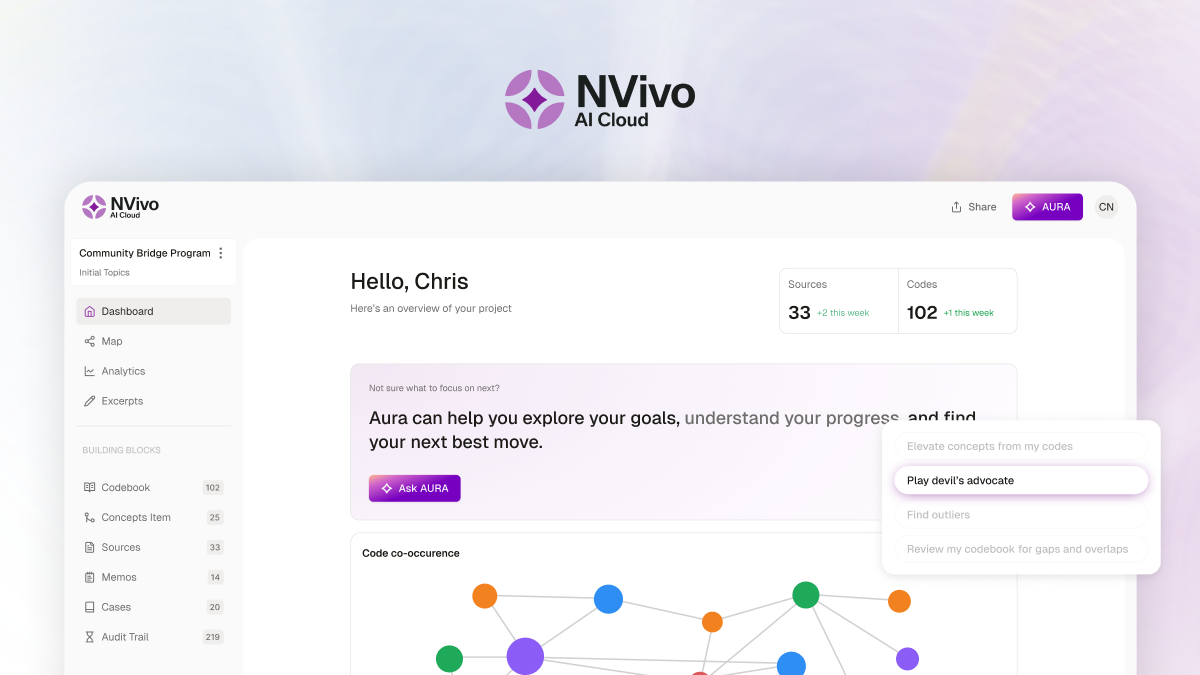
That's the gap NVivo AI Cloud was built to close: rigor designed directly into an AI-powered qualitative data analysis tool. NVivo AI Cloud, launching Oct. 6, 2026, combines agentic AI with the structure researchers already trust from NVivo, guiding project setup, coding, and querying, while every AI-generated output waits for the researcher's review and approval before it becomes part of the analysis.
Throughout development, our beta testers—experienced qualitative researchers—put NVivo AI Cloud to work. Their feedback kept landing on the same points: the platform is easy to pick up, and it handles the mechanical parts of qualitative research (setup, topic identification, organizing cases) without taking over the interpretive work that makes a finding defensible.
Their feedback didn't just confirm the design; it sharpened it, flagging issues we've addressed ahead of launch—such as terminology, the ability for the researcher to specify what initial topics it wants the AI to code and much more. Here's what they told us.
First impressions
When we asked our beta testers, their reactions clustered around three things: how easy the platform was to pick up, how confidently they could stand behind an AI-assisted finding, and whether it actually understood the methodology they were using rather than just running data through it.
Easy to pick up, from the first project
Ease of use matters in a research tool for one simple reason: every hour spent fighting software is an hour not spent with the data.
It was the first thing many beta testers commented on. NVivo Trainer and Independent Researcher, Dr. Evelyn Hibbert was "surprisingly impressed," saying "it seemed to be very smooth and easy."
Milagro Nunez, PhD Sociology Candidate at Colorado State University, pointed to the platform's automated metadata extraction—they didn't have to build out their data manually to get started: "[NVivo AI Cloud] did it by itself really nicely, without me needing to upload in Excel with other data. It read the data from the interviews, like, their age, and like the variables."
Publish with confidence
Confidence in a finding comes from knowing exactly how it was produced. Dr. Philip Adu of the Center for Research Methods Consulting described working with NVivo AI Cloud as interacting with a system rather than having the AI hand you an answer.
“Having a system like this where it's not like putting your information in and getting what you want, but interacting with the system, reviewing the output, making sure that everything is right, having a role to play. I think it's a very good selling point, because, most of the AI tools, they just put your information and get what you want and then present that information. But this one is like we are working, actively working with the system to review and get what you want and then present that information.”
— Dr. Philip Adu, Founder & Methodology Expert, Center for Research Methods Consulting, LLC
When every AI suggestion passes through your review, you stay as close to the data as manual coding keeps you—and the findings you present are ones you can defend. That's why NVivo AI Cloud was designed with the researcher's judgment at the center, as Dr. Elif Kus Saillard, Lead Analyst at IDG Global Survey, emphasized: "[NVivo AI Cloud] welcomes AI in a very good way but keeps the tradition and keeps the human as a subject in the space."
Methodology first, not an afterthought
Whether you rely on thematic analysis, grounded theory, or another approach to your data, NVivo AI Cloud structures the project around the methodology you choose—and keeps every analytical decision in your hands.
Where other AI tools simply summarize or distill whatever they're given, NVivo AI Cloud is designed to support how researchers actually work: suggestions grounded in your research questions, offered for your review, and never final until you accept them.
Dr. Evelyn Hibbert praised the topics the platform suggested from her data: "Topics that it suggested? They were good. I was pleasantly surprised."
Dr. Ben Meehan, Owner of QDATraining Ltd., pointed to a pain point the platform removes outright, saying, "I absolutely loved the way it set up the cases. That was brilliant, because that's the bane of our lives."
That held up even across languages. Milagro Nunez, PhD Sociology Candidate at Colorado State University, coded their interviews in English while some of the underlying data was in Spanish—and found the AI didn't lose the thread: "It did a really good job. Going through things like me putting the codes in English, and then doing the AI analysis. It understood the codes in English and drew the information that was related. But that information, some was in Spanish."
An all-in-one AI platform for qualitative researchers
General-purpose AI tools can help with parts of your research, but NVivo AI Cloud is built specifically for the needs of qualitative researchers—and there's more to it than data organization and coding. See a full comparison of AI research tools to understand how general assistants, discovery tools, and purpose-built platforms like NVivo AI Cloud each fit into a research workflow.
A guided project setup establishes rigor from step one, every project has space for a deep base of research literature, and a “devil’s advocate” mode actively searches for disconfirming and negative cases as your theory develops—building the pressure-testing that good qualitative analysis has always demanded directly into the workflow and putting it on the record.
It all speaks to Lumivero's commitment to qualitative data analysis—and here's what that looks like in practice.
How NVivo AI Cloud works
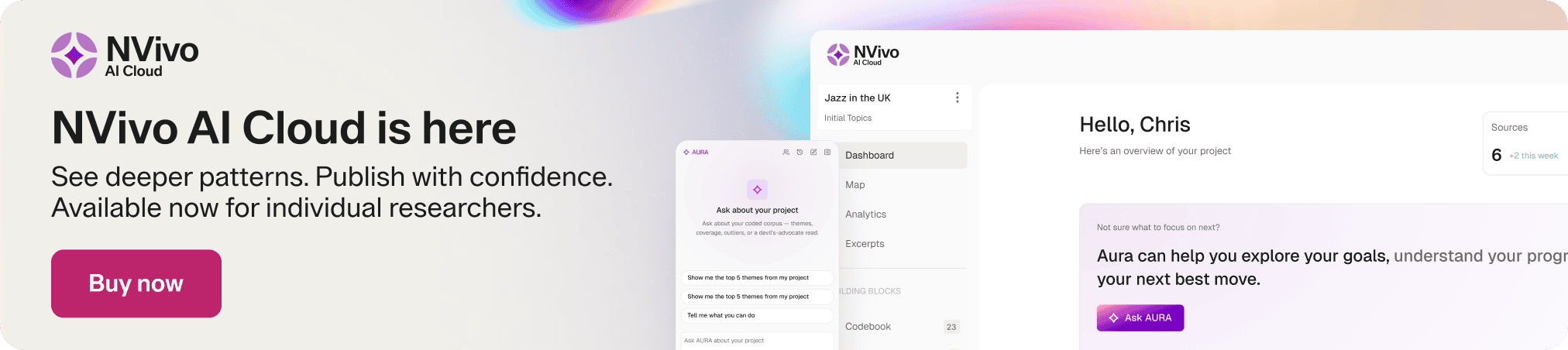
With NVivo AI Cloud, you can store your documents on our cloud-based platform, generate research questions, build a theoretical base of literature, organize your data into cases, and have the AI draft coding for your review. A project chat agent answers questions about your data—with every answer traceable back to the source material, so you can check it before you rely on it.
As powerful as NVivo AI Cloud is, the value of every research project lies in the human contribution. That's why every AI-enabled step requires human approval, and a full, exportable audit trail—including AI prompt inspection—makes AI-assisted coding as citable and defensible as manual coding. The AI drafts; you decide. You keep authorship of the analysis, and the record shows it.
As Dr. Evelyn Hibbert put it after testing the platform: "It has actually been a pleasure to try out something that works."
See it for yourself. NVivo AI Cloud will be revealed live on Oct. 6, 2026, at Illuminate, Lumivero's flagship innovation event, and will be available that day for individual researchers, with a waitlist open now for teams and institutions

Roehl Sybing
Research Associate, University of North Dakota
Roehl Sybing is a Research Associate in the College of Education and Human Development at the University of North Dakota and a content writer for Lumivero. His research interests include qualitative research methodology and dialogic interaction across languages and cultures. He has written extensively on qualitative research methods in scholarly and commercial publications, including several articles for ATLAS.ti's Research Hub.