









Key takeaways
Risk management methods and techniques split into two groups: response techniques (avoid, reduce, transfer, accept, plus escalation) decide what you do about a risk, while analysis techniques (from qualitative scoring to quantitative modeling like Monte Carlo simulation) determine how well you understand it first. The most common—and costly—mistake is choosing a response based only on a color-coded heat map, because two risks rated “high” can carry very different levels of exposure. Mature risk programs use both: qualitative analysis screens the full risk register, while quantitative modeling focuses on the 10–15% of risks where deeper analysis can change the decision.
What are risk management methods and techniques?
Risk management methods and techniques are the structured approaches organizations use to handle uncertainty on a project, program, or portfolio. The term covers two distinct families of techniques that most guides collapse into one—how you respond to a risk, and how you analyze it—and most only cover the first.
Most articles on this topic list the four response strategies and stop. Far fewer treat the second half seriously: the qualitative and quantitative analysis techniques that determine whether a response is well-informed, or just a guess dressed up in a color-coded chart. This guide covers both—starting with the response strategies most searches expect, then the risk analysis techniques that make them credible.
Response techniques vs. analysis techniques: The distinction that matters
| What it answers | Examples | When it's used | |
|---|---|---|---|
| Response techniques | "What do we do about this risk?" | Avoid, reduce, transfer, accept (active/passive), escalate when ownership needs to shift | After a risk is understood |
| Analysis techniques | "How likely and how severe is this risk, and how do risks interact?" | Qualitative scoring, Monte Carlo simulation, sensitivity/scenario analysis | Before you choose a response |
Many analyses only cover the top row and stop—which leaves risk managers choosing responses on weak analysis. A risk rated "accept" on a heat map and a risk quantified at a 3% chance of a $2M impact might get the same label, but they don't deserve the same confidence. This guide covers both rows and treats the second one as seriously as it deserves.
The core risk response strategies (methods for treating risk)
There are four core risk response strategies—avoid, transfer, mitigate, and accept—that make up the foundation of how organizations treat risk once it's understood. A fifth response, escalation, sits alongside these: rather than treating the risk directly, it routes ownership to whoever is actually equipped to handle it.
Risk avoidance
Risk avoidance eliminates a risk by removing the activity, approach, or exposure that creates it. It is the most complete form of risk treatment but may also mean giving up an opportunity. It is typically used when the potential impact is severe and the trade-off is acceptable.
H3 Risk reduction (mitigation)
Risk reduction (or mitigation) lowers the likelihood or impact of a risk through added controls, process changes, redundancy, or additional oversight. It's the most commonly used of all risk mitigation techniques, since most risks can be managed rather than eliminated.
Risk transfer
Risk transfer shifts the financial impact of a risk to a third party through mechanisms such as insurance, performance bonds, fixed-price contracts, or financial hedging. The risk itself remains, but responsibility for some of the consequences moves elsewhere.
Risk acceptance
Risk acceptance means consciously choosing to retain a risk rather than avoiding, transferring, or mitigating it—and it typically takes one of two forms.
- Active acceptance sets aside a contingency reserve—time, money, or resources—released only if the risk actually materializes. This is where contingency planning happens: pre-identified alternative suppliers, reserve budget, or a fallback plan that stays shelved until triggered.
- Passive acceptance involves no advance preparation, just periodic monitoring to confirm the risk hasn't grown more likely or severe.
Effective acceptance, in either form, is based on a clear understanding of likelihood and consequence — not simply leaving a risk unmanaged.
Escalation
Not every risk belongs to the person who identified it. Escalation hands a risk to whoever has the authority to actually own it—a program manager, portfolio sponsor, or executive steering committee—because its potential impact or required response sits outside the project team's authority or tolerance. It's a distinct move from the four core strategies above: instead of choosing how to treat the risk, you're choosing who should.
| Strategy | What it means | When to use it | Example |
|---|---|---|---|
| Avoidance | Eliminate the activity or exposure entirely. | Risk is severe and the activity isn't essential. | Cancelling a supplier contract in an unstable region rather than managing the exposure. |
| Reduction (mitigation) | Lower the likelihood or impact through controls. | Most risks, most of the time—the default response. | Adding redundant suppliers to reduce the impact of a single-source delay. |
| Transfer | Shift the financial impact to a third party. | Risk is insurable, contractual, or hedgeable. | Insurance, performance bonds, fixed-price contracts, financial hedging. |
| Acceptance (active) | Retain the risk, with a contingency reserve held in case it occurs. | Cost of avoiding, transferring, or mitigating exceeds the exposure, but some preparation is still warranted. | A reserve budget or fallback supplier held in case a primary risk occurs. |
| Acceptance (passive) | Retain the risk with no advance preparation, just monitoring. | Risk is low-priority or low-impact. | Accepting minor schedule float on a low-impact task rather than adding cost to control it. |
| Related strategy: Escalation | Route the risk to whoever has the authority to own it. | Risk exceeds the project team's authority or tolerance—not a treatment choice, an ownership one. | Elevating a supply-chain risk that could affect multiple programs to the portfolio owner. |
The response strategy you choose is only as good as the analysis behind it. "Accept" without quantification is a guess wearing a decision's clothes—which is why analysis comes first in a well-run process, even though it's less commonly discussed.
Risk analysis techniques: How you understand a risk before you respond
Risk analysis techniques fall into two categories—qualitative and quantitative—and strong programs use both. Qualitative techniques triage a full risk register quickly; quantitative techniques go deeper on the risks that matter most.
Qualitative risk analysis techniques
Qualitative risk analysis uses structured judgment rather than numerical modeling to rate and prioritize risks through techniques such as risk matrices, heat maps, risk registers, probability/impact scoring, expert judgment, and SWOT analysis. It is fast, inexpensive, and effective for screening large risk registers to identify where deeper analysis is needed. Its limitation is subjectivity: ordinal scales do not behave like numbers, so two risks rated “high” may represent very different levels of exposure.
The heat-map trap: color-coding feels rigorous, but a risk with a 5% likelihood of catastrophic impact and one with a 60% likelihood of moderate impact can appear identical on the same map.
Quantitative risk analysis techniques
Quantitative risk analysis uses numerical modelling and probability to express risk as a range of possible outcomes rather than a single score. Key techniques include:
- Monte Carlo simulation—runs thousands of scenarios across defined probability ranges to produce a distribution of possible outcomes rather than a single estimate (for example, an 82% chance of finishing under budget).
- Sensitivity analysis—shows which variables have the greatest influence on an outcome, often using tornado charts.
- Decision-tree analysis—maps sequential decisions and probabilistic outcomes to compare options based on expected value.
- Scenario analysis and stress testing—models alternative outcomes and disruption scenarios to test resilience.
- Interdependency and correlation modeling—analyzes how risks interact and compound across a portfolio rather than treating them as isolated events.
Getting analysis right has a real cost attached to getting it wrong: McKinsey found that, on average, projects overrun their budgets and schedules by 30 to 45 percent, based on a recent survey of senior project executives.
Correlation is where naive methods go dangerously wrong—treating risks as independent can significantly underestimate aggregate exposure across a portfolio. This issue is particularly important in risk management in infrastructure and civil engineering projects, where connected ground, cost, and schedule risks can significantly affect the overall exposure.
Qualitative vs. quantitative risk analysis: Which technique when?
| Qualitative | Quantitative | |
|---|---|---|
| What it produces | A category or score | A range and a probability |
| How risk is expressed | High / Medium / Low | e.g., "82% chance under budget," P90 cost estimate |
| Handles interdependencies? | No—risks assessed in isolation | Yes—correlation and portfolio effects can be modeled |
| Supports financial trade-offs? | Limited | Yes—supports contingency sizing and capital allocation |
| Typical tools | Risk registers, heat maps, scoring matrices | Monte Carlo simulation, sensitivity analysis, decision trees |
| Best for | Screening a large register quickly | Prioritized, high-impact risks |
| Key limitation | Subjective; ordinal scales don't aggregate | Requires more data, time, and modeling skill |
The answer to “which is better?” is neither—they serve different purposes. Qualitative techniques triage what needs attention; quantitative techniques analyze what matters most. A practical rule of thumb is to apply full quantitative analysis to the highest-impact risks (typically the top 10–15% of the register), semi-quantitative scoring to the middle, and qualitative assessment to the remainder.
The risk management process: Where these techniques fit
Response strategies and analysis techniques are not separate topics—they are two stages of the same risk management cycle. Analysis comes first: understanding likelihood, impact, and interdependencies determines which response is appropriate. This sequence aligns with ISO 31000, the international risk management standard, which defines risk management as a continuous process rather than a one-time exercise. The techniques and response strategies covered in this guide fit into the cycle as follows:
- Identify risks through workshops, historical data, and expert input.
- Analyze risks using qualitative and quantitative techniques to understand likelihood, impact, and exposure.
- Evaluate and prioritize risks based on the analysis.
- Respond using avoidance, transfer, mitigation, or acceptance (active or passive)—or escalate when the risk sits outside the team's authority.
- Monitor and review continuously as risk exposure changes across projects and portfolios.
For the full walkthrough of this cycle at an enterprise level, see our five steps to enterprise risk management.
Femern A/S used Predict! to run a single ISO 31000-compliant risk framework across an €7 billion, 18km undersea tunnel program.
Choosing the right techniques for your risk maturity
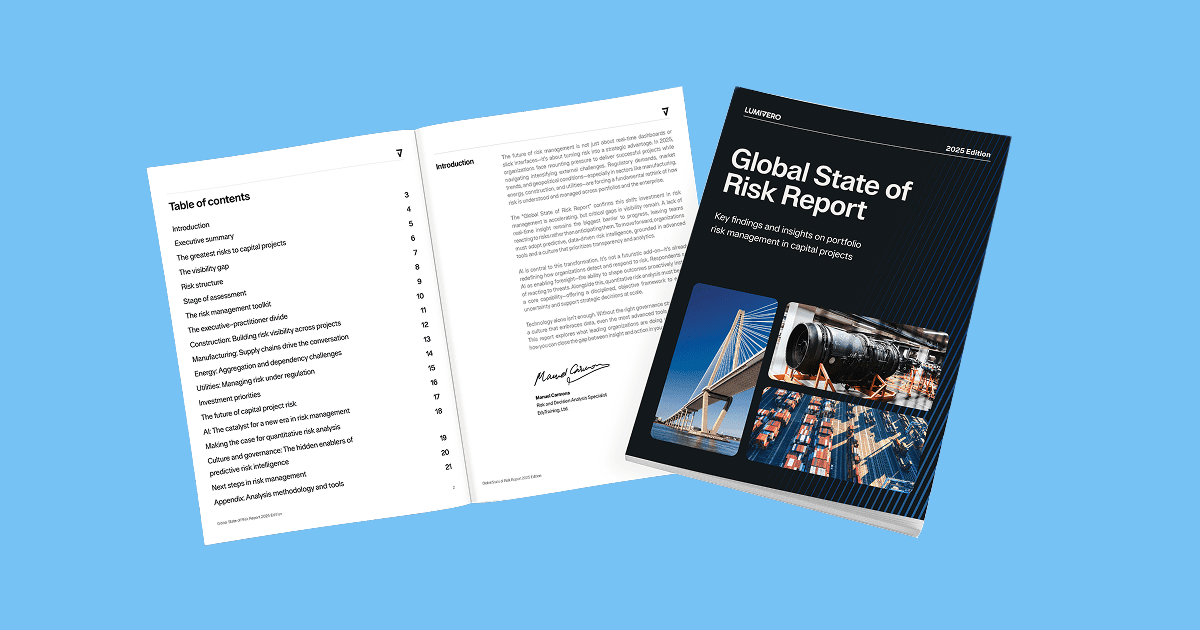
Lumivero's 2025 Global State of Risk Report found that only 25% of organizations operate an enterprise-wide risk framework, and just 12% manage risk at the portfolio level. The gaps show up in day-to-day tooling too: 42% still rely on Excel or Google Sheets for risk tracking, and 40% cite a lack of real-time visibility as their biggest portfolio risk-management challenge.
In other words, most programs are earlier on the maturity curve than they'd like to be—which is exactly why picking the right technique for where you actually are matters more than reaching for the most advanced one. Risk capability typically develops through a maturity ladder:
- Qualitative heat maps—basic risk identification and prioritization.
- Structured risk registers and workflows—defined ownership, tracking, and governance.
- Semi-quantitative scoring—more consistent prioritization using weighted criteria.
- Scenario and sensitivity analysis—understanding how assumptions and uncertainties affect outcomes.
- Full quantitative modeling—Monte Carlo-based analysis across projects and portfolios.
The practical advice is to adopt one level above your current maturity, not five. A program relying only on heat maps does not need to jump straight to portfolio-wide simulation; it needs the processes and data foundation to support more advanced analysis first.
Intelligent Decision-Making Across Project Portfolios Guide
Discover how to connect data, analyze risk, and make smarter project portfolio decisions with greater visibility, aligned priorities, and real-world strategies for complex organizations.
Download eBook →The costlier mistake isn't over-engineering your risk analysis—it's staying qualitative-only on high-stakes portfolios where the numbers matter, then getting blindsided by a risk the heat map rated "medium." Maturity should match the decisions you need to make, not the tools you're used to.
Common mistakes in applying risk management techniques
- Treating response strategies as the whole of risk management. Avoid, reduce, transfer, and accept are only one half of the process—they come after analysis, not instead of it.
- The heat-map trap. Color-coding a risk as “high” feels like measurement, but two risks in the same category can represent very different levels of actual exposure.
- Choosing a response before doing real analysis. Deciding to accept or mitigate a risk without understanding its likelihood, impact, or uncertainty is a response based on assumption rather than evidence.
- Treating correlated risks as independent. Risks that move together can compound exposure, and ignoring those relationships can lead to underestimated portfolio risk — a mistake AI itself can make when left unchecked, as shown in this case study on risk management in the energy industry.
- Staying qualitative-only where quantification is warranted. Qualitative techniques are effective for screening, but high-impact decisions often require deeper quantitative analysis.
- Analyzing risk once instead of continuously. A risk assessment that is not updated as conditions change quickly becomes a record of past assumptions rather than current exposure.
See how a practical monte carlo simulation example in excel demonstrates how AI assistant tools can accidentally assume variable independence and how to fix it.
How Lumivero helps risk managers apply these techniques
Applying risk management techniques consistently to complex projects and portfolios is where many organizations struggle. Lumivero brings risk management and decision-making together—portfolio and project risk management, predictive modeling, and scenario planning—in one connected approach.
- Predict! provides portfolio and program risk management with enterprise-grade visibility, real-time dashboards, alerts, and audit trails, bringing qualitative and quantitative risk techniques into one governed workflow.
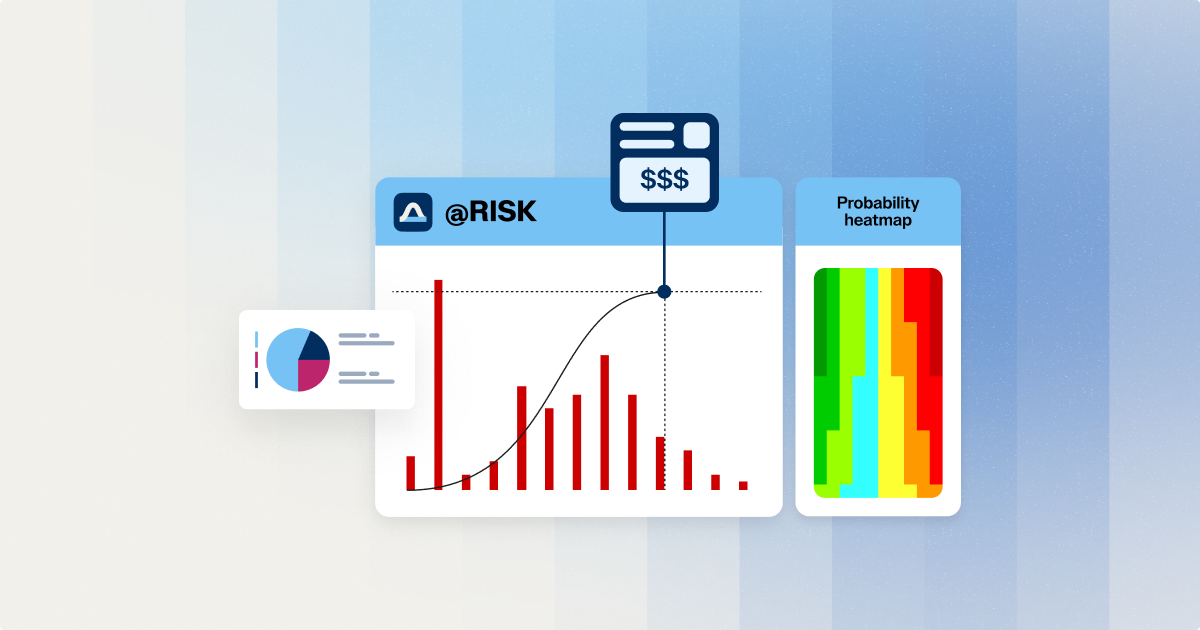
- @RISK provides the quantitative engine, using Monte Carlo simulation in Excel to quantify uncertainty and exposure.
- SharpCloud adds scenario planning and strategic portfolio visualization to see how risks and decisions interconnect, helping teams understand dependencies and how changes in one area can affect the wider portfolio.
Unlike governance-first GRC platforms, Lumivero is purpose-built for portfolios and projects, not general compliance workflows. And unlike spreadsheet-only approaches, it connects Excel-native simulation with portfolio-wide visibility, keeping the golden thread intact between individual project risks and portfolio-level decisions.
This enables organizations to see risk clearly, understand dependencies, and decide confidently. Designed by risk professionals and data scientists and trusted by 90% of the Fortune 100 and 27,000+ customers, Predict! and @RISK together help organizations apply these techniques with greater confidence and visibility.
Request a demo to see how your team can apply qualitative and quantitative risk techniques to strengthen decisions.

Nicky Clarke
Freelance B2B technology copywriter
Nicky Clarke is a freelance B2B technology copywriter with more than 11 years' experience creating content for enterprise software companies. Having spent over a decade leading content and communications for SharpCloud, she specializes in project management, risk management, and strategic decision-making—producing blogs, website content, e-books, and thought leadership that make complex concepts accessible, engaging, and relevant for business audiences.
Frequently asked questions
The four core risk management techniques are risk response strategies: avoidance (eliminating the risk), reduction or mitigation (lowering the likelihood or impact), transfer (shifting the financial impact to a third party, such as through insurance), and acceptance (consciously retaining the risk). These strategies define how organizations respond after a risk has been identified and analyzed. Escalation is sometimes treated as a related fifth response, used when a risk's impact or required decision sits above the project team's authority—but unlike the other four, it's a question of ownership rather than treatment.
Qualitative risk analysis ranks risks using categories such as high, medium, or low, often with tools like risk matrices and heat maps. It is quick and useful for prioritization, but it can be subjective and does not quantify uncertainty. Quantitative risk analysis uses numerical data, probability distributions, and techniques such as Monte Carlo simulation and sensitivity analysis to model possible outcomes, measure uncertainty, and support better financial and strategic decisions. Mature risk management practices use both: qualitative analysis to prioritize risks and quantitative analysis to understand their potential impact.
Monte Carlo simulation is a quantitative risk analysis technique that runs thousands of possible scenarios using defined probability ranges to show the likelihood of different outcomes. Instead of producing a single estimate, it creates a distribution of possible results, helping risk managers answer questions such as “What is the probability we finish under budget or on schedule?” Monte Carlo simulation is widely used in tools such as @RISK to quantify uncertainty and support better decisions.
The most common risk assessment methods include qualitative techniques such as risk registers, risk matrices, heat maps, and probability-impact scoring, and quantitative techniques such as Monte Carlo simulation, sensitivity analysis, decision tree analysis, and scenario analysis. The right method depends on the complexity of the decision, the level of uncertainty, and the potential impact of the risk.
There is no single best technique—response and analysis techniques serve different purposes, and qualitative vs. quantitative analysis suit different situations. A practical rule of thumb: run full quantitative analysis on your highest-impact risks (roughly the top 10–15% of the register), semi-quantitative scoring on the middle, and qualitative rating on the rest.
The standard risk management process consists of five steps: identify risks, analyze them using qualitative and/or quantitative techniques, evaluate and prioritize, respond (avoid, reduce, transfer, accept—active or passive—or escalate when the risk sits outside the team's authority), and monitor and review risks over time. This approach aligns with frameworks such as ISO 31000 and helps organizations manage uncertainty throughout the lifecycle of a project, program, or portfolio. See our five steps to enterprise risk management for the full walkthrough.
Portfolio risk management involves managing risks across multiple projects as an interconnected system rather than as isolated initiatives. It requires understanding dependencies between projects, aggregating risk exposure, modeling uncertainty, and maintaining portfolio-wide visibility. These project risk management techniques—Monte Carlo simulation and scenario analysis, supported by tools like Predict!, help organizations understand overall risk exposure and how risks in one project may affect wider portfolio outcomes.