









Key takeaways
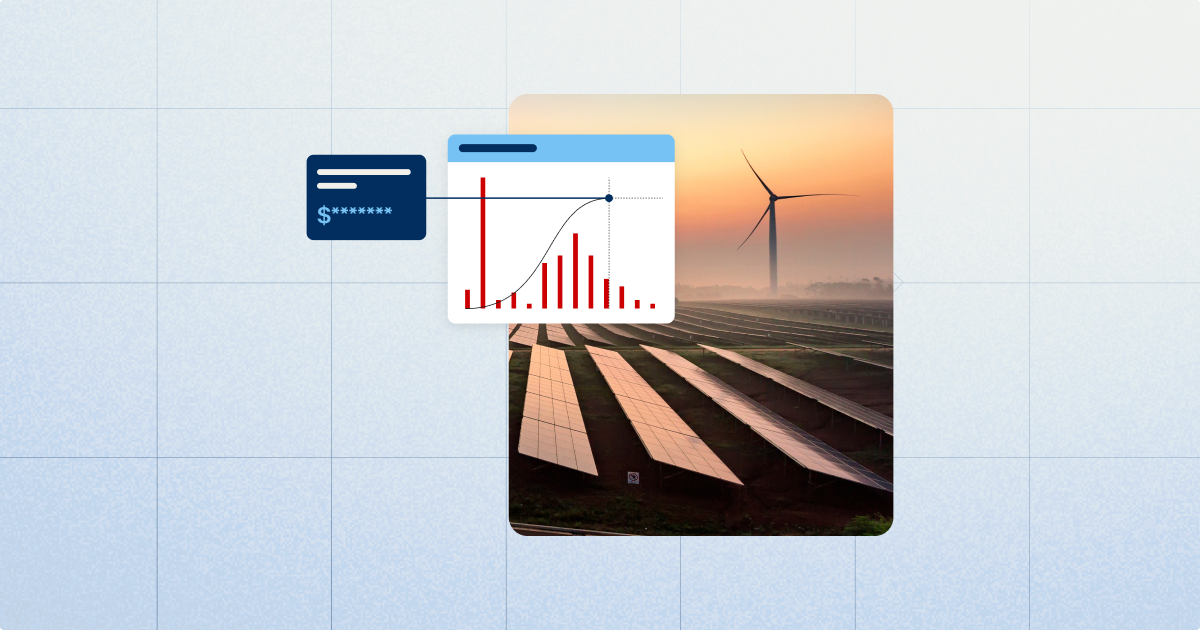
Energy and utilities projects combine enormous capital, long asset lives, and deep uncertainty—exactly the conditions a single-point estimate hides rather than reveals. This article works a real offshore-wind investment decision through @RISK with @RISK Agent embedded in the workflow: where AI accelerates the modeling, where the simulation engine catches what AI gets wrong, and which industry-specific caveats belong in every energy model.
Why the biggest capital decisions in energy now demand probability, not point estimates—and where AI earns its place in the workflow
The International Energy Agency puts the scale of the problem plainly: annual investment in electricity grids needs to roughly double to more than USD 600 billion a year by 2030, yet some 1,500 GW of renewable projects already sit in connection queues waiting for the green light—five times the solar and wind capacity the world added in a single recent year. Behind every one of those figures is a financing decision made under deep uncertainty: volatile power prices, shifting regulation, twenty-five-year asset lives, and interconnection dates nobody fully controls. A single-point estimate of return does not quantify that uncertainty. It hides it.
That is precisely the kind of decision Monte Carlo simulation was built for—and precisely where AI, used well, now changes the economics of getting it right.
Energy investment committees do not approve numbers they cannot interrogate. When a director asks “how did you get that?”, an @RISK model built in Excel can show the answer cell by cell—distributions in place of point estimates, thousands of iterations in place of a single scenario, tornado charts and correlation matrices sitting alongside the model for anyone to read. Adding AI to that environment does not change the platform. It changes how fast the analyst can work within it. The same question of where AI adds value applies beyond energy risk models to AI in capital project management more broadly.
In our AI prompt engineering for risk managers field guide, we covered how to prompt the @RISK Agent well. In this article, we put it to work inside a real decision.
On-demand webinar + example model
Dig deeper into this topic by watching Manual Carmona’s demonstration of this case study, plus download the model to follow along.
The case: An offshore wind investment decision
A developer is approaching Final Investment Decision on a 250 MW offshore wind project. CAPEX is estimated at €900 million. The asset carries a fixed-price revenue contract for its first years, followed by a long exposure to wholesale electricity prices. The investment committee does not want a forecast of NPV. It wants the distribution of NPV outcomes, and a clear view of what is driving the spread.
The inputs are numerous, and the relationships between them are not independent: wind yield, availability, power price, O&M cost escalation and the interconnection date all move together in ways that matter. This is the structure Monte Carlo handles and a spreadsheet forecast cannot.
Stage one: Building with @RISK Agent
The @RISK Agent embeds AI directly in the @RISK Excel environment through Lumivero’s Model Context Protocol layer. The analyst describes the asset and the decision in plain language; the @RISK Agent proposes a model structure, suggests distribution types for each uncertain input, and flags the variables likely to dominate. Scaffolding that once took hours is ready in a fraction of the time.
One practical point decides whether this works. The prompt has to tell the @RISK Agent explicitly to use the @RISK model through the MCP. Ask the question loosely and a general-purpose model will answer from its own knowledge of energy finance—plausible, fluent, and disconnected from your actual distributions. Point it at the model, and every suggestion is grounded in the workbook in front of you. That distinction is the whole reason the @RISK Agent exists.
The analyst reviews, overrides, and brings the domain knowledge the AI cannot have: the specific contract terms, the local market, and the grid operator’s track record on connection dates.
Stage two: Verifying with @RISK
Ten thousand iterations later, the tornado chart ranks the drivers of NPV variance at a glance. Here, power-price uncertainty dominates, followed by wind yield and the interconnection date. The chart does more than confirm intuition—it shows the relative weight of each driver and flags where the assumptions deserve the most scrutiny.
This is the audit step, and it is where the analyst’s judgment becomes decisive. AI builds models quickly; it does not always build them correctly. In this case, AI had treated power price and merchant-period revenue as independent inputs—a common and consequential error, because in an energy model they are anything but. The correlation matrix exposes it immediately. Correcting that single assumption widens the downside materially: the P10 NPV moves, the project still clears at the central estimate, but the tail looks different. That is a different conversation with the committee. No prompt surfaces that finding. The simulation engine does.
Stage three: interrogating the output
With the model corrected, the Agent’s natural-language interface lets the analyst interrogate the results directly, asking questions like:
- What drives NPV below zero?
- How does the picture change if the connection slips a year?
- At what price does the merchant period stop covering its costs?
The answers come from the simulation data—grounded through the MCP in the actual output, not the AI’s general knowledge—and they come back specific, traceable, and ready to drop into a board paper or an executive summary the @RISK Agent can draft on request.
Where AI fits
Across an energy model, the pattern is consistent. AI is strongest on the mechanical work that surrounds judgment: proposing a first-pass structure, suggesting distributions with a documented rationale, reviewing a model for gaps before it runs, interpreting a dense set of outputs into plain language, and turning results into a draft report.
It is weakest—and must never be trusted—on the things that decide whether the model is right: the correlations, the calibration of tail risk, and the domain facts a general model has no way of knowing. Used inside @RISK, AI accelerates the first list while the simulation engine and the analyst hold the second.
Caveats that belong in every energy model
A few caveats are specific enough to the energy and utility sector to be worth stating plainly:
- Experts give you percentiles, not distributions.
Wind-yield consultants and reservoir engineers hand over P90 / P50 / P10, not a parametric curve. Fit the distribution to the percentiles you were actually given rather than imposing a shape—and be explicit when the AI does the fitting for you. - Rare events have little history.
For a cable failure, a turbine fault or a spill, you rarely own enough data to estimate frequency directly. Borrowing a frequency from a wider dataset is legitimate, but it is a modeling choice to be stated and defended, not buried. - Correlation is the rule, not the exception.
Price, yield, availability and cost escalation move together. The single most common silent error—by humans and AI alike—is modeling them as independent. - Regulation and long asset lives stretch the horizon.
A twenty-five-year asset is exposed to policy regimes that do not exist yet. Scenario structure, not a single discount rate, is how that uncertainty enters the model honestly.
The modeler stays in control
AI accelerates. It does not decide. Every distribution reflects a judgment about how uncertain an input is; every correlation reflects knowledge of how the real system behaves; every scenario reflects a view of what could go wrong and how badly. Those judgments belong to the analyst, and in energy—where the capital is large, the horizon is long, and the downside is real—they always will.
What the @RISK Agent changes is the cost of asking one more “what if”. In this sector, that is exactly the capability worth having.
Learn more about AI in risk management
This is one installment in a series on AI and Monte Carlo simulation in risk management. Next, the series turns from energy to the tunnels, bridges, and roads of infrastructure and civil engineering—same probabilistic discipline, a different risk profile, and a fresh set of caveats.
Catch up on the rest of the series:
- AI prompt engineering for risk managers: A practical field guide with @RISK Agent
- Monte Carlo simulation in the age of AI: What changes, what doesn’t, and what gets better
- AI and risk management in infrastructure and civil engineering
Ready to see where probability—not point estimates—takes your next capital decision? Buy @RISK to get started today.

Manuel Carmona
Director, EdytrAIng, Ltd.
Manuel Carmona is the author of Artificial Intelligence and Project Risk Analysis (Taylor & Francis, 2026) and founder of EdytrAIning. He’s a PhD researcher at the University of Westminster in London and consults and trains organizations in quantitative risk analysis, Monte Carlo simulation, and AI-integrated decision-making across the energy, infrastructure, and commercial sectors.