










Key takeaways
Scenario planning is a structured way to prepare for several plausible futures instead of betting on a single forecast. You identify the key uncertainties, build 3–4 distinct scenarios, then stress-test your strategy and portfolio against each. Done well, it turns uncertainty from a threat into a decision advantage.
- What it is: a method for planning against multiple plausible futures, not predicting one
- Why single-point forecasts fail: they give you nowhere to go when reality diverges from the plan
- The core steps: define the decision, identify uncertainties, build distinct scenarios, test your portfolio, set signposts
- The techniques: from the classic 2x2 matrix to inductive, backcasting, and quantitative Monte Carlo methods
- The leap most teams miss: connecting scenarios to the live portfolio and putting a probability on them, instead of leaving them in a slide deck
What is scenario planning?
Scenario planning is a structured process for identifying and preparing for multiple plausible futures, rather than committing to a single predicted outcome. Instead of asking "what will happen?" it asks "what could plausibly happen, and how do we make sure our plan holds up across all of it?" It's one of the clearest paths to informed strategic decision-making.
The discipline traces back to military and corporate planning in the mid-20th century—Herman Kahn's work at RAND, later adapted for business by Pierre Wack at Shell, whose team's scenario work famously helped Shell respond faster than competitors to the 1973 oil shock.
Scenario planning vs. forecasting vs. contingency planning
|
Term |
What it does | Where it falls short alone |
|---|---|---|
|
Forecasting |
Predicts one most-likely future |
Wrong the moment reality diverges, with no backup plan |
|
Contingency planning |
Prepares a single response to one anticipated risk event |
Reactive; doesn't explore multiple interacting uncertainties |
|
Scenario planning |
Builds several distinct, plausible futures and tests your plan against all of them |
Requires more upfront thinking, but builds a robust plan |
The confusion between forecasting and scenario planning comes down to one word: certainty. A forecast commits to a single version of what's coming. Strategic scenario planning doesn't—it explores several plausible futures and asks whether your strategy still holds up in each one. The strongest plan isn't the one optimized for the future you hope for; it's the one that remains resilient across the futures you didn't expect.
Why scenario planning matters now
Portfolios today are more interdependent and more exposed than they were a decade ago. Supply chains, regulatory regimes, funding environments, and technology costs can all shift within a single planning cycle—and a plan built around one version of the future has no answer when a different one shows up.
This isn't a new problem, but it's a more visible one. According to McKinsey's article, “The executive’s survival guide to capital projects,” even the best project and portfolio teams are subject to optimism bias—creating plans that tend to fit within available capital or schedule expectations rather than reflecting external realities. When teams build a single-point plan around that optimistic assumption, they leave themselves nowhere to pivot when reality arrives. Disconnected planning tools compound this by hiding how a shift in one assumption ripples across the rest of the organization.
Most plans turn out to be wrong eventually—that was never the real issue. The real cost comes when reality diverges from the plan, and there's no next move already worked out. Scenario planning closes that gap by building the response before it's needed, rather than scrambling to create one after the fact.
Preparing for multiple plausible futures—rather than optimizing for a single forecast—is how organizations move from reactive scrambling to proactive control.
The scenario planning process: 5 steps
1. Define the decision and time horizon
Start with the specific decision you need to support and the period over which it needs to remain valid.
A PMO deciding which initiatives to fund over the next 18 months will need different scenarios from an organization planning a five-year capital strategy.
2. Identify the critical uncertainties
Separate what you can reasonably predict from what you truly can't, then rank the uncertainties by their potential impact and level of uncertainty.
A PMO might rank funding stability and regulatory change above a minor shift in vendor pricing—not just because they matter more, but because they're harder to call.
3. Build 3–4 distinct scenarios
Combine your top uncertainties into coherent, named futures—not a best-case/base-case/worst-case spread on one variable. That's a sensitivity range, not a set of scenarios.
Real scenario set combines multiple drivers into distinct, internally consistent futures. For example, "funding tightens while regulation loosens" creates a very different planning environment from "funding tightens while regulation also tightens."
4. Test your strategy and portfolio against each
Assess which initiatives remain viable across every scenario and which depend on one future unfolding.
A portfolio team might discover that a major transformation program only succeeds if funding remains stable, while other initiatives continue to deliver value across multiple futures. This is where scenario planning moves from workshop exercise to portfolio decision-making—the point where connected portfolio data and what-if analysis become essential.
5. Define signposts and revisit
Identify the leading indicators that show which scenario is beginning to unfold, then review your scenarios regularly.
A PMO might monitor budget decisions, regulatory milestones, or supply-chain disruptions as signposts that one future is becoming more likely. Scenario planning should be an ongoing discipline, not a one-off workshop exercise.
The 5 steps to scenario planning at a glance
|
Step |
What you do | Output |
|---|---|---|
|
1. Define the decision |
Name the decision and its time horizon |
A clearly scoped planning question |
|
2. Identify uncertainties |
Rank drivers by impact and uncertainty |
A prioritized list of critical uncertainties |
|
3. Build scenarios |
Combine top uncertainties into 3–4 distinct, named futures |
A set of plausible scenarios |
|
4. Test the portfolio |
Assess which initiatives hold up across scenarios |
A view of robust vs. exposed bets |
|
5. Set signposts |
Define indicators and a review cadence |
A living, monitored scenario plan |
Scenario planning techniques and models
There's no single "right" model. The right scenario planning model or technique depends on how much data you have and what kind of decision you're making.
Deductive method (the 2x2 scenario matrix)
Pick your two biggest, most uncertain drivers, cross them as axes, and the four resulting quadrants become your four scenarios. It's the default for workshop settings—fast, visual, and good at getting a leadership team aligned in a single session. A PMO might cross "funding stable vs. funding constrained" with "regulation loosens vs. regulation tightens."
The tradeoff is baked in: reality rarely sorts into four tidy boxes, and the exercise only works if you picked the right two drivers to begin with.
Inductive method
Builds scenarios bottom-up from data, events, and emerging signals, rather than forcing them onto two predefined axes. It suits teams with rich data who don't want to pre-decide the outcome by choosing axes too early.
The cost is time: it's slower and messier to land on a clean, presentable set of scenarios than the 2x2 ever is.
Normative method (backcasting)
Starts from a desired—or feared—end-state and works backward to what would have to be true to get there. Well suited to vision-setting and transformation programs, where the destination matters more than the path.
Watch out: left undisciplined; it can drift from plausible future into wishful thinking.
Exploratory / trend-based scenarios
Extrapolates current trends forward at different speeds and combinations—a cost curve, an adoption rate, a demographic shift. Strong for gradual, cumulative change.
Weak at catching sudden shocks, which is why it's usually paired with another method rather than used alone.
Quantitative and probabilistic modeling (Monte Carlo)
Runs your uncertain variables—cost, schedule, demand—through thousands of simulated iterations using Monte Carlo simulation to produce a full probability distribution, instead of a handful of named stories. Best once your drivers are truly measurable, and the question has shifted from "what could happen" to "how likely, and how costly."
Consideration: it takes real data and modeling effort to do properly—the heaviest lift of the five, though tools like @RISK Monte Carlo simulation software—more on that in "Quantifying scenarios" below—make it manageable.
Which scenario planning technique fits your situation?
|
Technique |
Best for | Watch-out |
|---|---|---|
|
Deductive (2x2 matrix) |
Fast, workshop-friendly alignment |
Forces exactly four futures; only as good as the two chosen drivers |
|
Inductive |
Rich data, avoiding pre-constrained outcomes |
Slower, harder to land on a clean set |
|
Normative (backcasting) |
Vision-setting, transformation programs |
Can drift into pure aspiration |
|
Exploratory / trend-based |
Gradual, cumulative change |
Weak on shocks and discontinuities |
|
Quantitative (Monte Carlo) |
Measurable drivers needing probability, not just direction |
Requires data and modeling effort upfront |
Ask a room to name a scenario planning technique and most people reach for the 2×2 matrix—which is exactly the problem. Two axes always produce four scenarios, whether or not the situation naturally divides that way. Use it to open the discussion, not to constrain it. And don't confuse scenarios with sensitivity analysis: a best-case, base-case, and worst-case range for a single variable isn't a set of scenarios. Real scenarios combine multiple drivers into distinct, internally consistent futures.
Scenario planning examples
Capital project portfolio. A PMO manages a portfolio of capital projects and builds two scenarios: one where funding is delayed by a budget cycle, another where a policy mandate accelerates timelines. Testing the existing portfolio against both reveals which projects are resilient and which only make sense under one assumption.
Supply chain disruption. A manufacturer models a scenario where a key supplier region faces a major disruption, alongside a "steady state" scenario, to see which sourcing decisions hold up either way—a common entry point for supply chain scenario planning.
Regulatory change. An organization facing a possible shift in industry regulation builds a scenario where compliance requirements tighten significantly, testing which current initiatives would need to change course.
Finance teams run a related version of this at the budget level—financial scenario planning typically means modeling revenue or cost outcomes under different assumptions in a driver-based forecast. It's a narrower, single-discipline application of the same underlying idea covered here.
From scenarios to decisions: Connecting scenario planning to your portfolio data
McKinsey's research on capital project delivery highlights a familiar trap: leadership sees positive status updates and assumes the project is under control, right up until it isn't.
This is where most scenario planning efforts quietly fail: the scenario gets built, presented, and shelved, because it lives apart from the actual portfolio. A slide deck or spreadsheet can describe a funding-delay scenario, but it can't show you, in real time, which of your 40 active initiatives that scenario actually touches, which dependencies break, or where risk concentrates.
That gap is exactly the leap strategic scenario planning needs to make: from a story about the future to a live view of how that future would ripple through the work you're actually doing—the difference between a scenario that sits in a deck and one that actually feeds informed strategic decision-making.
See the whole picture, decide what happens next
This is where a visual decision environment, like SharpCloud, fills that gap—connecting strategy, portfolio, and risk so teams can model a scenario once and instantly see its impact across the live data.
Devon & Somerset Fire & Rescue felt the alternative firsthand: before adopting this approach with SharpCloud, the team was reconciling 30+ disconnected Excel workbooks by hand. Network Rail takes the same approach a level higher, using it for strategic portfolio management to break down silos, connect risk data, and give leadership a clear, enterprise-level view of risk and its potential impact.
What makes scenario planning actionable:
- A connected data model, so a change in one assumption updates everything linked to it
- Side-by-side visual comparison, so teams can quickly see how scenarios differ instead of comparing separate documents or slides.
- Rapid re-planning, so testing a new scenario takes minutes rather than rebuilding everything from scratch.
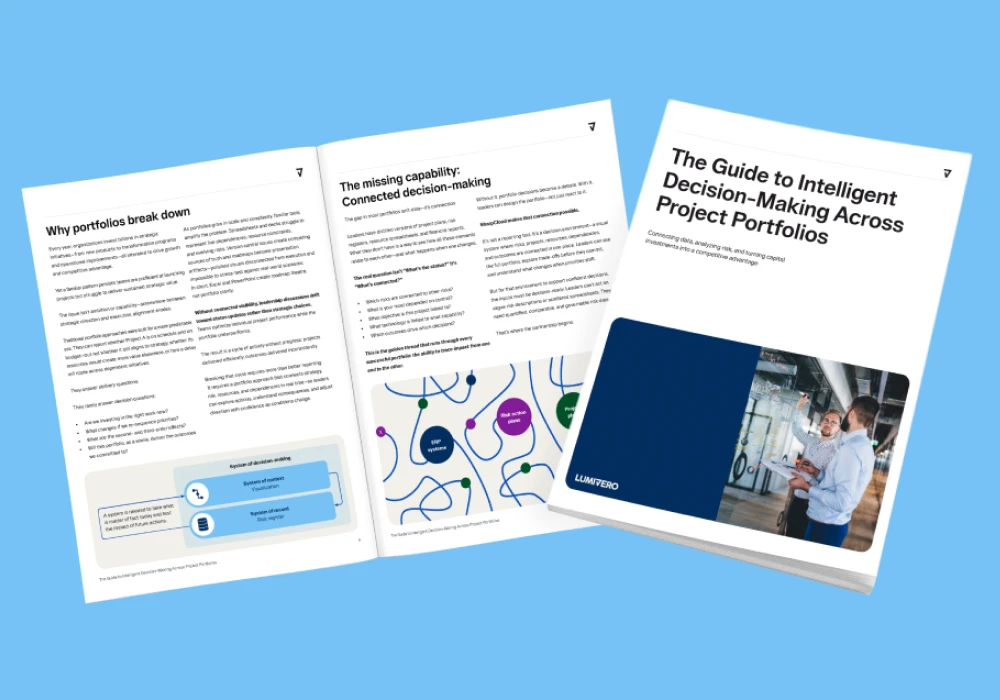
Download the guide: Intelligent Decision-Making Across Project Portfolios
Discover how to connect data, analyze risk, and make smarter project portfolio decisions with greater visibility, aligned priorities, and real-world strategies for complex organizations.
Download eBook →
Quantifying scenarios: Adding probability and risk
Qualitative scenarios tell a story. They don't, on their own, tell you how likely each future is or what it would cost. That's where scenario planning meets quantitative risk analysis.
A handful of named futures can only take you so far—they tell you what could happen, not how likely each one is or what it might cost. @RISK brings Monte Carlo simulation software into Excel, turning "optimistic" or "pessimistic" into an actual probability range: instead of three or four fixed stories, it runs your uncertain variables through thousands of iterations and provides a full distribution of possible outcomes.
Predict! extends this to portfolio and program risk management—pulling simulation results in through its @RISK connector so risk data from individual projects rolls up into live, enterprise-wide dashboards, giving teams visibility into how risk compounds across a whole portfolio.
Together, SharpCloud, @RISK, and Predict! work as one system rather than three separate tools: SharpCloud keeps the scenario connected to the live portfolio, helping you explore decisions and their trade-offs in real time, while @RISK and Predict! put a number on how likely and how costly each one really is—quantified, connected, and ready to act on.
Qualitative vs. quantitative scenario planning
|
|
When it's enough |
When to combine with the other |
|---|---|---|
|
Qualitative scenarios |
Early-stage strategic alignment, workshop-level exploration |
When decisions have real cost or schedule exposure attached |
|
Quantitative modeling |
Decisions with measurable, data-backed variables |
When leadership also needs a narrative to align around, not just a distribution |
Used together, a connected platform and a quantitative model complement each other: one gives you the narrative and the execution view; the other gives you the probability and the cost range behind it.
Common scenario planning mistakes
Mistaking a sensitivity range for scenarios
Sliding one number up and down to get a best case, a base case, and a worst case feels like scenario planning, but it isn't—it's one assumption stretched across three guesses.
Why it happens: it's quick, and it fits neatly in a spreadsheet column.
The fix: build separate futures out of different driver combinations, each with its own name and its own internal logic. Portfolio management software like SharpCloud can help here—instead of eyeballing how one number might move, you can see how a real combination of shifting drivers plays out across your actual portfolio, and how the trade-offs between different decisions ripple downstream. A sensitivity range tells you what happens if one thing changes; a proper scenario, tested this way, tells you what happens to everything else because of it.
Building too many scenarios
Try to account for every possibility and you end up with a pile of near-identical futures nobody can act on.
Why it happens: teams worry about leaving out the "correct" one.
The fix: cap the set at 3–4 sharply contrasted scenarios, and only add another if a genuinely new uncertainty shows up—not just to hedge against being wrong the first time. That's a much easier discipline to hold to inside a connected decision environment like SharpCloud, where the live portfolio data is already there to explore in real time. Revisiting the set costs minutes, not a rebuild, so there's no pressure to over-build it from the start.
Treating it as a one-off offsite
The scenarios get workshopped, presented once, and then quietly forgotten.
Why it happens: nobody owns them once the meeting ends, and nothing prompts anyone to look again.
The fix: assign an owner and a standing review cadence, so the scenarios keep influencing decisions instead of expiring the day the workshop ends. That's easier to sustain in a connected decision environment like SharpCloud, where the scenario lives alongside the live portfolio data it was built from—there's something to check back into, not just a slide deck to dig up.
No signposts or early-warning indicators
A well-built scenario set with no way to tell which future is actually showing up is just an interesting document.
Why it happens: naming leading indicators is the unglamorous last step, and workshops tend to run out of time before they get to it.
The fix: pick 2–3 concrete, observable signals per scenario that someone can watch for. The harder part isn't naming them—it's actually noticing when one shifts and understanding what that means for everything connected to it. That's what a connected decision environment like SharpCloud is built for: because your scenarios sit alongside live portfolio data, a change to one of those signals surfaces automatically, and you can explore what it means for other decisions and initiatives downstream instead of finding out weeks later that the ground already moved.
Scenarios disconnected from execution
This is the one that undoes everything else—the scenarios sit in a deck, the actual portfolio sits somewhere else, and a shift in assumptions never touches the real work.
Why it happens: the planning exercise and the delivery systems live in different tools entirely.
The fix: run scenarios against the live portfolio itself, so a changed assumption visibly re-plans what's actually happening. Without that connection, a scenario reflects whatever the portfolio looked like on the day it was built—not what it looks like now. On a connected platform like SharpCloud, checking a scenario becomes a review of current reality instead of a rebuild from scratch.
Confusing plausibility with probability
Without numbers attached, it's easy to quietly favor the scenario you'd prefer to be true, or to shrug and call them all a toss-up.
Why it happens: qualitative scenarios are stories, and stories don't come with odds attached.
The fix: quantify what you can—probability and cost ranges turn a preference into an informed call. This is where @RISK earns its place in the process: instead of eyeballing which named future feels most likely, Monte Carlo simulation runs your uncertain variables through thousands of iterations to help you see all possible outcomes, and the likelihood they’ll occur.
Scenario planning mistake → fix at a glance
|
Mistake |
Fix |
|---|---|
|
Sensitivity range mistaken for scenarios |
Build distinct futures from combined drivers |
|
Too many scenarios |
Narrow to 3–4 well-contrasted futures |
|
One-off offsite |
Assign an owner and a review cadence |
|
No signposts |
Name 2–3 indicators per scenario |
|
Disconnected from execution |
Model against the live portfolio |
|
Plausibility confused with probability |
Quantify likelihood and cost where possible |
How scenario planning software helps
Scenario planning can be run entirely on paper, but at portfolio scale, a spreadsheet or slide deck becomes the bottleneck fast—every new scenario means rebuilding the model from scratch, and nothing updates automatically when an assumption changes.
When evaluating a scenario planning tool, ask these five questions:
- Does it connect to your live portfolio data? A scenario that sits apart from your real data is a hypothesis, not a realistic test.
- Can you change an assumption and immediately see the downstream impact? If updating a scenario means rebuilding it, teams won't test alternatives often enough.
- Can you compare scenarios side by side? Decision makers need to understand the trade-offs between plausible futures, not review each scenario in isolation.
- Can it quantify uncertainty? The best tools combine narrative scenarios with probabilities, cost ranges, or other measurable impacts to support better decisions.
- Can teams collaborate in one shared environment? Scenario planning should be a shared decision-making process, not a spreadsheet owned by a single analyst.
SharpCloud is built around that first question. Instead of pulling data together from scattered spreadsheets and slide decks each time a scenario needs testing, it connects strategy, projects, and risk in one live model—so the picture you're working from is always current, not a snapshot from whenever it was last assembled.
That connection within SharpCloud is what makes the rest of the list possible. Because everything lives in one place, changing an assumption ripples through automatically, scenarios sit side by side for direct comparison, and the whole team works from the same view instead of reconciling separate files. The conversation shifts from "whose numbers are right" to "what should we do about it."
Request a demo of SharpCloud to learn more.

Nicky Clarke
Freelance B2B technology copywriter
Nicky Clarke is a freelance B2B technology copywriter with more than 11 years' experience creating content for enterprise software companies. Having spent over a decade leading content and communications for SharpCloud, she specializes in project management, risk management, and strategic decision-making—producing blogs, website content, e-books, and thought leadership that make complex concepts accessible, engaging, and relevant for business audiences.
Frequently asked questions
Scenario planning is a way to prepare for several possible futures instead of betting everything on one prediction. You map the biggest uncertainties, build a handful of distinct "what if" futures, and check whether your plan holds up in each.
1. Define the decision and time horizon
2. Identify the critical uncertainties
3. Build 3–4 distinct scenarios
4. Test your strategy and portfolio against each
5. Set signposts to revisit regularly.
Forecasting predicts a single most-likely future; scenario planning prepares for several plausible futures at once. Forecasting optimizes for one outcome; scenario planning builds a plan that's robust across many.
A PMO testing its capital portfolio against funding-delay vs. accelerated-mandate futures, a supply chain modeling a major-disruption scenario, or an organization planning for tighter regulation.
Scenario planning surfaces which risks matter most under each future, then quantitative tools like @RISK for Monte Carlo simulation in Excel and portfolio risk models put probabilities and cost ranges on them, turning narrative scenarios into measurable risk.
Teams use tools that connect scenarios to their live data—visual decision platforms like SharpCloud for portfolio-wide what-if modeling, and quantitative tools like @RISK and Predict! for probability and risk.