










Key takeaways
Real-world evidence (RWE) in health research captures patient experiences outside of controlled trials—giving healthcare researchers a richer, more human picture of how treatments actually work. Qualitative methods like concept elicitation and cognitive interviewing are the foundation of rigorous RWE collection, and tools like NVivo make it possible to analyze that data at scale—with the coding structure, transcription accuracy, and collaborative workflow that regulators and journal publishers require. .
Think about the last time you picked up a prescription from the pharmacy. If you read the information in the package insert, you may have assumed that the data about reported side effects to physical health and other patient outcomes was all drawn from randomized controlled trials. This may not be the case in all health care systems, however. Instead, you may have been reaping the benefits of a form of qualitative healthcare research output known as real-world evidence (RWE).
In the webinar, “Coding the Real World: What Is Real-World Evidence in Health and Why Is NVivo Critical?,” three senior researchers from Cerner Enviza, an Oracle Company, explained why RWE is increasingly critical in drug development and healthcare research. They also described how using coding software for qualitative research like NVivo helps generate robust analyses from unstructured data that communicate insights to research teams, journal publishers, regulators, and commercial stakeholders.
Representing Cerner Enviza were:
- Kathleen Beusterien, MPH – Principal, RWE
- Colleen Welsh-Allen, RN – Qualitative Research Subject Matter Expert in the U.S. for Commercial, RWE, and Regulatory
- Rebecca Nash, PhD – Business Leader, RWE
In this article, we’ll highlight the main discussion points—from their research methods to using NVivo coding software for qualitative data analysis (QDA).
From complex data to clear insights with NVivo
Uncover deeper insights from your qualitative and mixed methods data with NVivo.
Defining real-world evidence and its applications in healthcare research
Qualitative research has always been a central part of scientific research aimed as understanding health systems and what patients actually experience when engaging health services—something that lab tests and imaging can’t fully capture. In healthcare research, this is where real-world evidence comes in: it fills the gap between data from trials in clinical research and the lived reality of patients navigating treatment to ensure patient safety and high standards for medical services from health professionals.
“If you’re like me, a qualitatively trained social scientist,” said Dr. Rebecca Nash, “the term ‘real world’ seems a little bit funny, because isn’t everything the real world?” However, she explained that RWE within the healthcare and pharmaceutical industries simply means any evidence that isn’t gathered within the context of a randomized controlled trial. RWE can also mean any evidence that isn’t generated by a lab test or imaging technique, such as a blood analysis or MRI.
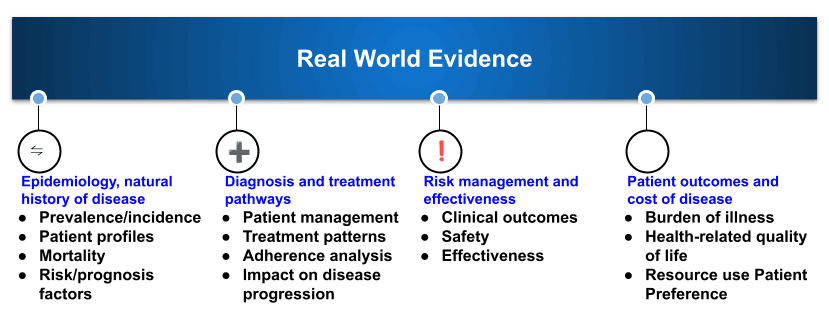
Real world evidence examples in the areas of epidemiology, natural history of disease, diagnosis and treatment pathways, risk management and effectiveness, and patient outcomes, and cost of disease.
Usually, RWE is gathered through qualitative interviews focused on understanding patient preferences or health outcomes—any change in their status following a treatment or procedure. “Rigorous qualitative analysis is so important in bringing forth the voice of the patient,” said Kathleen Beusterien.
Insights drawn from RWE complement randomized controlled trials and help inform drug development at every stage. RWE can influence clinical trial design, regulatory compliance reporting, treatment or diagnosis pathways, and marketing. It also informs the prescription medication inserts that explain side effects which can’t be measured with lab tests like pain, fatigue, or symptoms of depression.
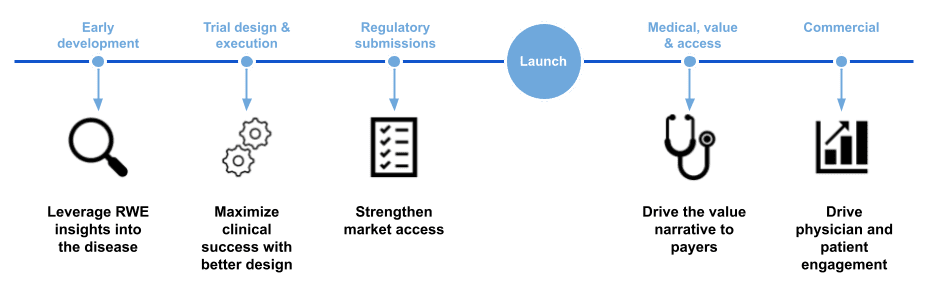
Timeline showing where real world qualitative data and research may happen within the product lifecycle. Phases before the launch include early development, trial design and execution, regulatory submissions and after the launch include medical, value, and access, and commercial.
The Cerner Enviza team presented three examples of how RWE helped researchers understand patient needs and experiences during drug development:
- Interviews with the families of pediatric patients coping with a rare genetic disorder called neurofibromatosis type 1 gave researchers insight into the symptoms that potential therapies could help treat.
- RWE from parents of children with severe allergies helped researchers develop an interactive diagnosis pathway that explained how clinicians can help families move from the chaos of an initial attack to informed self-management of their child’s condition.
- After conducting qualitative research, development teams were better able to understand why diabetes patients preferred the nasal spray form of glucagon—a drug that stops potentially fatal hypoglycemic episodes—rather than the injectable form.
RWE is applied across a wide range of healthcare research areas, including:
- Epidemiology and natural history of disease
- Diagnosis and treatment pathway
- Risk management and clinical effectiveness
- Patient outcomes and burden of illness
- Cost of disease and health-related quality of life
Qualitative analysis methodologies for gathering real-world evidence in healthcare
The Cerner Enviza team explained that while the FDA and other regulators increasingly accept or even require RWE about patient preferences or health outcomes, there are guidelines about how to conduct this kind of qualitative research. There are two main methodologies for capturing RWE in the healthcare or pharmaceutical context.
First, there is concept elicitation (CE). CE involves an open-ended, narrative-style one-to-one interview. “It’s a fancy name for qualitative interview,” said Colleen Welsh-Allen. She went on to explain that these interviews can be conducted over the phone, in person, via an internet video tool such as Zoom, or in an online chat. In addition to yielding insight into patient needs and experiences, CE can also help inform the development of survey questions for quantitative studies.
The second methodology for gathering RWE is a cognitive interview. Cognitive interviewing as a methodology was developed in the 1980s, and is often required by federal agencies as a step in the development of a quantitative survey. In a cognitive interview, “we really are hoping to understand how a subject arrives at their answer,” explained Colleen Welsh-Allen. Researchers will ask patients to answer a question while explaining their reasoning. “We want to make sure that everybody has universal understanding of the intent of the question,” Welsh-Allen clarified.
In summary, here’s how the two primary RWE collection methodologies compare:
- Concept elicitation (CE): Open-ended, narrative-style interviews that surface unprompted patient experiences and inform quantitative survey design.
- Cognitive interviewing: Structured interviews that probe how patients interpret and arrive at their answers—essential for validating the intent and clarity of survey questions.
After conducting qualitative research, it’s time to analyze it. That’s where NVivo comes in.
How NVivo supports qualitative coding in healthcare research
Because healthcare and pharmaceutical research is subject to institutional review boards (IRBs, or research ethics committees), it’s required to have verbatim transcripts for all interviews conducted, to obtain counts, and to carry out rigorous coding of interviews. This may not always be required for qualitative research in other fields, but where necessary, it can be incredibly helpful to employ a qualitative data analysis tool for transcription, data visualization, and to analyze data in large quantities.
While it’s possible to analyze qualitative research in a variety of ways—for example, through discourse analysis or grounded theory methodologies—the Cerner Enviza team uses thematic analysis because it allows for a bottom-up approach that lets patient concerns or experiences emerge from the data.
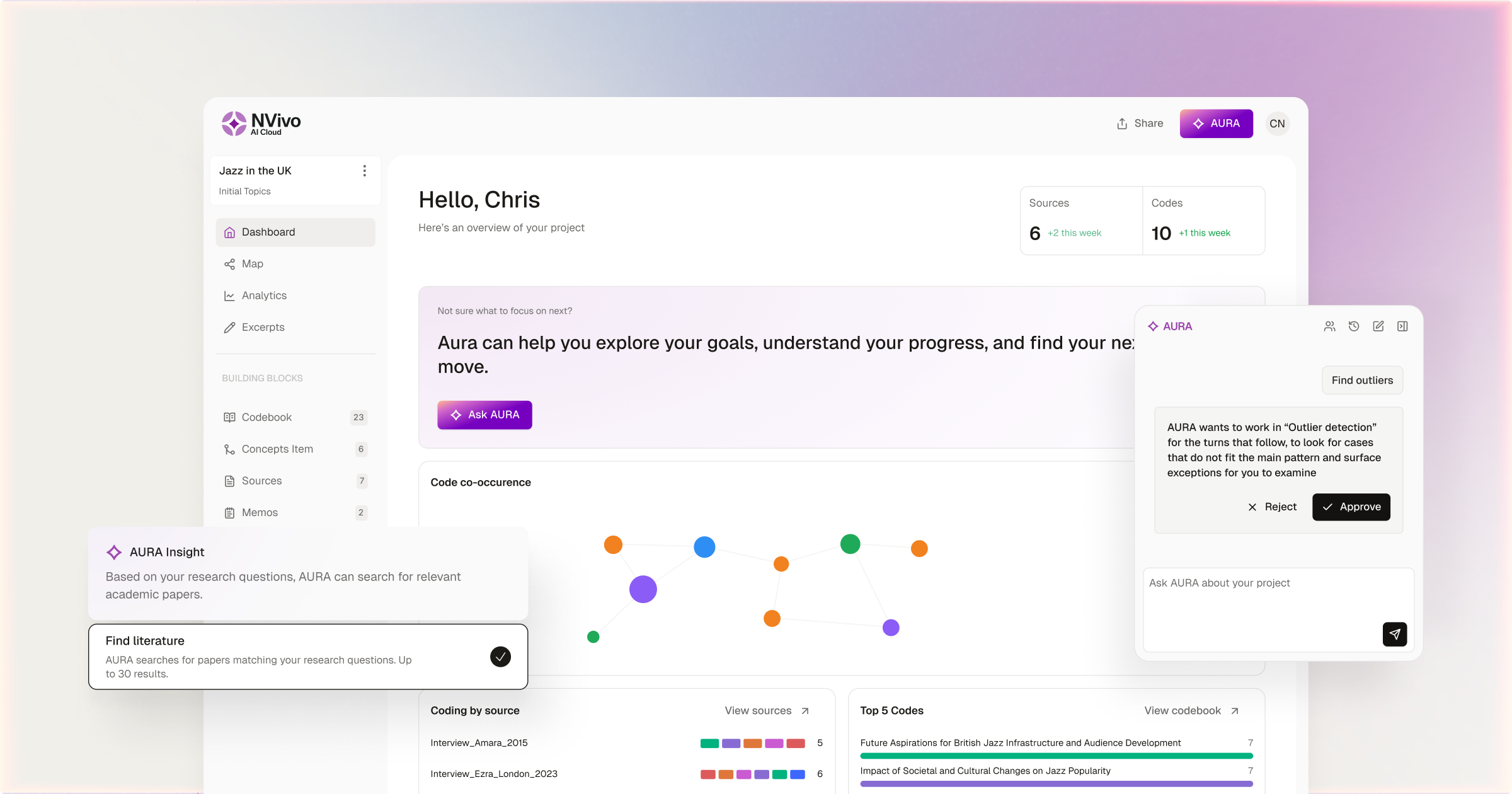
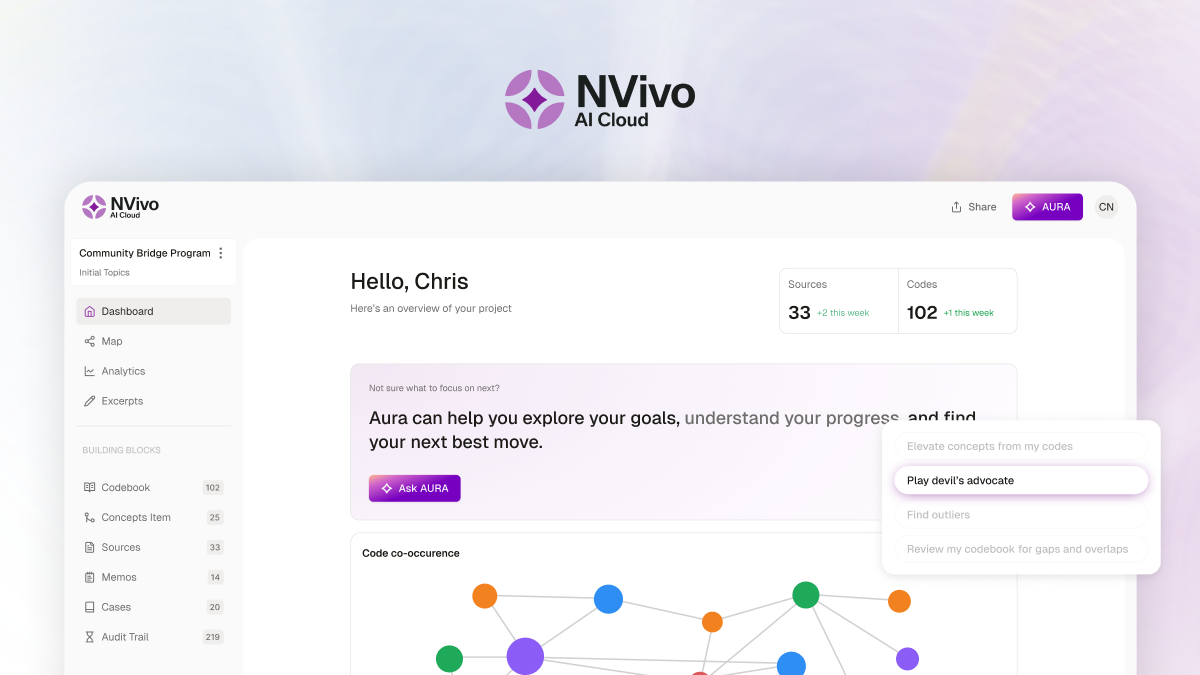
NVivo’s coding features allow for robust thematic analysis and speeds up the coding process with user-driven machine-powered autocoding. This automated tool for qualitative coding of textual data saves valuable time and can reveal patterns that might otherwise have gone unnoticed.
With NVivo, RWE researchers can:
- Tease out repeated patterns and construct themes by analyzing qualitative interview transcripts.
- Indicate whether qualitative data is spontaneous/unaided versus prompted from interviewer questions.
- Generate visualizations such as saturation grids to determine whether follow-up interviews may be necessary.
- Import audio and video files to produce verbatim transcriptions with 90% accuracy using NVivo Transcription.
- Securely share data and collaborate in real time across teams using NVivo Collaboration Cloud.
The Cerner Enviza team was also able to work together efficiently with the help of NVivo Collaboration Cloud. With this tool, they could securely share data and insights to the same project and update, code, and analyze research in real-time.
NVivo’s rigor and adaptability makes it possible for research that includes RWE to meet the standards of medical and academic journals, conference organizers, and regulators. With text analysis, content analysis, and sentiment analysis supported by NVivo, teams can gather RWE that gives patients a voice in the treatments and interventions that can advance healthcare.
It’s also worth noting that RWE qualitative findings often feed directly into quantitative study design—a connection the Cerner Enviza team illustrated through their use of concept elicitation to inform survey development. This kind of mixed-methods integration, where qualitative depth informs quantitative breadth, is increasingly common in healthcare research and is well-supported by NVivo’s ability to work across both data types.
Take your healthcare research further with NVivo
Rigorous qualitative analysis is what gives patients a voice in the treatments and interventions that shape healthcare. NVivo gives you the tools to do that work with the depth, consistency, and defensibility that regulators, journals, and research partners expect. Interested in watching the full Cerner Enviza presentation? Access the webinar recording and handout materials to see NVivo in action—then get started with NVivo today.
FAQs
Qualitative healthcare research generates large volumes of unstructured data—interview transcripts, audio recordings, open-ended responses—that can be time-consuming and difficult to analyze consistently. Researchers also face strict IRB and regulatory requirements for verbatim transcription and rigorous coding, which raise the bar for both accuracy and documentation. When teams are distributed across sites or institutions, maintaining consistency in how data is coded and interpreted adds another layer of complexity. And ultimately, findings need to hold up to scrutiny from journal reviewers and regulatory bodies—making methodological defensibility a core concern from the start.
AI-assisted tools like NVivo’s autocoding feature can help researchers move through large datasets faster—identifying text patterns and word frequencies without requiring a manual, systematic review of every line of text. This is especially valuable in healthcare research, where interview sets can be extensive and coding timelines are often tight. Importantly, AI in this context accelerates the researcher’s work rather than replacing their judgment. Researchers review, refine, and validate what the tool surfaces—keeping human insight and critical thinking at the center of the analysis.
Clinical trials are essential for establishing whether a treatment works under controlled conditions—but they can’t capture everything. RWE fills the gaps by documenting how patients actually experience a treatment in everyday life: the side effects they notice, the preferences they form, and the outcomes that matter most to them. As the Cerner Enviza team explained, RWE can inform clinical trial design, support regulatory submissions, shape diagnosis and treatment pathways, and give context to the patient-facing information included in medication inserts.
Credibility in qualitative healthcare research comes down to rigor and transparency. Regulators and journal reviewers expect verbatim transcripts, documented coding frameworks, and evidence that themes emerged systematically from the data rather than being imposed on it. Thematic analysis—especially when supported by software like NVivo—provides a clear, auditable trail from raw interview data to final findings. NVivo’s ability to track coding decisions, generate visualizations, and support collaborative review makes it easier for research teams to demonstrate the integrity of their process.