Researchers examining how cities plan for flood resilience used NVivo to analyze 49 documents spanning governance, green infrastructure, climate adaptation, and risk management. NVivo helped them organize diverse terminology, compare themes across disciplines, and surface patterns that aren’t visible when reading documents individually. Their analysis revealed how these interconnected factors shape urban flood resilience—and where opportunities exist.
When you're dealing with concepts like flood resilience, you're bound to be analyzing multiple topics and the complex relationships between them. Making sense of it all and presenting it in a clear and accessible way can be a formidable challenge without the right tools.
That's why Mehrafarin Takin, Elizelle Juanee Cilliers, and Sumita Ghosh used NVivo as the analytical backbone of their literature review in their study, “Advancing flood resilience: the nexus between flood risk management, green infrastructure, and resilience.”
Their goal: understand how cities are planning for flood resilience around the world, and where current approaches could improve. In this article, we outline their process and show how NVivo helped them organize, compare, and interpret a diverse body of work.
The research team set out to understand how cities are approaching flood resilience as climate change intensifies flood events worldwide. For this research, thematic analysis using NVivo was used to review 49 documents covering flood risk management, green infrastructure, climate adaptation, and governance. Their goal was to see how these ideas connect in practice and where planning systems still fall short.
Because the documents came from different disciplines and used different terminology, the team needed a consistent way to sort through the material and compare themes. NVivo gave the researchers a consistent structure for sorting through the documents, helping them see how ideas aligned, diverged, and connected across sources.
The researchers started with a broad search across academic and policy sources. They refined the list several times, eventually narrowing it to documents that addressed governance, risk management, resilience, and green infrastructure in a meaningful way. The final set included journal articles, government guidelines, flood reviews, and technical reports.
Working with a dataset this large required an organized structure. NVivo gave the team a practical way to manage the mix of formats and perspectives, especially when different sources described the same idea using different language.
Once the team imported the documents into NVivo, they created a set of codes to reflect the main topics that appeared across the literature. In total, they used 37 codes representing issues such as governance roles, resilience concepts, stormwater practices, and planning frameworks.
Coding qualitative data helped the team move quickly between documents and see how different authors described similar challenges. NVivo acted as the workspace where they could sort, compare, and revisit key ideas as the analysis developed.
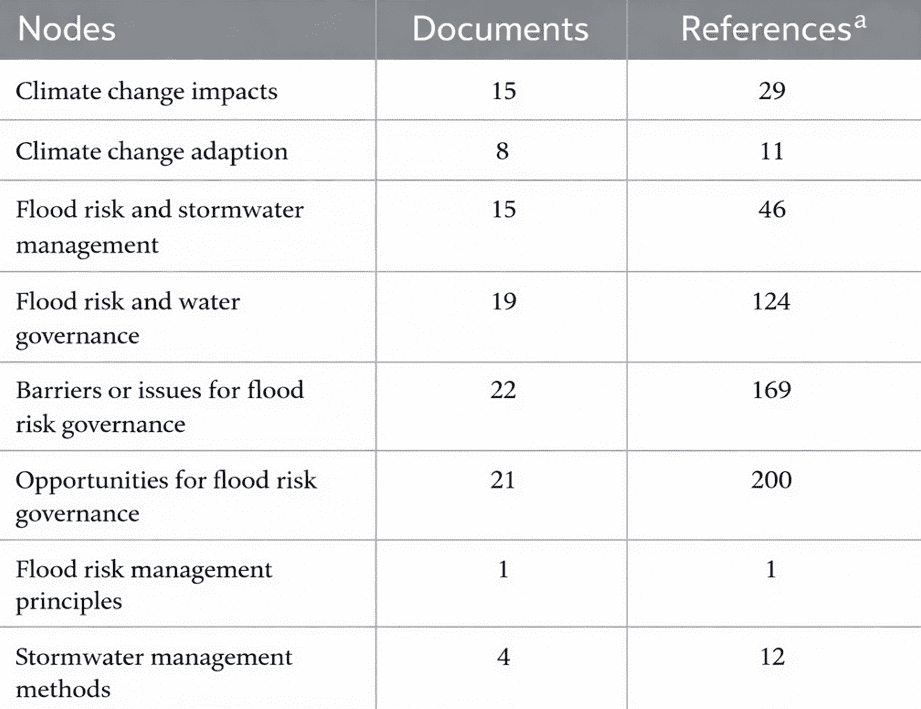
A portion of the research team’s nodes (codes) used to analyze themes across documents. Source: “Advancing flood resilience: the nexus between flood risk management, green infrastructure, and resilience”
With the coding structure in place, NVivo helped the team track how themes were distributed across the dataset.
For example, documents on engineering often focused on structural defenses, while planning documents emphasized adaptation and long-term resilience. Codes related to governance highlighted concerns about overlapping responsibilities, inconsistent policies, and limited coordination.
Because all coded material lived in NVivo, the team could pull up everything related to a specific idea—such as green infrastructure or community resilience—and review it side by side. This made it easier to identify patterns that were hard to see when reading documents individually.
The team also used NVivo’s query tools to support their coding decisions. An analysis of word frequencies helped confirm which topics appeared most consistently across the dataset. Words like “floods,” “risks,” “water,” and “governments” stood out, reinforcing the importance of management strategies and governance structures in the discussions they reviewed.
These queries served as quick checks that their coding aligned with prominent themes in the field and helped them refine the structure of their analysis.
Working through the coded material in NVivo, the team identified three areas that were central to the way the documents approached flood resilience.
Flood risk management. Many sources described a shift from traditional “keep water out” strategies toward more adaptive approaches. Integrated risk management—covering prevention, mitigation, preparation, and recovery—appeared across the documents, often with green infrastructure included as part of the strategy.
Resilience. The documents framed resilience as the ability of systems to absorb shocks and adjust to changing conditions. Some described resilience in engineering terms, while others emphasized ecological or socio-ecological perspectives. The key idea was that cities need to be prepared for disturbance rather than rely on complete protection.
Green infrastructure. Many documents highlighted green infrastructure as a practical way to manage stormwater, reduce flood impacts, and support urban adaptation. Examples included wetlands, green roofs, and water-sensitive urban design. Successful use of green infrastructure depended heavily on coordination, multifunctionality, and engagement with stakeholders.
NVivo helped the team trace how these themes interacted—particularly how governance challenges limited the use of green infrastructure, or how resilience concepts shaped planning recommendations.
NVivo gave the researchers a shared structure for interpreting a large, diverse set of documents. Instead of working through sources independently, they could use the same codes, revisit coded sections, and check how themes appeared across the dataset. Queries also helped them confirm the weight of certain ideas and track patterns that were easy to overlook in isolated readings.
For a topic like flood resilience, where planning, engineering, and environmental perspectives overlap, NVivo helped the team organize the complexity and see how different approaches fit together. It offered a way to stay grounded in the evidence while making sense of a large and varied body of work.
NVivo is one of the most trusted qualitative data analysis platforms for researchers who need to work efficiently, collaborate effectively, and uncover defensible insights from complex datasets. Whether you're conducting a literature review, analyzing interviews, or exploring multi-layered concepts like flood resilience, NVivo helps you bring structure to your data and clarity to your findings.
Explore other ways NVivo has powered real-world breakthroughs in our Behind the Breakthroughs series:
Ready to see how NVivo can elevate your research?
Buy NVivo today.