






Blogs
Explore insights, tips, and industry trends

Case studies
See how organizations achieve real results

eBooks and reports
Access in-depth research and expert analysis

Research
Discover original research and data-driven insights

Webinars
Join live and on-demand sessions with experts

Whitepapers
Access research and expert analysis

Academy
Build skills with structured courses and training

Certified trainers
Get expert training from certified professionals

International partners
Connect with trusted partners around the world

Knowledge center
Find guides, tutorials, and product documentation




Expert guide to managing project interdependencies
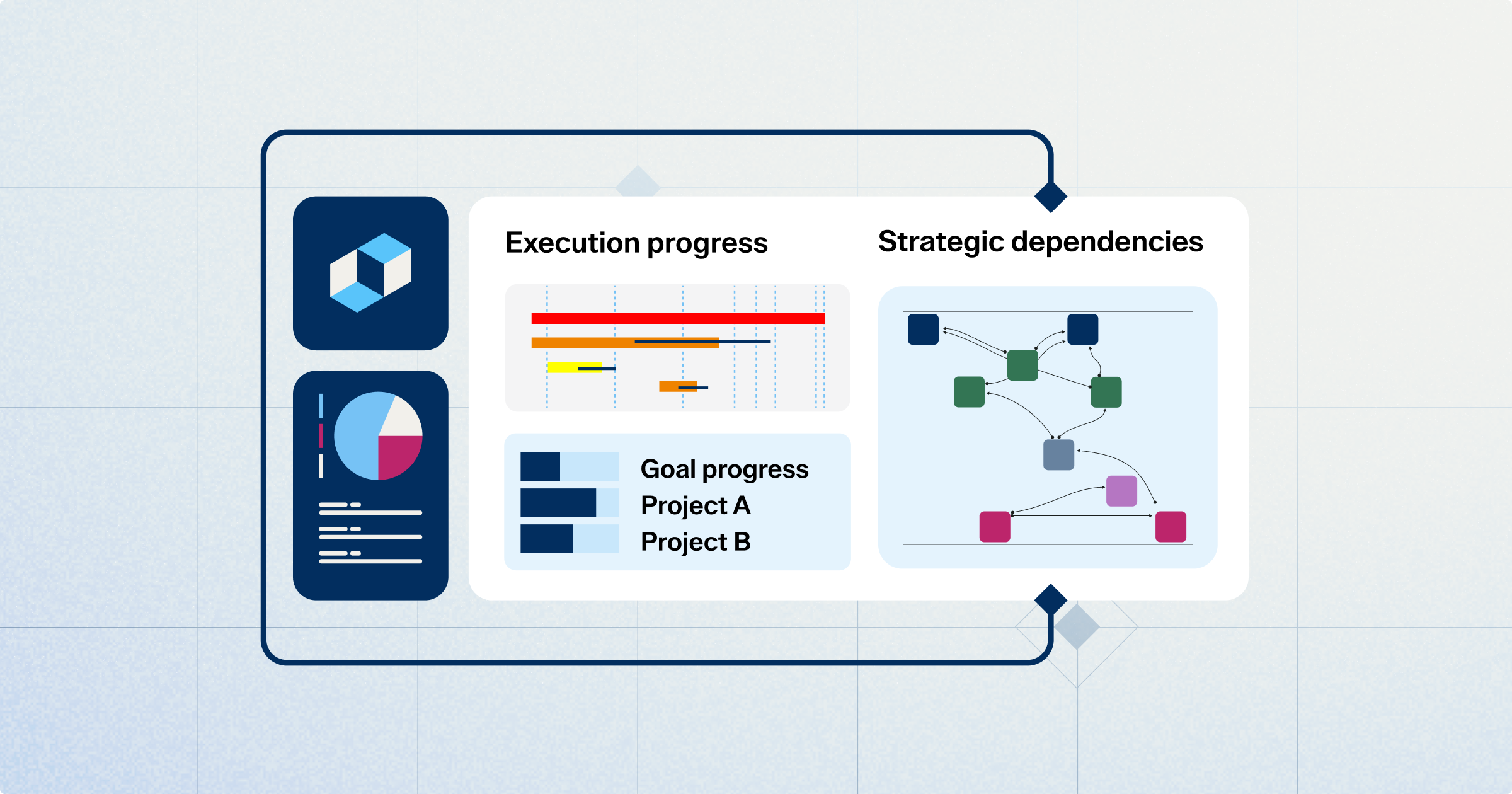
By Nicky Clarke, Technology Copywriter, project portfolio and risk management specialist
Edited by Abigail Jacobsen, Senior Content Marketing Manager, Lumivero
Key takeaways
- Project interdependencies are relationships between projects, programs, or portfolios where changes in one can affect the resources, timelines, or objectives of another.
- Dependencies vs. interdependencies: Dependencies typically exist within a single project, while interdependencies cross project boundaries and connect initiatives across a portfolio.
- Four core types—resource, knowledge/technological, market, and strategic—can create different risks and coordination challenges across projects.
- Mapping interdependencies through tools such as an interdependency matrix, project profiles, and portfolio visualization makes relationships, risks, and dependencies easier to understand and manage.
- The payoff: Making cross-project relationships visible helps turn hidden risk into better coordination, more informed decisions, and strategic advantage.
If you manage capital projects, you already know that projects rarely run in isolation. The interdependencies between projects, programs, and portfolio management create a web of connections that can either accelerate success or amplify failure across entire strategic initiatives. Understanding and managing these relationships has become critical for achieving strategic objectives while maintaining time and budget constraints.
Project interdependencies represent the invisible threads that connect your organization's work, where decisions in one project ripple through multiple others—affecting resource allocation, timelines, and ultimately your business objectives. Managed well, these connections become strategic advantages. Ignored, they become organizational vulnerabilities.
This guide explains what project interdependencies are, how they differ from task-level dependencies, and how to map and manage them across your portfolio.
The State of Capital Project Portfolios: 2027
Explore the 2027 state of capital project portfolios, including portfolio reshuffle drivers, prioritization strategies, visibility challenges, and a five-step framework.
Download eBook →What are project interdependencies?
If you’re wondering “what are interdependencies,” “what does interdependencies mean,” or “what is interdependencies,” the short answer is the same: it’s a relationship that exists between projects, not inside one.
Project interdependencies are relationships between separate projects, programs, or portfolios where a change, delay, or outcome in one affects the resources, timelines, or objectives of another. Unlike task-level dependencies within a single project schedule, interdependencies cross project boundaries, connecting initiatives through shared resources, deliverables, risks, or strategic goals.
Most teams conflate dependencies and interdependencies, but the distinction matters. Dependencies are typically managed within a project schedule, while interdependencies require visibility across projects, programs, and portfolios—that’s the difference between project-level scheduling and thinking about interdependencies in project management at the portfolio level.
At the portfolio level, interdependencies create a complex ecosystem where multiple projects compete for the same skilled resources, deliverables from one project become inputs for others, strategic initiatives depend on coordinated timing across programs, and risk events in one area cascade through connected projects.
The Project Management Institute emphasizes that effective portfolio management requires understanding these connections to optimize resource constraints and achieve strategic objectives across the organization's project work.
Dependencies vs. interdependencies: What's the difference?
A dependency is a relationship between tasks or activities within a project, while an interdependency connects separate projects, programs, or portfolio elements. That distinction—the core of dependency vs interdependency project management—matters because interdependencies can create knock-on effects across resources, timelines, risks and strategic objectives that aren't visible in an individual project schedule.
| Attribute | Dependency | Interdependency |
|---|---|---|
| Scope | Within a single project | Across projects, programs, or portfolio elements |
| Level | Task or activity level | Project, program or portfolio level |
| Direction | Usually a direct relationship between activities | Often many-to-many relationships across initiatives |
| Who manages it | Project managers and project teams | Program, portfolio, and cross-functional teams |
| Tooling | Project scheduling and task management tools | Portfolio management, visualization, and connected-data tools |
| Example | Task B cannot start until Task A is complete | A delay in Project A affects a shared resource needed by Projects B and C |
The difference becomes significant as portfolios grow. A project team can usually manage its own task dependencies within a schedule, but interdependencies require visibility beyond individual project boundaries. A change in one project may affect resources, timelines or deliverables elsewhere—and ultimately alter the value or timing of a wider strategic initiative.
Types of project interdependencies
The most common types are resource, technological / knowledge, market, and strategic interdependencies. Understanding which type you're dealing with determines who needs to be in the room to manage it.
1. Resource interdependencies
Resource interdependencies occur when multiple projects require the same specialized skills, physical facilities, budget allocations, or vendor capacity.
2. Technological/knowledge interdependencies
Technological and knowledge interdependencies emerge when one project's output enables—or blocks—another's, or when learning from one project changes assumptions in another. This covers both technical dependencies (a platform, API, or system one project builds that another relies on) and knowledge dependencies (a discovery or insight in one area that reshapes priorities elsewhere).
3. Market interdependencies
Market interdependencies arise when customer feedback, competitive responses, or market timing create coordinated requirements across projects.
4. Strategic interdependencies
Strategic interdependencies connect projects through shared business objectives, coordinated value delivery, and strategic alignment—this is the type most likely to surface in a portfolio review rather than a project status meeting.
Project interdependencies examples
Resource: A shared DevOps team supports both a mobile-app launch and a data-migration program. When the migration program hits an unexpected technical issue and needs two extra engineers, the mobile launch loses capacity it was counting on—pushing its release date back even though nothing went wrong on the mobile project itself.
Technological / knowledge: A new pricing engine must be delivered before a loyalty-program relaunch can go live, since the loyalty program's discount logic depends on it. At the same time, customer research commissioned for the pricing project uncovers a shift in what customers value, which changes the assumptions the loyalty program's design was built on—so the connection runs in both directions.
Market: Two product projects, run by different teams, both target the same customer segment and are racing to launch in the same Q4 window. Neither team has full visibility into the other's timeline, so a slip in one can hand the other's intended market moment to a competitor instead.
Strategic: A renewable-energy program combines a wind farm, an energy storage project, and a smart-grid upgrade, all of which must land together to deliver the organization's decarbonization target. When a policy change affects funding for the wind farm, the energy storage and smart-grid timelines have to shift too—even though neither project has a resource or technical link to the other.
Why interdependencies matter in projects and programs
The complexity of managing interdependencies between projects, programs, and portfolio management directly correlates with organizational success. Research from the Project Management Institute shows that:
- 72% of projects meet business goals in organizations that prioritize key capabilities like strategic alignment and collaboration.
- Only 28% of projects experience scope creep in these high-performing organizations.
- Organizations with mature practices are 2–3x more likely to achieve high project and benefits realization maturity.
These improvements occur because effective interdependency management transforms reactive problem-solving into proactive opportunity optimization across the project life cycle.
This isn't just a PMI framing. APM's Systems Thinking Interest Group, in its Fusion Point guidance on interdependency management, defines interdependencies specifically as a portfolio and program management concern—distinct from the task-level dependencies a project manager tracks day to day—and treats them as an inherent source of risk precisely because they sit outside any one project manager's direct control.
Two different standards bodies, same conclusion: managing interdependencies is a governance discipline, not a scheduling technique.
What challenges do interdependencies create in project portfolio management?
Left unmanaged, interdependencies compound faster than most teams expect—especially teams used to thinking about projects one at a time rather than managing a portfolio of projects as a connected whole.
Four challenges in managing interdependencies show up consistently:
Amplified risk exposure
When projects are interdependent, risks can cascade across multiple initiatives. A single project delay can trigger problems elsewhere, while traditional project risk management focused on individual projects can miss these portfolio-level vulnerabilities.
Resource allocation complexity
Shared resources become harder to manage as interdependencies multiply. A resource constraint in one project can quickly create bottlenecks across connected projects that traditional scheduling may not reveal.
Communication overhead
Interdependent projects require significantly more coordination. Project teams must maintain awareness of changes across multiple initiatives, increasing information management complexity.
Strategic misalignment
When interdependencies are poorly managed, individual projects may succeed while the overall program fails to achieve strategic objectives.
The business cost of poorly managed project interdependencies
Organizations that fail to manage interdependencies effectively face measurable business impacts—not abstract risk, but delayed revenue, wasted spend, and lost market position.
Delayed strategic value: A financial services company's digital transformation program experienced 18-month delays when interdependencies between customer data migration, system integration, and user training projects were inadequately coordinated. The delayed program cost $12 million in projected revenue and allowed competitors to capture market share.
Resource waste: A manufacturing company discovered three separate automation projects were independently procuring similar equipment from different vendors. Poor interdependency visibility resulted in 40% higher equipment costs and delayed implementation.
Missed market opportunities: A consumer goods company's product launch program failed to coordinate between product development, marketing, and supply chain projects. Despite individual project success, poor timing coordination resulted in competitors launching first, reducing market share by 15%.
Case study: Global defence agency
A global defence agency used SharpCloud to identify interdependencies across its portfolio, helping it to uncover more than £1 billion in missed opportunities, commit £500 million to essential infrastructure, and build a clear rationale for an additional £3 billion in investment over the following two years.
How do you identify interdependencies across projects and programs?
Identifying interdependencies is a five-step, repeatable process—not a one-time audit.
Step 1: Strategic mapping
Map all projects against strategic objectives. Projects contributing to the same business goals likely have interdependencies requiring coordination.
Step 2: Resource analysis
Analyze resource requirements across projects, identifying shared dependencies on critical personnel, budget allocations, facilities, or vendor capacity.
Step 3: Timeline cross-reference
Map project timelines against deliverable dependencies, identifying where outputs from one project become inputs for others. Record these relationships so teams can track dependency points and potential delays.
Step 4: Stakeholder analysis
Examine stakeholder involvement across projects. Stakeholders participating in multiple projects often create informal interdependencies through shared decision-making.
Step 5: Risk assessment
Conduct cross-project risk analysis to identify how problems in one area might cascade through connected initiatives.
The project interdependency matrix explained
A project interdependency matrix is a grid that plots every project in a portfolio against every other project, with each cell showing whether the two projects are connected and, if so, the type and strength of that relationship. It provides a simple visual way to identify cross-project dependencies that might otherwise be difficult to see.
To build one, list every active project on both the rows and columns. Then work through each cell, asking whether the two projects are connected through shared resources, technology or knowledge, market factors, or strategic objectives. Record the relationship type and its strength, such as low, medium, or high, or use a simple 1–3 score.
Worked example (five-project portfolio):
| Project A | Project B | Project C | Project D | Project E | |
|---|---|---|---|---|---|
| Project A | — | Resource (high) | — | Strategic (medium) | — |
| Project B | Resource (high) | — | Technological (medium) | — | — |
| Project C | — | Technological (medium) | — | Resource (low) | Market (high) |
| Project D | Strategic (medium) | — | Resource (low) | — | — |
| Project E | — | — | Market (high) | — | — |
The matrix is most useful when it becomes a living view rather than a one-time exercise. Review it as projects, resources, timelines, and priorities change so teams can spot new dependencies and potential points of failure.
Do you need a matrix template?
If you're looking for a project interdependency mapping template Excel, a simple spreadsheet grid is a reasonable starting point for five or fewer projects. Building the matrix manually can also help teams agree on the relationship categories and strength ratings before introducing more sophisticated tools.
The challenge is scale. A portfolio of 30 projects has 435 possible pairwise relationships, making a manually maintained spreadsheet increasingly difficult to keep current. As dependencies change, an outdated matrix can miss the connections that matter most. For larger portfolios, portfolio management software, like SharpCloud, can make the matrix easier to maintain by connecting it to live project and portfolio data rather than relying on manual updates.
Building a project interdependency profile
A project interdependency profile is a record that captures, for a single project, each other initiative it's linked to—the nature of each link, its direction, who owns it, and how much risk it carries. Where the matrix shows the whole portfolio at a glance, the profile goes deep on one project at a time.
A typical interdependency profile includes:
- Linked projects—every other initiative this project depends on or is depended on by
- Relationship type—resource, technological/knowledge, market, or strategic
- Direction—does this project depend on the other, does the other depend on this one, or is it mutual
- Owner—who is accountable for monitoring and escalating this specific link
- Risk exposure—the likely impact if the link breaks or the connected project slips
The profile and the matrix complement each other: the matrix tells you that two projects are connected and roughly how strongly; the profile tells you why, who's responsible, and what happens if it breaks. A profile is particularly useful for projects with several significant cross-project links.
A profile template doesn't need to be complicated. A one-page document or a single row in a tracking sheet per project, covering the five fields above, is enough to start—the value comes from actually maintaining it, not from the format.
The failure mode is the same one that hits the matrix: profiles built once for a governance review and never revisited become inaccurate the first time a linked project's scope changes. Some teams solve this by generating the profile view directly from the same live data feeding their interdependency matrix, so the two stay in sync automatically instead of being maintained as two separate documents.
SharpCloud supports this approach. It connects to project, financial, and operational data sources and models relationships as many-to-many connections, so you can see a project’s linked initiatives, the type of each link, and the risks attached to them in one visual view. Because that view draws on live data, it stays current as scope, timelines, and dependencies change, rather than going stale in a one-off document.
Interdependency mapping: Methods and tools
Interdependency mapping is the ongoing process of identifying, documenting, and visualizing the connections between projects—it's what turns the relationships captured in a matrix or profile into a living project interdependency map instead of one-off documents.
Interdependency mapping has four steps:
- Identify—surface every project's inputs, outputs, shared resources, and strategic linkages (this is the same groundwork as the identification steps above).
- Map relationships—document each connection in a matrix or a network diagram, capturing type, direction, and strength.
- Visualize—represent the map visually so non-specialists—sponsors, steering committees, resource owners—can understand it at a glance, not just the PMO.
- Monitor—keep the map current as projects progress, scope changes, and new interdependencies emerge.
A spreadsheet—the same matrix template discussed above—can handle steps 1 and 2 for a handful of projects. It struggles at step 3, because a static grid isn't a visualization anyone outside the PMO wants to read, and it becomes increasingly difficult at step 4, because nobody reliably keeps a shared spreadsheet current as five, ten, or thirty projects move in parallel.
This is where dedicated project interdependency mapping tools—SharpCloud among them—become valuable: they keep the map live, connected to real project data, and visual enough for a steering committee to actually use in a meeting.
How to manage project interdependencies: a strategic framework
Managing interdependencies well—or project interdependency management—follows a repeatable, four-phase process for anyone figuring out how to manage dependencies across projects rather than just within one.
Phase 1: Establish governance
Create cross-project coordination structures with authority to make resource allocation and priority decisions across interdependent initiatives. Implement structured communication processes ensuring changes in one project are immediately communicated to all connected initiatives.
Phase 2: Deploy visual management
Use strategic portfolio management providing real-time visibility into interdependencies across the portfolio. Create dynamic interdependency maps showing connections between projects, updating automatically as conditions change.
Phase 3: Implement monitoring
Deploy monitoring systems identifying potential interdependency conflicts before they impact outcomes. Monitor changes to project timelines, resources, deliverables, and risks that could create conflicts or disrupt connected initiatives. Establish procedures for quickly addressing conflicts when they occur.
Phase 4: Optimize continuously
Schedule periodic assessments of interdependency management effectiveness. Use historical data to identify patterns, prioritize projects, and optimize resource allocation based on empirical evidence.
What tools help manage interdependencies between projects and programs?
The best tools for managing interdependencies between projects and programs go beyond single-project scheduling, providing many-to-many relationship modeling, cross-project visibility, scenario analysis, risk context, and live data connections.
Traditional project management tools
Standard project management software handles individual project dependencies effectively but struggles with cross-project interdependencies. Gantt charts and task management systems provide limited visibility into resource conflicts across multiple projects, relationships between initiatives, or program-level strategic alignment. They can be useful for managing dependencies within a small number of projects, but become harder to use when relationships span departments, programs, and the wider portfolio.
Specialized portfolio management solutions
Spreadsheet trackers and single-project scheduling tools can get a small portfolio through the identification stage, but they weren’t built to model many-to-many relationships or stay current as a portfolio scales. And governance-first tools provide strong oversight and controls, but they may not offer the project-level relationship modeling and visual portfolio views needed to see how dependencies propagate across initiatives.
Modern project portfolio management software closes those gaps through integrated resource management, cross-project timeline visualization, real-time collaboration, and advanced analytics for identifying interdependency patterns.
SharpCloud is PPM software that tracks dependencies across multiple projects, providing a visual way to understand relationships, risks, and potential impacts across a portfolio. It can help teams move beyond spreadsheet-based tracking by connecting project and portfolio information in a shared, interactive visual environment—built for exploring complex project interdependencies.
How to evaluate interdependency management tools
When comparing tools for managing portfolio interdependencies, look for:
- Many-to-many relationship modeling—the ability to represent one project connected to several others, not just linear task chains
- Cross-project visibility—a single view spanning the whole portfolio, not per-project dashboards stitched together manually
- Scenario / what-if modeling—the ability to test how a delay or change in one project would propagate before it happens
- Risk overlay—interdependency risk shown alongside the map itself, not in a separate risk register
- Live data connectors—pulling from existing project, financial, and operational systems, so the map reflects reality rather than a manually-updated copy
These capabilities become particularly important when managing cross-departmental project dependencies, where changes in one initiative can affect resources, timelines, risks, or outcomes elsewhere in the portfolio.
How project portfolio management software visualizes interdependencies
Effective PPM software transforms complex interdependency relationships into understandable visual representations:
Multi-dimensional views
Advanced platforms provide layered visualizations showing interdependencies at different organizational levels—from task dependencies within projects to strategic connections across portfolios.
Dynamic network diagrams
Interactive network visualizations show projects as nodes connected by interdependency relationships. Changes in one project immediately highlight potential impacts across connected initiatives.
Resource heat maps
Visual representations of resource allocation help identify bottlenecks and conflicts before they impact timelines. Color-coded displays show utilization intensity and highlight areas requiring attention.
See our roundup of the best project portfolio management tools for how different platforms approach this.
How SharpCloud supports interdependency mapping and risk management
SharpCloud brings connected data and relationships together in visual views that help teams understand complex interdependencies across projects, programs, resources, risks, and strategic objectives. This supports many-to-many relationships, connected risk visibility, and portfolio views that can be explored by both technical and non-technical stakeholders.
Many-to-many relationship modeling and universal data integration
SharpCloud connects with virtually any data source, bringing information from project management systems, financial platforms, and operational databases into unified portfolio views. It can model relationships between projects, programs, resources, risks, and other portfolio elements as many-to-many connections rather than forcing complex dependencies into linear task chains.
Live network diagrams
SharpCloud can turn complex interdependency data into interactive network diagrams that stakeholders can explore. Users can focus on specific relationships, time periods, or areas of the portfolio, making it easier to see how connected elements relate and where changes could create knock-on effects.
Risk overlay and predictive modeling
Risk information can be connected to the wider portfolio, allowing teams to see risks alongside projects, dependencies, and other connected factors rather than in a separate register. SharpCloud can also support scenario modeling, helping teams explore the effects of proposed changes before making decisions. Where configured, risk relationships can be represented through bow-tie visualizations to show causes, consequences, and controls.
Visualizing trajectory, not just status
Where milestone and other time-based data is configured in SharpCloud, teams can create views that show how projects and programs are progressing over time. Combined with the wider network of relationships, these views can help decision-makers explore where a project may be heading and what other areas could be affected if conditions change.
Real-time collaboration
Multiple stakeholders can explore connected portfolio information together, supporting collaborative decisions around resources, priorities, risks and dependencies. Changes to shared information are immediately visible to all, helping teams work from a common picture when coordinating interdependent projects and programs.
AI-assisted analysis with POLI
POLI, the SharpCloud intelligent agent, builds on that scenario modeling by working inside your connected portfolio model. Ask in plain language how a delay or funding cut would ripple across connected projects, or compare a revised plan against the approved one to find conflicts and dependencies before you commit. POLI also surfaces at-risk projects and summarizes findings so you can see what’s driving exposure. . Every answer is grounded in your live, governed data and shows how it was produced. POLI can’t exceed your own permissions, every change requires your approval, and no customer data ever trains a model.
Case study: TD-Info
Discover how TD-Info used SharpCloud to give people from different companies, sectors, and seniority levels across the MoD and UK industry one shared “big picture” of its assets and projects, so resources went to the initiatives that mattered most to mission success.
Learn more →From interdependency risk to strategic advantage
The interdependencies between projects and programs represent either your organization's greatest vulnerability or its most powerful strategic advantage—the difference lies entirely in how deliberately you manage them.
Organizations that treat interdependencies as an afterthought experience cascading failures, resource conflicts, and strategic misalignment. Organizations that treat interdependency management as a core portfolio discipline—not a side effect of good project management—turn those same relationships into coordination advantages that accelerate value delivery and strengthen competitive positioning.
Turning interdependency management into a competitive advantage takes three capabilities working together:
- Collaboration skills that cross project boundaries
Communication, resource sharing, and systems thinking that extends beyond any one project's team. - Establishing portfolio maturity
Governance structures that span multiple projects and decision-making processes that explicitly account for interdependency impact, not just individual project status. - The right technology
A platform that gives portfolio-level visibility, integrates live data, and visualizes relationships in a way people outside the PMO can actually use.
Done well, interdependency management pays off in faster strategy execution, more efficient use of resources, and less risk exposure across the portfolio.
Request a demo to see how SharpCloud can help you visualize project interdependencies, connect risk to the wider portfolio, and make better-informed decisions.

Nicky Clarke
Freelance B2B technology copywriter
Nicky Clarke is a freelance B2B technology copywriter with more than 11 years' experience creating content for enterprise software companies. Having spent over a decade leading content and communications for SharpCloud, she specializes in project management, risk management, and strategic decision-making—producing blogs, website content, e-books, and thought leadership that make complex concepts accessible, engaging, and relevant for business audiences.
Frequently asked questions
Interdependencies are relationships between separate projects, programs, or portfolios where a change in one affects the resources, timelines, or objectives of another. Unlike dependencies, which sit inside a single project schedule, interdependencies cross project boundaries.
A dependency is a relationship within a single project—one task can't start until another finishes. An interdependency is a relationship between separate projects, programs, or portfolios that share resources, timelines, or objectives. Dependencies are managed by the project manager in a schedule; interdependencies are managed at the program or portfolio level.
The most common types are resource (shared people, budget, or assets), technological / knowledge (one project's output or discovery affects another), market (initiatives competing for the same customers or window), and strategic (projects tied to the same business objective).
A grid that plots every project against every other, with each cell marking whether—and how strongly—the two are connected. It turns invisible cross-project relationships into a single visual so teams can spot conflicts and cascading risk before they hit delivery.
A record that captures, for a given project, every other initiative it's linked to—the nature of each link, its direction, the owner, and the risk exposure. It complements the matrix by adding depth to each connection.
Identify each project's inputs and outputs, document where they connect to other projects, plot those links in a matrix or network diagram, then monitor them continuously as plans change. Portfolio management software keeps the map live instead of letting it go stale in a spreadsheet.
Because a delay or change in one project ripples through every project connected to it. Unmanaged interdependencies are a leading source of portfolio-level schedule slip, resource conflict, and missed strategic outcomes.
Portfolio management platforms that model many-to-many relationships, visualize them as live network diagrams, and overlay risk—such as SharpCloud—go beyond spreadsheet trackers and single-project scheduling tools by keeping the full cross-project picture current and interactive.
When two projects depend on the same resource or output and their plans collide, one slips to accommodate the other—and that slip cascades to every downstream project connected to it, compounding across the portfolio.


How can we help you? Contact us.