






Blogs
Explore insights, tips, and industry trends

Case studies
See how organizations achieve real results

eBooks and reports
Access in-depth research and expert analysis

Research
Discover original research and data-driven insights

Webinars
Join live and on-demand sessions with experts

Whitepapers
Access research and expert analysis

Academy
Build skills with structured courses and training

Certified trainers
Get expert training from certified professionals

International partners
Connect with trusted partners around the world

Knowledge center
Find guides, tutorials, and product documentation




The importance of strategic alignment and how to achieve it
Key takeaways
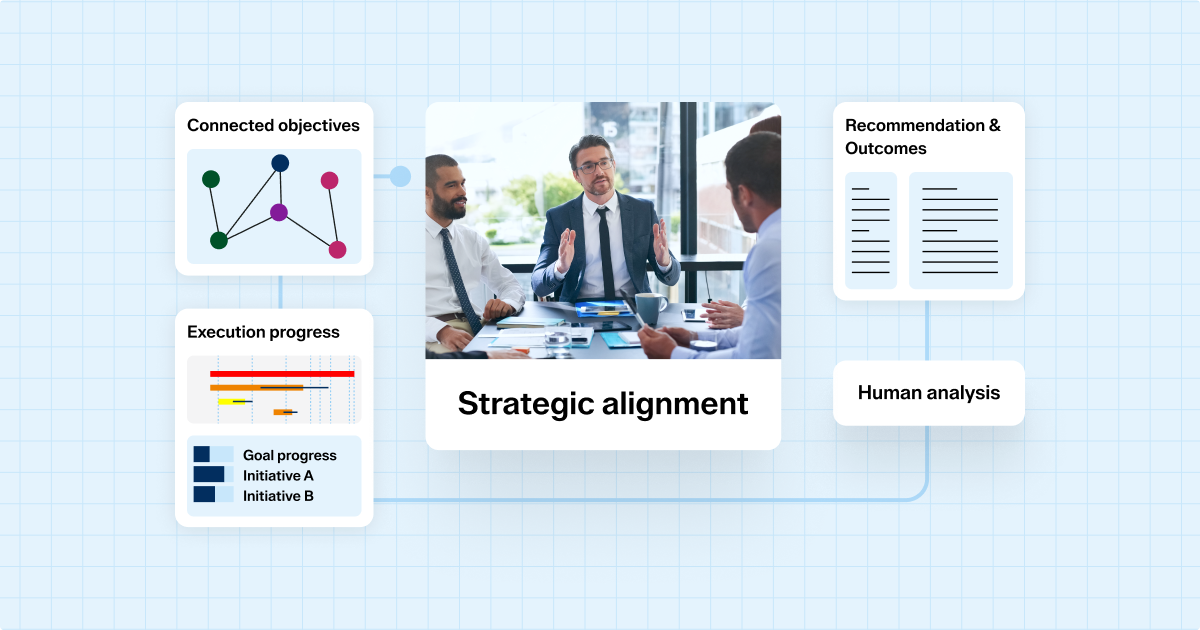
Strategy only works when the whole organization is aligned. Clear goals must translate into coordinated action across teams, resources, and initiatives. Silos, unclear communication, and disconnected initiatives prevent organizations from turning strategy into results. Leaders need shared tools, clear communication, and real-time insight to keep teams focused on the same strategic outcomes.
In the wise words of Stephen Covey, “Most leaders would agree they’d be better off having an average strategy with superb execution, then a superb strategy with poor execution.”
Probably the most important driver for successful strategy implementation is 'strategic alignment’—the systematic process of bringing the actions of each business unit and employee into line with the organization’s strategic objectives. The challenge is to make them all work together towards a common goal, thereby improving the overall performance of the company.
So why is strategy execution so difficult? Is it process, people, systems? Who or what is responsible for the lack of strategic goal attainment?
What is a business strategy?
A business strategy by definition is the starting point for corporate behavior—it's the foundation for transformational change. It expresses an organization’s ambitions, sets out its chosen direction, and describes the principal initiatives and projects necessary to achieve its mission.
Any strategy has little value until implemented. Enter strategic alignment.
Download “The Guide to Intelligent Decision-Making Across Project Portfolios”
Discover how top organizations align teams and stakeholders around shared portfolio insights—and make high-stakes decisions with confidence.
What is strategic alignment?
Forbes says, “There is no universal or one-size-fits-all prescription for a winning business. But corporate leaders today seem to agree that strategic alignment is high on the list.”
According to Wikipedia, "strategic alignment is a process that ensures an organization's structure, use of resources, and culture, supports its strategy."
Another definition: Strategic alignment is the process of aligning an organization’s decisions and actions such that they support the achievement of strategic goals.
This connected line between strategy, decisions, projects, and outcomes is often described as the golden thread in business.
There’s a lot to navigate in today’s world, but it should become clear that strategically aligned organizations have a better chance of long-term success in today’s challenging business environment. Strategy, organizational capabilities, and architecture must be in sync.
Why does strategic alignment matter?
According to CGI’s Voice of Our Clients research, 91% of organizations have a digital strategy, yet only 25% are realizing the expected results.
Strategic alignment is one of the key differences between organizations that perform well and those that don’t. High-performing organizations are often the most aligned, engaged, prepared, and change-ready.
- Strategic planning plus implementation excellence equals strategic alignment, which can positively influence your organizational alignment.
For a business to successfully execute its strategy, it needs to align with both senior management and the rest of the organization to shape a winning culture. This coupled with the need for a solution that helps define, communicate, and control the execution of a business strategy around 'value-creation' and helps overcome common challenges when delivering on a Business Plan.
- Strategic alignment matters because it is very strongly linked to improved business results.
According to the 2018 Pulse of the Profession®, a global survey conducted by Project Management Institute (PMI), organizations around the world waste roughly $2 trillion dollars a year due to the ineffective implementation of business strategy.
The study goes on to say “Executives often fail to recognize that effective project and program management is what delivers on strategy. More than one in three organizations report not having strong alignment of initiatives and projects that directly deliver against strategy. This indicates the need for C-Suite executives to better recognize the full potential of project management to execute strategy, and to ensure they are leveraging the right programs to directly deliver against strategy.”
Why is aligning strategy important for a business?
- Achieve organizational unity - strategic alignment can help improve collaboration within an organization. When all members of an organization work collaboratively toward a common goal, efficiency, productivity and consistency may improve.
- Effectively use resources - employees are more likely to optimize their resources and focus their efforts accordingly if they understand the practices and priorities that contribute to the fulfillment of company goals.
- More accurate reporting - regular status updates and progress reports on employees' contributions toward company goals can help businesses make educated decisions about their practices and make changes as necessary.
- Improve planning - understanding company goals is critical when creating organization-wide plans because it allows decision-makers to focus on steps, practices and short-term deliverables that contribute to long-term success and fulfillment of organizational goals.
- Making adjustments - adaptability is an important aspect of successful businesses because it allows them to respond to changes in the market and among their target audience without compromising productivity or efficiency, improving agility.
Why do so few enterprises manage to achieve strategy alignment?
- Inconsistent messages about the transformation at hand
If strategy is to be delivered successfully by an organization, it must be clearly articulated and communicated throughout the business. In other words, the strategy must be widely understood at all management levels so that operational plans and day-to-day activities are aligned with corporate goals and objectives.
- Failure to co-ordinate across units in the organization
Organizational architecture is important to understand and get right because efforts to communicate strategy and create interconnections, support, and momentum won’t reach their potential in a mismatched organizational structure.
- Reliance on the traditional approaches such as meetings or roadshows
Organizations must learn to better leverage IT for working digitally and autonomously. Having everyone working together to co-create meaningful content and solutions can be more effective for your business. Collaborating with others helps push beyond the obvious and create unique solutions, at the speed of now. Teams are connected using lean visualization tools.
- Culture, resistance to change
Many organizations have excessively complex structures with too many layers complicating business, and a culture that is characterized by fear of failure and resistance to change. In order to get the best from agile and deliver the full benefits, an agile culture, influenced by leadership, is needed across the organization.
How to achieve strategic alignment
Aligning business units and employees with the organization's strategy is not a one-time deal but an ongoing process that requires constant leadership, communication, and monitoring.
The approach to strategy, operating model and systems change has pivoted from a predict and plan approach to a continuous and joined up approach of sensing and
responding. Business agility across all three dimensions has now become a critical capability to provide competitive advantage.

1. Align and unite your leadership team
In today’s world, a leader needs to be able to think both conceptually with a bird’s-eye view across the whole organization, and practically with the ability to make progress a reality.
Lack of strategic alignment often starts at the top and can negatively impact leaders at all levels getting “on board", particularly in larger siloed organizations where individual business groups have their own agendas, often working toward their self-interest rather than toward company-wide strategic priorities.
Culture is significantly influenced by the leadership, so this means management needs a comprehensive plan for managing the expectations of the business, easing resistance to change, encouraging motivation, and promoting the skills and behavior required for agile.
2. Develop and communicate your strategy
The fundamental purpose of strategic planning is to align a company’s mission with its vision - the strategic plan is the roadmap that helps you navigate from one to another. Effective communication lies at the heart of strategic alignment. It pretty much goes without saying that staff members can only implement a new strategy successfully if they are able to understand it and accept it.
With many teams working remotely, it's harder for executives to engage with each other, and deliver a cohesive strategic vision for achieving long-term business goals, so enabling better collaboration is crucial.
The digitally enhanced and richly connected world we live in today creates new challenges and opportunities for designing effective collaboration and communication for this way of working.
3. Inspire commitment
Employee participation is one of the most effective ways to create strategic alignment. Employees should be involved both in strategy development and in decisions on how to implement the strategy in practice.
The best collaboration tools allow you to share your work easily but also securely, and encourage co-creation among team members, suggestions, and real-time feedback. No matter where you’re working, everyone in the business can strategically plan and strive towards a single destination, ensuring 'buy-in'.
Individual performance goals should always be linked to the strategic goals of the organization. This way, employees are encouraged to constantly make a personal contribution to the achievement of corporate goals.
4. Don't set and forget
Inevitably things change along the way. You can and should revisit your strategic plan to make sure key initiatives and goals remain valid, and if any strategy or tactic opposes your organization’s values, then it should be reconsidered.
Regular evaluation reduces the implementation risk and makes it easier to stop non-profitable projects before they incur huge losses. The flexibility to revise and re-prioritize projects at an early stage is essential. Dashboards reflect the current performance status at a glance, and, therefore, are very suitable for making quick tactical decisions.
5. See the big picture
Silo thinking is one of the greatest stumbling blocks for strategic alignment. Free flow of real-time information both horizontally between teams and departments and vertically from top management all the way to front line employees and vice versa is key. Outdated spreadsheets, documents and slide decks, and constant searching for the latest information will only limit alignment between departments.
Information on changes in the external business environment that could affect the organization's strategy needs to be passed on quickly too. Strategy software can help facilitate efficient communication within the organization.
6. Use a strategic alignment model
Agile delivery approaches have introduced new ways to visualize work progress, providing teams and decision makers with new insights, encouraging transparency and collaboration, and ultimately alignment.
The Strategic Alignment Platform CGI provides a one stop shop for your Transformation Management. The power is in seeing and understanding the connections, managing complexity, and creating more achievable plans focused on realizing shared value.
The Strategic Alignment Platform
CGI's solution, powered by SharpCloud, helps organizations adopt a sense and respond approach, connecting the dots between drivers of change, stakeholders, strategies, objectives, operating model, product/service, execution and shared value.
Connecting the dots and improving alignment increases the probability of realizing shared value and becoming a sustainable business. Creating an agile process that can adapt quickly to continuous change while optimizing their operations is key to achieving balance. Balance is continual, and it is achieved by always taking a holistic
approach to enterprise decisions—across their value chain.
Accelerating the discovery process
Using pre-populated models (like STEEP), assessments, canvases, we can quickly understand the organizations' external and internal context. The Platform brings structure and improves the depth and quality of analysis
Assessing business agility, strengths and gaps
CGI’s Business Agility Maturity Assessment has been built uniquely for today’s complex organizations operating in a dynamic world. The Platform manages the design, distribution, collection, and analysis of the Maturity Assessment.
Visualizing connections and managing complexity
The Platform visualizes the Strategy, Operating Model, and Execution elements across the enterprise. It helps visualize relationships, which is critical to assessing change impact, that continue to arise as the enterprise evolves.
Focusing on a shared value
We use the Five Capitals model to identify shared value and build value hypothesis. This helps align the stakeholders on the potential and guide early prioritization. Wardley Maps help to facilitate decision making on the most appropriate strategy and approach to achieve the desired outcomes.
Improving transparency and decision-making
The Platform allows you to design and customize Kanban Boards to align with your organization’s stagegate processes and stakeholder needs.
Visualizing progress and tracking value realization
The Platform provides a number of visualizations that can be customized to meet the reporting and tracking needs of the organization.
A company of the future is one that understands the changing dynamics between the company, its employees and customers and can deal with constant change by creating flexible, agile and decentralized environments that can execute autonomously, yet are working to achieve a shared, clear vision.
If done correctly, strategic alignment is a business investment that can positively influence organizational alignment; improving efficiency, effectiveness, and profitability. By aligning strategy to execution, The Strategic Alignment Platform will help organizations to take their business to the next level.
- Align goals, teams and data to get a complete view of the business – use your big picture to identify risks and opportunities.
- Empower and align your teams with increased visibility of priorities and accountability for delivery.
- Spend less time on rework – create and connect data sets and information once, use it over and over again.
-
- Escape from slide decks and complex spreadsheet discussions.
- Stop searching for information – standards for capturing information ensures trust; dynamic data means everyone is on the same page.
- Make better data-driven decisions with increased visibility and understanding of implications.
- Improve alignment through joint decision-making based on accurate information.
- Get instant visibility across all areas of the business with real-time customizable dashboards and reports.
Connecting risk, decisions, and strategy in one workflow
Strategic alignment doesn’t happen through planning alone—it requires a connected system that links risk, resources, and decisions in real time. Many organizations struggle not because they lack data, but because that data lives in silos—making it difficult to see how everything connects when it matters most.
This is where Lumivero’s decision solutions—@RISK, Predict!, and SharpCloud—work together to create a continuous, connected decision-making process.
From uncertainty to decision-ready insight
Each solution plays a distinct role in turning complexity into clarity:
- @RISK quantifies uncertainty using Monte Carlo simulation—replacing single-point estimates with probability distributions so teams can understand likelihoods and confidence levels, not just averages
- Predict! operationalizes that analysis by standardizing risk data, connecting it to portfolio objectives, and enabling enterprise-wide governance and reporting
- SharpCloud brings everything together in a shared, visual decision environment—connecting risks, projects, resources, and strategic priorities so leaders can explore trade-offs and understand impact before committing
Together, they create a connected decision engine—one where risk is not just analyzed, but actively used to guide strategic choices. This is a practical example of decision intelligence applications in business, where risk and strategy data are brought together to inform consequential choices.
How this supports true strategic alignment
When these tools are connected, organizations can move beyond fragmented reporting and toward coordinated execution:
- Align decisions to strategy by linking every initiative, risk, and dependency back to business objectives
- Evaluate trade-offs with full context—understanding downstream impacts before resources are committed
- Create a shared view across teams so decisions are made with the same data, not competing versions of it
- Continuously adapt as new data emerges, rather than relying on static plans or outdated reports
This approach enables leaders to trace the full path from risk to outcomes—connecting controls, resources, dependencies, and decisions in one continuous view.
In practice, that means faster alignment, clearer prioritization, and more confident decisions across the organization.
Align strategy and execution with Lumivero
Strategy only delivers results when the entire organization is aligned. Lumivero’s risk and decision solutions help you connect goals, teams, and initiatives in one shared environment—breaking down silos, improving communication, and providing real-time insight so everyone stays focused on the same strategic outcomes.
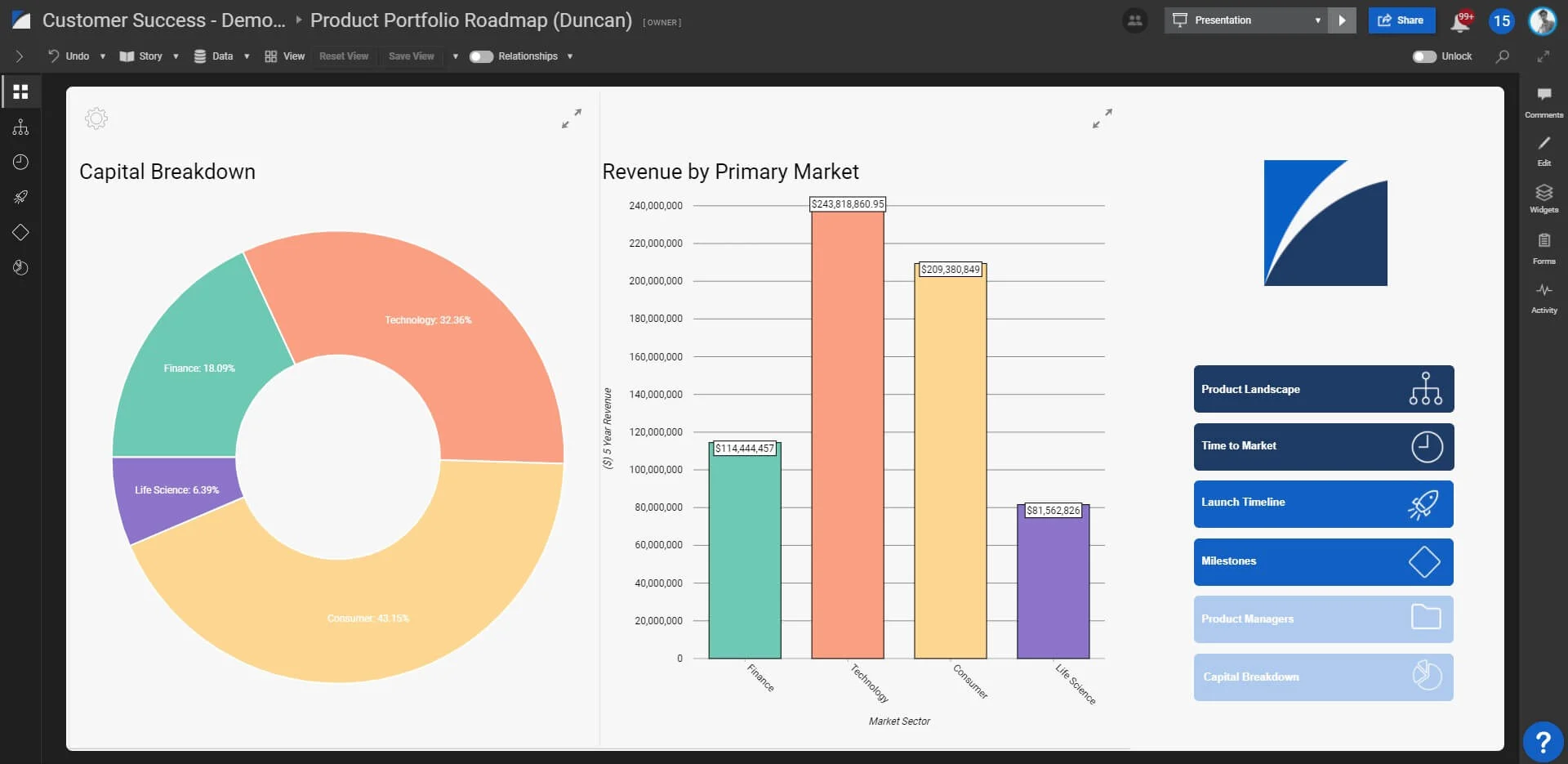
However, unless these dashboards are easy to interpret and drill down to extract the correct takeaways that influence business decisions, analysts must explain them via written reports, phone meetings or video walkthroughs. One step forward and two back.
And that's assuming you have a team of data experts on hand who can decipher massive data sets and then turn these key insights into understandable reports on command.
It's time to take the guesswork out of decisions
Q: So how exactly do we close the gap between the skills and data understanding of the expert analyst and the pressed-for-time, strategy-focused executive?
A: By empowering your organization with the right technology that helps uncover, convey and deliver insights to all areas of your business for better decision making.
The right tool will
- connect ideas to actions and strategy
- filter out the noise and highlight the important data
- help the audience to understand how one decision connects to or impacts others
- translate the complex into simple, concise action steps for non-data experts and stakeholders
- encourage and facilitate knowledge sharing, collaboration and more transparent channels of communication
- enable a shared understanding of strategic decisions
With access to the tools you need to automate and scale insight throughout the enterprise, the delay in knowledge sharing and data understanding will be eliminated...as will the decision waste. No more silos, duplicated work, wasted time or frustration.
See the big picture
From launching or retiring the wrong product, to failing to connect information across departmental silos, to pursuing disconnected strategies that delay growth or increase risk—these decisions can make or break organizations.
Our audience-centric software helps decision-makers in enterprise organizations see every interrelationship and make agile, informed decisions using consolidated, real-time data pulled from point solutions across the business.
Start making more informed decisions—explore SharpCloud or request a demo today.

How can we help you? Contact us.