










Key takeaways
MAXQDA and NVivo are two of the most widely used qualitative data analysis platforms, and the right one depends on how you work. NVivo is the trusted choice for structured, rigorous, mixed-methods research that needs to stand up to peer review — and the most-cited QDA software in published research, with built-in statistical analysis, researcher-controlled AI, and flexible, governable deployment. MAXQDA is a capable qualitative data analysis tool with AI integrations. If you're also weighing ATLAS.ti, we compare all three near the end so you can see the full landscape before deciding.
Qualitative data analysis (QDA) software is essential for researchers making sense of large volumes of unstructured data. From interviews and focus groups to survey responses, social media, and multimedia files, the right tool helps you organize, code, and interpret information to surface the patterns and insights that matter.
The days of coding everything by hand are behind us. The best QDA software streamlines the mechanical work so you can focus on drawing meaningful conclusions instead of wrestling with repetitive tasks. Whether you're running an in-depth case study or analyzing trends across hundreds of documents, the platform you choose can be the difference between chaos and clarity.
The challenge is choosing. Coding tools, visualization, collaboration, data compatibility, AI, and pricing all factor into the decision—and two names come up again and again: NVivo and MAXQDA. This guide compares them side by side across the factors that matter most, then takes a quick look at how a third popular option, ATLAS.ti, fits into the picture.
How to choose the right QDA software
Qualitative researchers have more software options than ever, which makes the decision worth getting right. A few factors matter more than the rest:
A workflow that matches how you think
The best tool is the one that fits your methodology rather than fighting it—whether you need predefined structure and consistent coding, or a more open, exploratory approach.
Advanced data handling
Qualitative research now spans text, audio, video, images, surveys, and social media. A strong platform handles diverse formats and gives you robust ways to organize, categorize, and retrieve large datasets without losing the thread.
Efficient—and trustworthy—coding tools
Qualitative coding is the backbone of analysis. You want intuitive manual coding and AI assistance that speeds up the early, repetitive work—without taking interpretation out of your hands or obscuring how findings were reached.
Depth of analysis and methodological rigor
For academic, healthcare, policy, and funded research, it's not enough to find themes—you need to explain and defend how you got there. Advanced queries, framework analysis, coding comparison, and a clear audit trail separate a tool you can publish with from one you can only explore in.
Collaboration and governance
Consider not just whether a tool supports collaboration, but how it's deployed. Real-time cloud collaboration suits distributed teams; on-premise or server deployment matters for institutions with strict data-residency or governance requirements.
Support, training, and ecosystem
The best platforms back you with documentation, training, certification, and responsive support—and connect to the other tools in your research workflow, from literature review to statistical analysis.
MAXQDA vs. NVivo at a glance
| Software | NVivo | MAXQDA |
|---|---|---|
| Best for | Researchers working on rigorous or complex qualitative, mixed-methods, or multi-source projects, from individual studies to institution-wide research programs | Researchers needing qualitative and mixed-methods workspace with built-in options for visualization and statistical analysis |
| Academic credibility | Widely cited and recognized across the global research community | Strong presence in European universities and research institutions |
| Depth of analysis | Advanced queries, Framework Matrices, inter-coder reliability testing, visualizations, and flexible analytical workflows | Supports qualitative analysis through visual mapping, document comparison, and coding workflows |
| AI-assisted analysis | AI Assistant supports document summaries, coded content summaries, Framework Matrix summaries, sentiment analysis, and child code suggestions. Outputs remain connected to source material, codes, and memos, supporting transparent, traceable analysis. | AI Assist supports document and code summaries, AI coding, AI chat, and report generation. Includes a broader set of AI-driven automation capabilities. |
| Collaboration | Supports real-time collaboration through either Collaboration Cloud or Collaboration Server (on-premise). Flexible deployment options help organizations meet governance, security, and data residency requirements. | TeamCloud supports shared team workflows, with project updates synchronized through the cloud. No on-premise deployment option. |
| Quantitative and mixed methods | Built-in: descriptive statistics, Crosstab Queries, Matrix Coding Queries, coding frequencies, PCA, box plots, survey analysis. Plus XLSTAT integration via the Lumivero ecosystem for advanced statistics. | Statistical analysis available via separate MAXQDA Analytics Pro add-on |
| Multimedia and data sources | Text, audio, video, images, PDFs, surveys, social media (NCapture), bibliographic data (Citavi, EndNote, Zotero, Mendeley, RefWorks), SurveyMonkey, Qualtrics | Text, audio, video, images, PDFs, surveys |
| Free trial | 14-day free trial with full features | 14-day free trial |
| Training and certification | Free Learning Hub included with subscription, featuring courses on fundamentals, querying, visualizations, and teamwork. Optional certification programs and a global network of certified trainers support ongoing skill development. | Courses and certification programs available through MAXQDA Academy and purchased separately. |
| Research ecosystem | Part of the Lumivero research ecosystem, connecting literature review (Citavi), qualitative analysis (NVivo), and advanced statistical analysis (XLSTAT). | Standalone QDA tool |
Feature comparison: NVivo, ATLAS.ti & MAXQDA
Coding and analytical depth
All three tools let you tag, annotate, and organize qualitative data with precision. The difference is in how far the analysis can go.
NVivo is built for depth and rigor. Its structured coding supports hierarchical organization, and its advanced query tools—matrix coding and cross-case comparison—let you interrogate the same dataset from multiple methodological angles. Framework Matrices, a defining NVivo feature, organize coded data into a case-by-theme grid so you can move cleanly from coding to cross-case synthesis. Combined with intercoder agreement tools, this makes NVivo especially strong for large, multi-coder, or formal research projects where consistency and a defensible audit trail matter.
ATLAS.ti takes a more flexible, iterative approach. It’s strong network visualization and concept mapping support connecting ideas and identifying relationships. Minimal setup means you can start coding almost immediately—well suited to exploratory and early-stage research where the structure emerges as you go.
MAXQDA emphasizes manual and systemic coding, giving researchers structured tools to categorize text-based data methodically.
Data management and data types
NVivo, ATLAS.ti, and MAXQDA all handle the core qualitative data types—text, PDFs, audio, video, images, and survey data—so you can consolidate sources in one place. NVivo and ATLAS.ti extend this further: NVivo with stronger survey, mixed methods, and structured-data integration, and ATLAS.ti with document grouping, filtering, visualization, and export-based analysis workflows.
Visualization and mapping
Visualization turns analysis into something you can present and defend. NVivo offers a broad set of structured visuals—matrix coding, cluster analysis, charts, models, and concept maps—that make patterns and comparisons clear.
ATLAS.ti's standout is network visualization: dedicated tools for mapping the relationships between codes, quotations, documents, and concepts as connected nodes, which is excellent for exploratory analysis.
MAXQDA also offers visualization options such as document comparison charts and word frequency analyses. These visualization tools allow researchers to identify relationships, trends, and themes within their data intuitively.
Collaboration
Collaborative research needs tools that work across locations and roles. NVivo offers the most deployment flexibility of the three: real-time collaboration via Collaboration Cloud, on-premise Collaboration Server for institutions with strict governance or data-residency requirements, and manual project sharing and merging. That governance and deployment flexibility is a genuine differentiator for government, healthcare, and enterprise research.
ATLAS.ti builds real-time collaboration directly into ATLAS.ti Web, with automatic syncing and shared project access, plus desktop project merging—a clean, low-setup model for distributed teams.
MAXQDA includes some collaborative features, such as shared team workspaces, but they lack the dynamic and integrated nature of NVivo’s collaboration tools. For research teams, particularly those working on large or distributed projects, NVivo offers a clear advantage.
AI capabilities
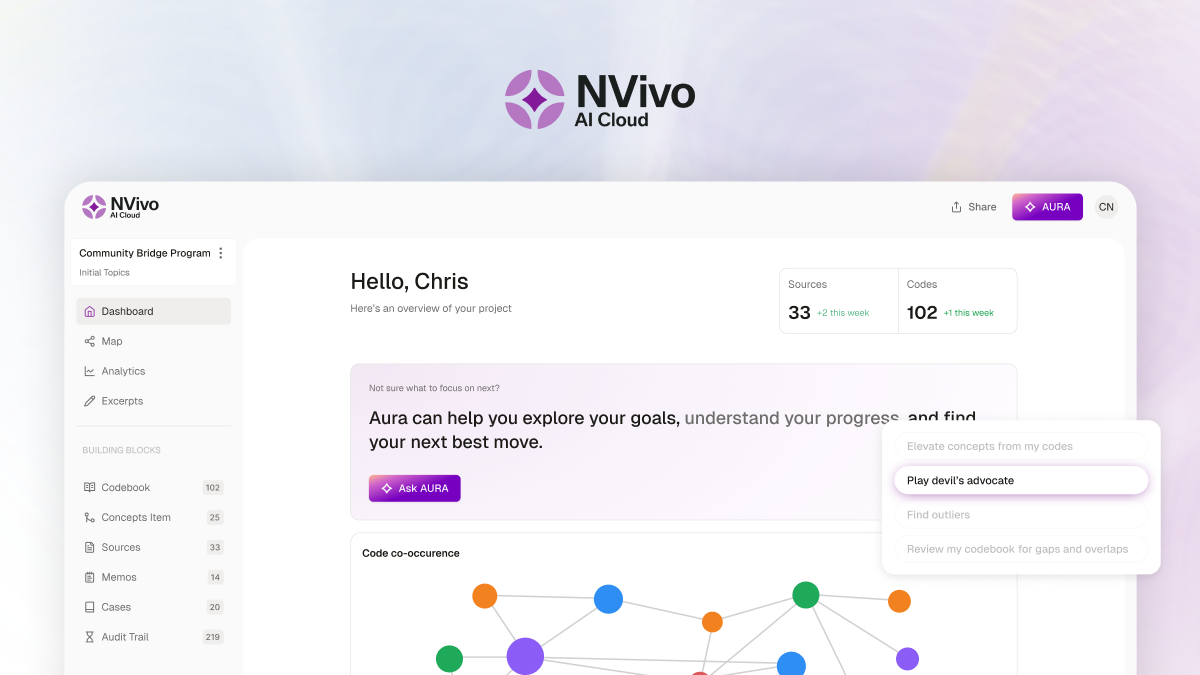
This is where philosophy matters as much as feature count. NVivo's AI is researcher-controlled by design. The AI Assistant offers task-based actions—document and coded-content summaries, child-code suggestions, and sentiment analysis—and keeps every output connected to your source material, codes, and memos so you can trace findings back to the evidence. AI can be disabled at the user or organizational level, which supports teams working under strict IRB, ethics, or data-privacy requirements. The goal is to accelerate the early, repetitive work while keeping you responsible for interpretation and final analytical decisions.
ATLAS.ti takes a more conversational approach, with AI built into the platform (web and desktop): chat-based interaction with your data, AI-assisted coding, and document and group summaries. Like NVivo, its AI can be governed and disabled at the organizational level. This allows you to work more broadly, summarize across documents, ask questions, query your documents, suggest codes and more.
Both NVivo and ATLAS.ti take different approaches to AI that suit different research styles. If transparency, traceability, and organizational governance of AI are priorities, NVivo's structured, task-based AI Assistant is built for that. If conversational, prompt-based exploration of your data is a better fit for your workflow, ATLAS.ti's included AI is a strong fit.
MAXQDA's AI Assist supports document and code summaries, AI coding suggestions, AI chat, and report generation.
Mixed methods and statistics
For researchers combining qualitative and quantitative work, NVivo does the most inside a single environment. You can import surveys, assign case classifications and attributes, and quantify coded data—then go further with built-in descriptive statistics, Crosstab Queries, Principal Component Analysis (PCA), and box plots, all without leaving NVivo or buying a separate module. When you need more, NVivo connects to XLSTAT in the Lumivero ecosystem and exports cleanly to SPSS, R, and SAS.
ATLAS.ti supports mixed methods more lightly—code frequencies, code-document tables, and relative-frequency comparisons—and relies on export to external tools for deeper statistical analysis. MAXQDA offers native statistical analysis through Analytics Pro, available as an additional purchase.
Platform and deployment
NVivo is desktop-first (Windows and Mac) with flexible deployment—local, cloud, or on-premise server—which gives institutions real control over where data lives. ATLAS.ti offers a browser-based web app in addition to its desktop application—lowering setup requirements and supporting cloud collaboration out of the box, though the web version is lighter in functionality than the desktop. MAXQDA runs on Windows and Mac.
Pricing and licensing
ATLAS.ti generally has a lower entry price and a low-cost, monthly web-only option, which makes it accessible for individual researchers and students getting started quickly. NVivo uses a modular model—subscription or perpetual license, with add-ons such as the AI Assistant, transcription, and collaboration—alongside named and concurrent licensing for larger organizations. MAXQDA is positioned as a budget-friendly option with flexible licensing.
The right way to think about cost is total value for your research: entry price matters, but so does what's included, how the tool scales with your team, and whether it supports the depth your work requires.
Support, training, and ecosystem
NVivo is backed by the NVivo Learning Hub (now included at no extra cost), certification pathways, and a global trainer network—plus the broader Lumivero ecosystem, including Citavi for literature review and reference management and XLSTAT for statistical analysis. That means NVivo supports more of the end-to-end research lifecycle than a standalone QDA tool. ATLAS.ti benefits from the same Lumivero portfolio backing. MAXQDA provides its own documentation and support resources.
The payoff of learning NVivo well is real: once your project structure is set up, its querying and organizational tools make complex, large-scale projects far easier to manage than manual methods allow. While getting there can take some upfront effort, but most researchers find it's worth the investment. If you want support along the way, the Lumivero Community and expert webinars connect you with other researchers and hands-on training.
Which QDA tool is right for you?
Consider NVivo if you need:
- Structured, systematic analysis with a defensible audit trail
- Cross-case comparison, Framework Matrices, and advanced queries
- Mixed methods and built-in statistical analysis in one environment
- Flexible deployment—cloud, on-premise, or local—for governance or data-residency needs
- A tool whose credibility is recognized by reviewers, funders, and institutions
- Training, certification, and a connected research ecosystem
NVivo also scales down comfortably: you don't need a large team or a formal setup to get value from it. Many projects start by simply importing documents and coding, then building structure over time.
Consider ATLAS.ti if you need:
- Flexible, exploratory, iterative analysis
- Strong network visualization and concept mapping to connect ideas
- A browser-based experience and built-in cloud collaboration
- Conversational, prompt-based AI included in the platform
- Minimal upfront setup—ideal for UX, early-stage, and smaller-team research
Because both NVivo and ATLAS.ti are part of the Lumivero portfolio, you can choose the workflow that fits your research style with confidence that you're backed by the same research-focused team.
Where MAXQDA fits
MAXQDA is a capable, established platform for qualitative and mixed-methods analysis, with native statistical tooling available through a paid Analytics Pro add on. For researchers who want methodological depth, governance and deployment flexibility, researcher-controlled AI, and a connected research ecosystem, NVivo consistently offers the stronger long-term fit—which is why it remains the most-cited QDA software in published research.
Why researchers trust NVivo
NVivo stands out as a comprehensive, versatile, and rigorous qualitative data analysis solution. As the most-cited QDA and mixed-methods software in Scopus-indexed research, it carries something no feature list can: recognition and trust across the research community. When findings need to withstand peer review, publication, grant reporting, or stakeholder scrutiny, that track record becomes a meaningful advantage.
Beyond credibility, NVivo's strength is the depth and transparency of analysis it supports—advanced queries, Framework Matrices, coding comparison, and multiple ways to interrogate and synthesize the same dataset, all with a clear audit trail. Add researcher-controlled AI, flexible and governable deployment, built-in mixed-methods and statistical capabilities, the NVivo Learning Hub, and a research ecosystem that spans literature review to statistical analysis, and NVivo delivers the functionality to handle even the most complex qualitative research projects.
NVivo's development hasn't stopped, either—recent releases continue to add AI-powered features and usability improvements that keep it at the cutting edge of QDA software.
Ready to see which QDA tool fits your research?
Explore the full Lumivero research portfolio, including NVivo and ATLAS.ti, or buy your QDA software today.