









Key takeaways
NVivo AI Cloud supports researchers across every career stage by grounding AI in research methodology, maintaining transparent audit trails, and enabling deeper insights without sacrificing rigor. Whether you're defending a dissertation, delivering a policy recommendation, or managing a multi-year funded study, the platform keeps your findings defensible and your role as researcher firmly in the lead.
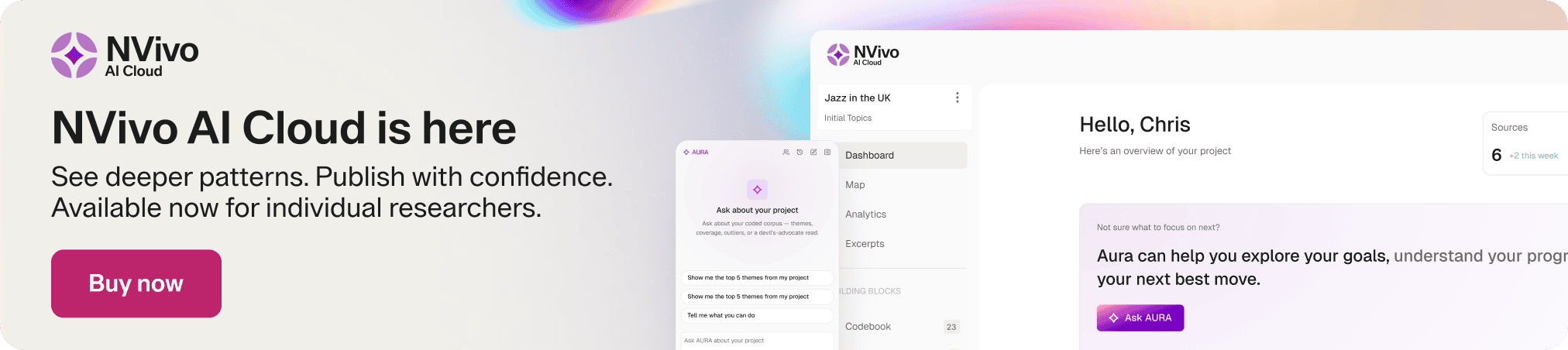
Qualitative research looks different than it did a decade ago. Teams are bigger, data pools are wider, timelines are tighter—and through all of it, one challenge hasn't moved: how do you defend a finding once you've made it?
Previously, that meant stitching together a patchwork of tools—ChatGPT for ideation, Google Scholar for literature, Citavi for references, NVivo for coding, Excel for quantitative analysis, Word for writing—plus ad hoc AI use with no methodology behind it and no audit trail to show for it. The friction wasn't just wasted time. It was an indefensible finding.
NVivo AI Cloud closes that gap. At its center is AURA, our AI-powered Unified Research Assistant, that helps you set up your study, code and query your data, and get grounded answers. It doesn't just help you move faster—it helps you see deeper patterns and publish work you can defend. NVivo AI Cloud delivers on that promise through three pillars:
- Methodology first — AI grounded in your research design, not bolted on after
- Deeper insights — patterns and connections surfaced across your data, not just summarized
- Publish with confidence — a transparent audit trail behind every action, ready to defend
To see how those pillars hold up under real conditions, meet three researchers working in the same environment—NVivo AI Cloud—at three different career stages: a PhD candidate defending her first dissertation, a program evaluator working under deadline, and a tenured principal investigator managing a multi-year, multi-institution study.
NVivo AI Cloud for PhD candidates: Methodology first
Priya is a second-year PhD candidate in sociology. Her research proposal just cleared her defense. She's ready to start her first wave of interviews—and terrified of the moment months from now when her dissertation committee will ask her to defend every research decision she made.
Her challenge: a blank project feels paralyzing when your degree depends on proving you did it right.
NVivo AI Cloud guides her from the start. The Project Pipeline walks her through structured setup: describing her research, naming her questions, choosing her methodology. AI suggests initial research questions based on her description; she accepts, edits, or discards each one. When she imports transcripts, AURA auto-identifies variables—gender, role, location, academic status—and she confirms or refines each suggestion. When Priya starts coding, the choice is hers: she can work through AURA's coding suggestions, accepting, editing, or rejecting each one, or code the data herself. For a PhD candidate, developing and demonstrating those analytic skills is part of the work, and both paths keep her judgment at the center of the analysis.
Months later, her committee asks: "Why did you code this excerpt this way?" She opens the audit trail. Every action—hers or AURA's—is logged with a timestamp. She can show the exact prompt AURA used, what it asked, and what it returned. She used AI's help, but every research question and every decision is hers to defend.
The takeaway: With NVivo AI Cloud, Priya's research had rigorous footing from day one. The decisions Priya defends at her viva are her own.
NVivo AI Cloud for policy researchers: Deeper insights
Jordan is a program evaluator at a state health department running his first fully independent evaluation. His team spent six weeks interviewing across a dozen counties about a public health program. Now he has eight weeks to turn that data into a defensible policy recommendation—the same methodological rigor as an academic study, compressed onto a timeline that academic research rarely allows.
His challenge: breadth and depth under deadline. The hopeful finding is exactly the one he has to pressure-test hardest.
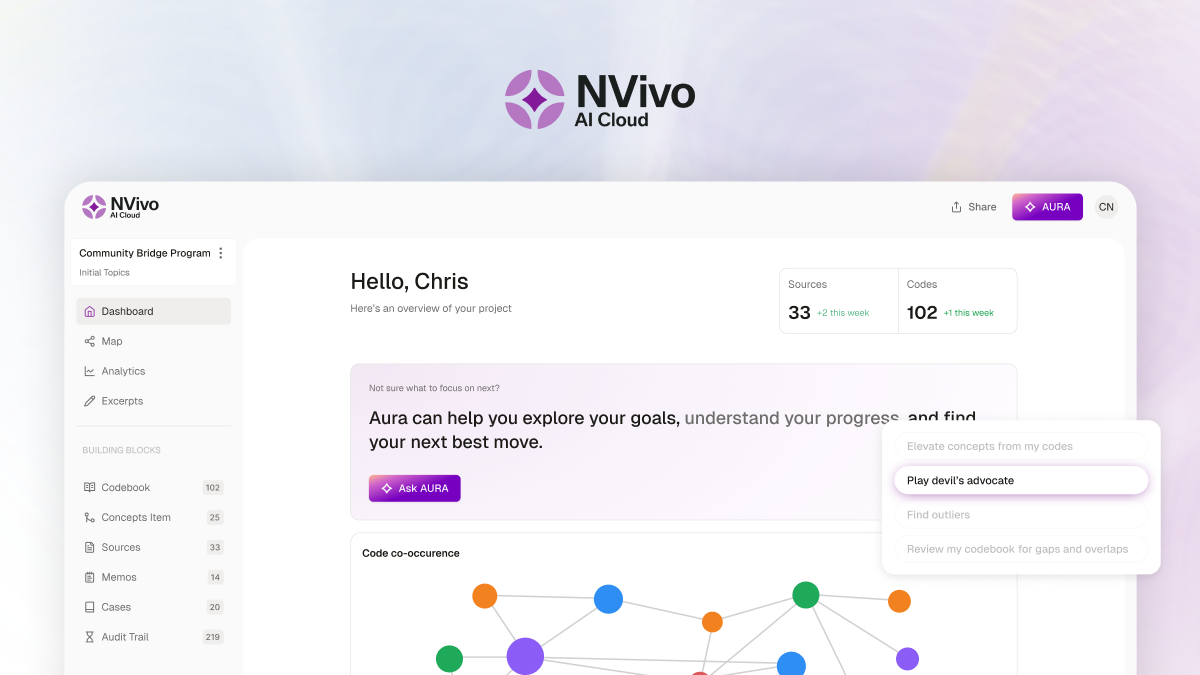
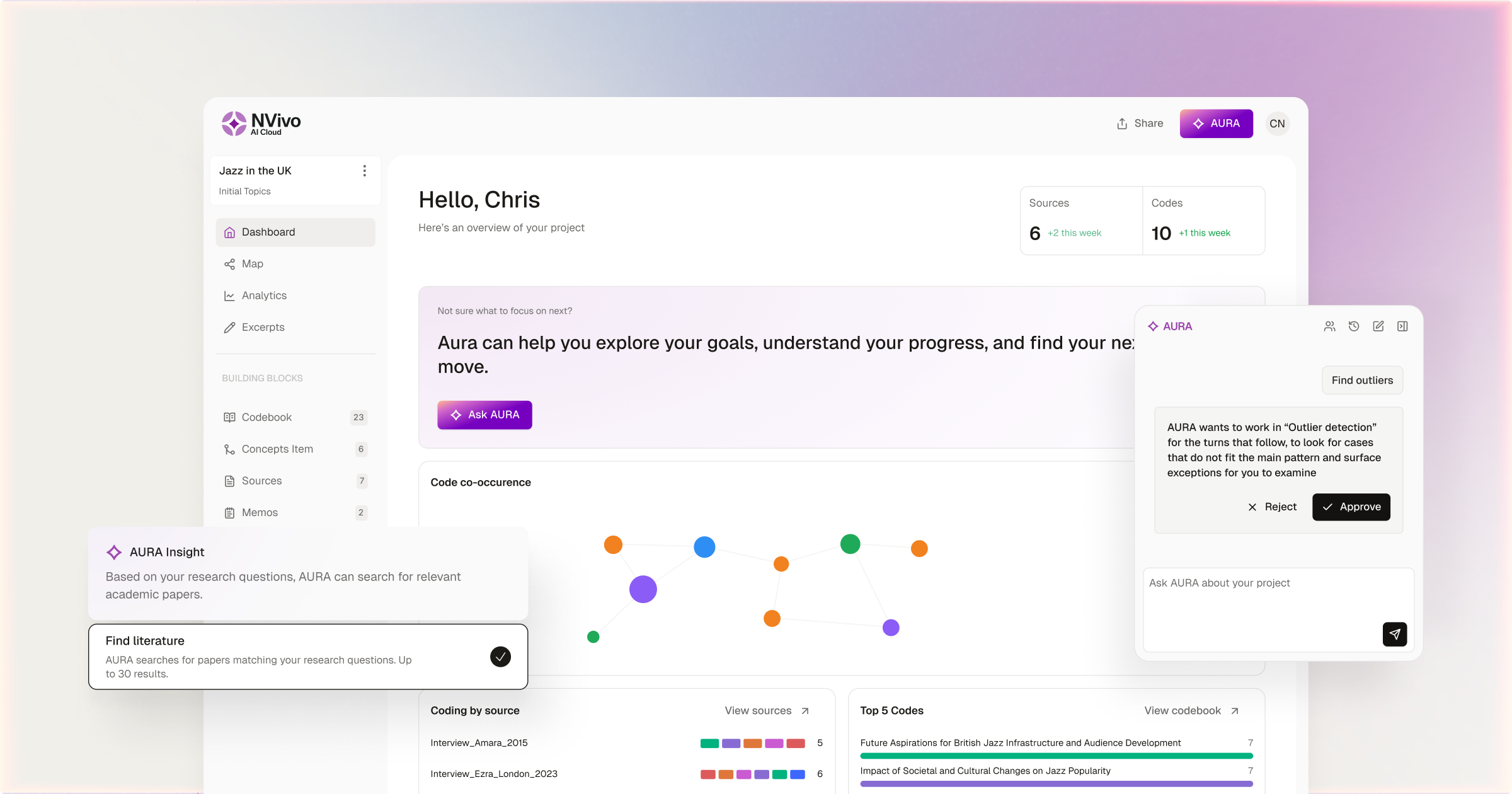
NVivo AI Cloud gives him a structured start. AURA searches for recently published literature, scored for relevance to his evaluation questions, and imports his primary data alongside it—AI does the legwork, Jordan keeps the judgment call. Every interview gets summarized against those specific questions—tailored to what he's trying to answer. He gets a topic map showing patterns across counties, with circles sized by frequency and lines for co-occurrence—the shape of his data before he's coded a single line himself. He reviews AURA's suggested codes with a one-click accept, reject, or refine, and a pattern emerges within days: the program is working.
But a pattern that holds across most counties can hide the ones where it doesn't. This is where AURA Chat's deeper-insights mode earns its place: rather than flattening the data toward the middle, it surfaces the outliers and exceptional cases a purely pattern-matching AI would smooth over. For a policy recommendation that has to serve more than just the average case, those exceptions are often the finding that matters most.
Then comes the critical move. Jordan activates Devil's Advocate mode. He states his finding and AURA surfaces disconfirming evidence. He reviews the exchange and decides what belongs in his case to the state: a funding recommendation already stress-tested, with evidence on both sides.
The takeaway: Working solo doesn't mean starting from zero. The audit trail keeps the pace defensible for agency reporting.
NVivo AI Cloud for research teams: Publish with confidence
Dr. Whitfield is a tenured associate professor, two years into a three-year, grant-funded study on remote and hybrid work. Her research team spans two institutions and includes six graduate students. A new wave of data has just arrived mid-grant, and her annual funder report is due—the one that determines whether funding renews.
Her challenge: managing a team across institutions while maintaining consistency across years and proving to a funder that the work is defensible.
NVivo AI Cloud keeps the research persistent and the team accountable. She and her collaborators work from a shared codebook—definitions, colors, and hierarchies generated automatically as the team codes—with every code attributed to whoever created it, AURA or a named team member. When the new wave of interviews lands, it joins the same project instead of starting a parallel one. When she pulls up the audit log, she can trace exactly who coded what and when.
She explores the analysis using filtering and pulls two auto-generated matrices: codes against variables, and how those codes connect across two years of work. She asks AURA for a project status update—what's been coded, what changed, the evidence behind it. It exports as a memo with charts. Before her funder sees anything, she opens Devil's Advocate mode and pressure-tests her own claims. Every AI-generated insight links back to source data.
The takeaway: Every insight links back to source. The work stays provable at scale.
What ties them together
Priya, Jordan, and Dr. Whitfield face very different research challenges. But underneath all three stories runs the same thread: the audit trail. It's what lets Priya defend her coding at her viva, Jordan defend a policy recommendation to his agency's leadership, and Dr. Whitfield defend her team's work to a funder—one capability, three different reasons to need it.
Look closer and a second thread connects two of the three: Jordan's outlier-surfacing and Dr. Whitfield's Devil's Advocate mode are the same idea from different angles—using AI to stress-test a finding, not just produce one. Defensibility across the entire research lifecycle is the bedrock NVivo AI Cloud is built on.
"Most of the AI tools, they just put your information and get what you want and then present that information. But this one is like we are working, actively working with the system to review and get what you want and then present that information.”
— Dr. Philip Adu, Founder & Methodology Expert, Center for Research Methods Consulting, LLC
Start your research on rigorous footing
NVivo AI Cloud is available in open beta for individual license holders, with project collaboration available to licensed users. NVivo AI Cloud is grounded in a platform vision that extends far beyond qualitative analysis—mixed methods workflows, statistical analysis, citation management, and survey tools are on the roadmap.
Ready to see it in action? Get NVivo AI Cloud and experience what rigorous, AI-assisted research looks like from day one.

Roehl Sybing
Research Associate, University of North Dakota
Roehl Sybing is a Research Associate in the College of Education and Human Development at the University of North Dakota and a content writer for Lumivero. His research interests include qualitative research methodology and dialogic interaction across languages and cultures. He has written extensively on qualitative research methods in scholarly and commercial publications, including several articles for ATLAS.ti's Research Hub.