






Blogs
Explore insights, tips, and industry trends

Case studies
See how organizations achieve real results

eBooks and reports
Access in-depth research and expert analysis

Research
Discover original research and data-driven insights

Webinars
Join live and on-demand sessions with experts

Whitepapers
Access research and expert analysis

Academy
Build skills with structured courses and training

Certified trainers
Get expert training from certified professionals

International partners
Connect with trusted partners around the world

Knowledge center
Find guides, tutorials, and product documentation




How to create a product roadmap: 5 simple steps

Key takeaways
A product roadmap connects product vision, goals, and initiatives to business objectives, ensuring teams stay focused on what truly matters. Effective roadmaps help identify and sequence initiatives, considering dependencies, risks, and value to maximize impact. Mapping dependencies, milestones, and timelines makes complex initiatives easier to understand and communicate across teams. Sharing and iterating the roadmap regularly ensures stakeholder engagement, adaptability, and alignment with changing priorities.
Well defined visual product roadmaps are the key to implementing an agile product strategy and driving your company towards a shared vision. But for some organizations, it's easy to get lost and lose focus of what the roadmap is there for.
Roadmapping should be fundamental to executing a product strategy, acting as a collaboration tool for shared decision making, rather than just a Gantt chart for planning. To ensure you stay on track, try following our 5 steps on how to create a product roadmap for successful product roadmapping.
What is a product roadmap and why is it important?
A product roadmap is a strategic visual plan that outlines the vision, direction, priorities, and progress of a product over time. It aligns cross-functional teams - product, engineering, marketing, and leadership - around shared goals and upcoming initiatives.
Product roadmaps or product plans are important because they:
- Provide strategic alignment between product goals and business objectives
- Help teams prioritize specific features and allocate resources effectively
- Enable transparent communication with stakeholders and customers
- Make it easier to adapt to change by providing a clear structure for shifting priorities
A strong roadmap ensures everyone understands where the product is going—and why.
What’s the difference between a product roadmap and a project plan?
A product roadmap outlines the strategic direction and high-level timeline of a product, including future features, goals, and priorities. A project plan, on the other hand, details the specific tasks, resources, and timelines needed to deliver part or all of the roadmap. In short: the roadmap defines the "what" and "why," while the project plan covers the "how" and "when.”
Who prepares a product roadmap?
A product manager typically leads the creation of a product roadmap using a product roadmapping tool. However, it's a collaborative effort involving key stakeholders across the organization, including:
- Engineering and development teams – for feasibility and timeline input
- Design and UX teams – to ensure user needs are met
- Sales team and marketing – to align roadmap with customer and market demands
- Leadership and executives – to ensure strategic alignment with business goals
The product manager brings these perspectives together to prioritize features and define a clear, achievable roadmap.
What should be included in a product roadmap?
Key elements of a digital product roadmap include:
- Vision and goals – The overarching strategy and desired business outcomes
- Initiatives or themes – High-level focus areas (e.g., user experience improvements, scalability)
- Specific features or deliverables – What the team will build or improve, user stories
- Timeline or release phases – Estimated timeframes or quarters for delivery
- Milestones and dependencies – Key events, deadlines, or interrelated work
- Status indicators – Progress updates to track development over time
Optional additions might include metrics for success, stakeholder assignments, or customer impact summaries to enhance clarity and value.
What does a good product roadmap look like?
A good product roadmap is:
- Clear and visual – Easy to understand at a glance, often with a timeline or milestone-based layout
- Strategically aligned – Tied to business goals, customer needs, and long-term vision
- Flexible – Able to adapt to change without losing focus
- Prioritized – Focused on delivering the highest-value features or outcomes first
- Audience-specific – Tailored to executives, development teams, or customers depending on who it’s for
It should communicate what will be delivered, why it matters, and when to expect it, without overwhelming with too much technical detail. Let's look at how to develop a product roadmap.
How to build a product roadmap
There are several types of product roadmaps - strategy, feature based, timeline, technology, portfolio, release - each serving different purposes depending on the audience, goals, and level of detail needed.
How to design a product roadmap typically involves the following 5 steps:
1. Define a product vision and strategy
Understand the long-term goals and how the product supports broader business outcomes.
Start by clearly articulating your product vision—a high-level, inspirational statement that defines what you aim to achieve with the product and why it matters. This should align with your organization's overall mission and values, giving your team a shared purpose.
Next, establish your product strategy—the actionable plan for realizing that vision. This includes identifying your target customers, market opportunities, competitive differentiators, and key performance indicators (KPIs). A strong strategy outlines how the product will evolve, the problems it will solve, and how it will deliver value to both users and the business.
Defining vision and strategy early ensures that every item on your roadmap ties back to long-term company goals and broader business outcomes. This will help stakeholders to focus their efforts and be more engaged in hitting that target. It also helps prioritize features and investments that move the needle - keeping development efforts focused and aligned with strategic intent.
See how you can build visually compelling roadmaps that are always accurate with SharpCloud. Learn more >
2. Gather inputs and requirements with a workshop
Collect data from customer feedback, market research, stakeholder needs, and internal teams
At the start of any product roadmapping process, we advise holding a roadmap planning workshop to achieve the following:
- Grow your product strategy
- Cement the product vision
- Plan the necessary steps
Workshops should be held in a collaborative environment. This helps to facilitate open discussion, idea generation, and get team members on board. Whether in person or virtual, workshops are a great way to capture the best thinking of your group. A roadmap planning workshop will enable you to build a strategy that works for your business
With SharpCloud, features like customizable forms, real-time data-driven views, and dynamic collaboration tools make for stronger engagement and a shared understanding both during and after a workshop.
Workshops are absolutely crucial at the start of the process. It's also good practice to continue to hold them frequently throughout. This encourages your stakeholders to remain dedicated to the product vision and ensures that your roadmap is never out of date. This is often overlooked, as most managers don’t consider product roadmapping an ongoing process.
3. Prioritize initiatives
Prioritization is essential in successfully implementing your product strategy or product plans.
From the workshop, you should have a good list of activities that need to be carried out to achieve your product vision—but in what order?
Knowing the sequence of tasks and how they link together is arguably the biggest challenge managers face when roadmapping. With so many elements to consider, you will need high-level logical thinking from someone who has a good view of the company’s overarching objectives.
With SharpCloud's roadmapping software, you can map the relationships and interdependencies between tasks and see how they impact each other. This will help prioritize the right projects and programs for the best trade-offs between results and risks. This ensures you efficiently organize and present your tasks to support effective real time decision making around innovation.
Once you’ve finished prioritizing tasks, you should be left with a functional product roadmap. But don’t stop there. Although your roadmap may seem clear to you, you need to be sure it is clear to stakeholders and the wider organization. To accomplish this, you need to make it visually enticing.
4. Visualize dependencies and milestones
Show how initiatives relate to each other and when key milestones are expected.
In complex projects—especially in industries like manufacturing, aerospace, or technology—initiatives rarely exist in isolation. One delay or decision can have a ripple effect across multiple teams or deliverables. That’s why being able to clearly visualize real time dependencies between initiatives is critical.
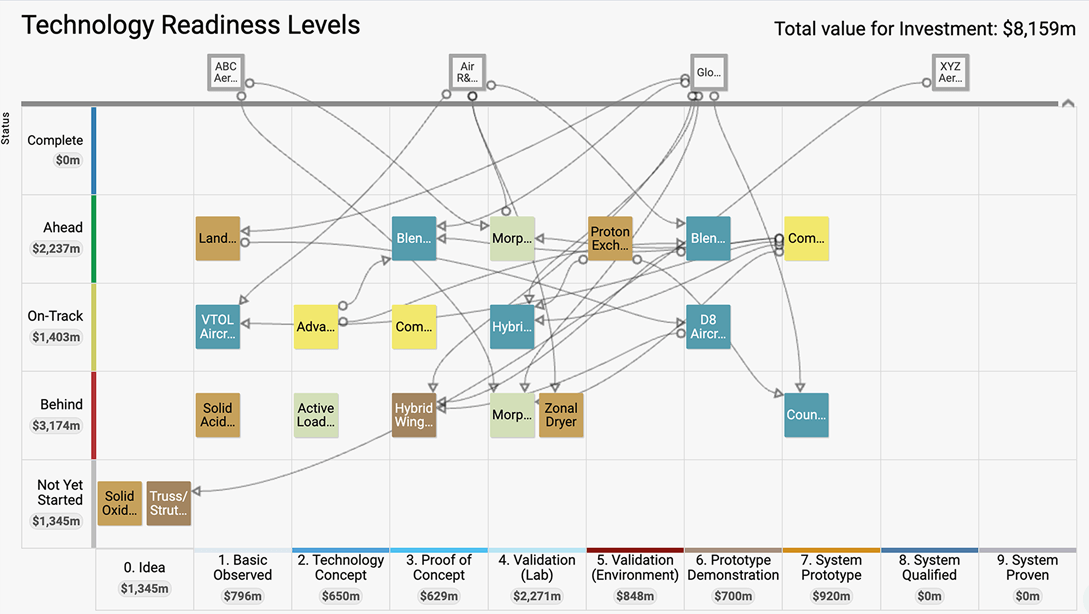
A robust roadmap allows teams to map out how different projects, features, or tasks are connected - whether one must be completed before another can start, or multiple streams need to converge at a specific milestone. This interconnected view helps you spot potential bottlenecks, anticipate risks, and proactively adjust product plans before issues escalate.
At the same time, highlighting key milestones provides clear visibility into when critical goals are expected to be achieved. Whether it's a product launch, regulatory submission, or a phase gate, milestones serve as anchor points to keep the entire organization aligned.
With a visual roadmap that shows both dependencies and milestones, teams and stakeholders gain a shared understanding of project timing, impact, and progression, improving coordination, reducing surprises, and accelerating informed decision-making.
5. Communicate and iterate
Share the roadmap with stakeholders regularly and update it as priorities evolve.
If a roadmap sits on a server and nobody sees it, does it have any value? It certainly won't be any good as a collaboration tool if it does. So, make sure your roadmap is hosted somewhere visible to stakeholders. Somewhere that would fit into their existing working habits, such as a frequently used internal resource. Using a roadmap shouldn’t be a distraction from work, it should be an integral part of it.
Of course, sharing a roadmap is much easier when it is hosted on a digital platform. With a live document, knowledge can be shared, trusted, and transferred with ease. Roadmaps that remain static get quickly out of date. Even if you already share your roadmap in an appropriate location, you cannot guarantee good engagement. By presenting your product roadmap, you can deliver better, two-way engagement with stakeholders.
Designing your roadmap to be visually attractive is key to engagement. Whilst content and message are important, the visual appeal will determine the level of buy-in from stakeholders. This stage is crucial if you plan to use your product roadmap as a presentation tool. Bringing your data to life in a visually rich interactive presentation will enhance its interpretability and help empower smarter business decisions.
SharpCloud turns complex roadmap data into clear, engaging visuals that are easy to understand for any audience. Interactive views, filters, and story panels allow you to tailor the message to different stakeholders—whether you’re speaking to execs, engineers, or customers—without needing to rebuild your roadmap in PowerPoint.
Why use SharpCloud for product roadmapping?
SharpCloud roadmapping software enables you to go beyond static roadmaps by offering live, visual, and data-driven roadmaps that link directly to business strategy. You can map dependencies, connect initiatives across teams, and update roadmaps dynamically as priorities shift - helping product leaders make better decisions faster and with full transparency.
From the initial stages of development to the presentation itself, SharpCloud covers the entire roadmapping process with ease. This powerful data-driven platform has the design capabilities to clearly visualize your data and dynamic movement that rivals mainstream presentation software.
Turn your product roadmap into a strategic advantage.
Explore SharpCloud to see how to align vision, prioritize initiatives, and visualize dependencies for smarter, faster decision-making or request a demo today.


How can we help you? Contact us.