









Key takeaways
Social scientists work with some of the most complex, unstructured data in research—interviews, field notes, media, and more. NVivo supports every stage of the qualitative research workflow, from organizing raw materials and coding themes to visualizing findings and collaborating across teams. When used thoughtfully, it helps researchers move faster without sacrificing the rigor and depth that define great social science.
Qualitative research lies at the heart of the social sciences. Whether you're studying community responses to public policy, exploring lived experiences through interviews, or tracing cultural narratives in media, the task of making sense of rich, unstructured data is both essential and demanding.
The challenge is real: qualitative data is by nature messy, voluminous, and resistant to easy categorization. Interviews, field notes, policy documents, social media archives, media texts—the material of social science research doesn't fit neatly into rows and columns, and the volume of it keeps growing. For social scientists, that complexity is the work itself, and managing it well is what separates surface-level findings from meaningful contributions.
NVivo is a qualitative data analysis tool designed to support exactly this kind of work. It helps social scientists organize, analyze, and draw insight from the complex data that defines their disciplines—without replacing the interpretive judgment that makes qualitative research valuable.
This guide walks through the qualitative research workflow for social scientists and shows how NVivo fits into each stage of the process, from initial data organization through final reporting.
What makes a social scientist?
Anyone who studies the social world in an empirical manner is a social scientist. The term encompasses researchers across sociology, political science, anthropology, psychology, education, social work, communication studies, and many adjacent fields. What unites them is a shared commitment to understanding human behavior, institutions, and social structures through systematic inquiry.
Social scientists work with a wide range of data. Some rely on quantitative data drawn from surveys, experiments, and statistical databases. Others work primarily with qualitative data—open-ended survey responses, interview transcripts, field observations, policy documents, social media posts, and more. Many researchers blend methods to capture the full complexity of social phenomena, combining qualitative depth with quantitative validation.
What social scientists do with qualitative data
Qualitative research is particularly valuable for building theoretical and conceptual frameworks that describe the dynamics of social life in rich detail. Rather than reducing human experience to numbers, qualitative inquiry preserves the language, context, and meaning behind the data. This makes it a powerful approach for exploring questions that resist easy quantification: Why do communities respond to crises in different ways? How do individuals experience identity and belonging? What processes shape organizational culture?
The challenge is that qualitative data doesn't lend itself to simple numerical summaries. Instead, social scientists rely on interpretive and analytical techniques that work directly with text, audio, video, and images. The core tasks in a qualitative research workflow include organizing unstructured data, understanding its meaning, identifying themes and patterns, and visualizing findings.
Organize unstructured data
Before any analysis can begin, researchers need to bring order to their raw materials. Interview transcripts, field notes, photographs, documents, and media files often come in varied formats and structures. Organizing this data means cataloging sources, establishing consistent file naming conventions, and grouping materials by case, theme, time period, or other meaningful categories.
For a study involving dozens of interviews across multiple research sites, even basic organizational decisions—how to label files, how to distinguish between first and follow-up interviews—can have a significant impact on the efficiency and clarity of the analysis. A well-organized dataset makes every subsequent step more efficient and transparent.
Understand the meaning of data
Qualitative analysis hinges on close, careful reading. Social scientists engage deeply with their data to understand what participants are saying, what events signify, and how language carries meaning in context. This process may involve repeated readings, memoing (writing reflective notes alongside the data), and annotating passages to capture initial impressions and questions.
The goal is to move beyond surface-level description toward a richer understanding of the perspectives and processes at play.
Identify themes and patterns
Once researchers are immersed in the data, they begin coding—assigning labels or categories to segments of text, audio, or video that represent recurring ideas, experiences, or concepts. Over time, these codes are grouped, refined, and organized into broader themes.
Thematic analysis, grounded theory, framework analysis, and content analysis are just a few of the methodological approaches social scientists use to identify patterns across their data. The choice may also include the different types of discourse analysis, depending on whether the study focuses on power, interaction, storytelling or persuasion. This is where the analytical narrative takes shape.
Visualize findings
Communicating qualitative findings effectively often requires more than written narrative. Diagrams, charts, concept maps, and other visual tools help researchers illustrate relationships between themes, show the distribution of ideas across a dataset, and make complex findings accessible to diverse audiences.
A well-designed visualization can convey at a glance what might take several paragraphs to explain in prose—and it can also serve as an analytical tool in its own right, revealing connections that might not be apparent in text alone.
How NVivo assists social scientists
NVivo provides a suite of tools designed to support social scientists at every stage of the qualitative research process. By organizing the logistical demands of working with large, complex datasets, NVivo creates the conditions for stronger interpretation—giving researchers the structure they need to focus on the analytical work.
Here's how NVivo's key features map to the social science workflow:
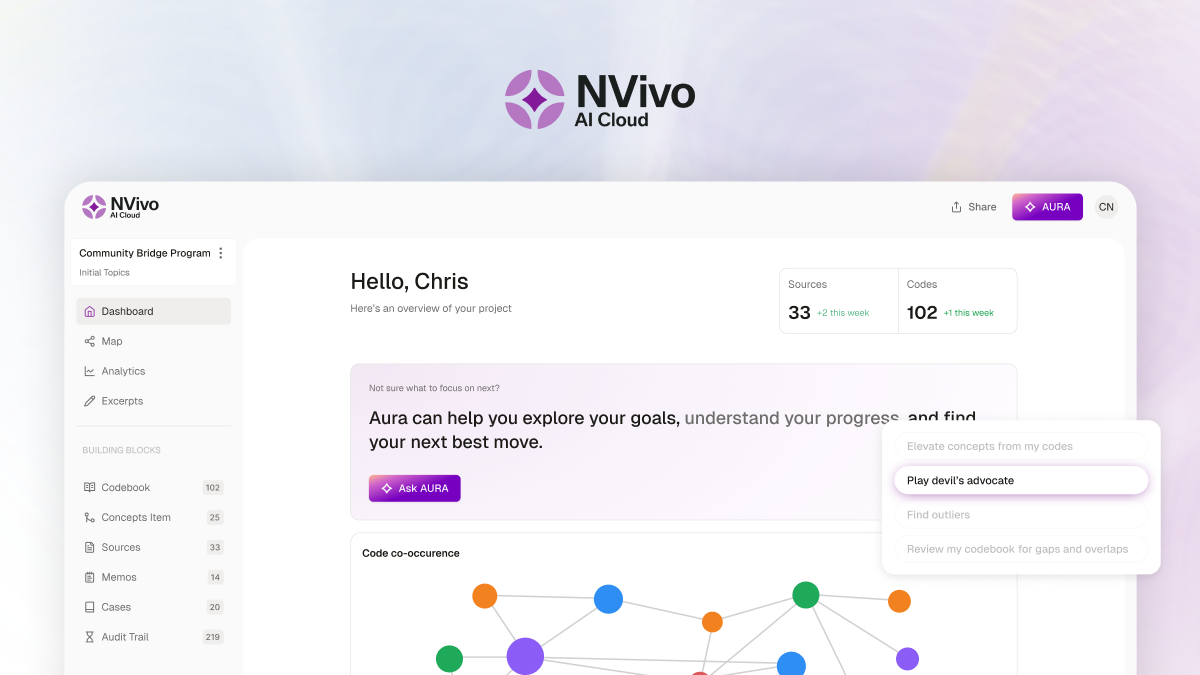
- AI Assistant helps accelerate early-stage analysis by suggesting potential codes, summarizing texts, and identifying preliminary patterns. It's especially valuable when working with extensive datasets where manually reviewing and coding each source would be time-consuming. The AI Assistant serves as a starting point—surfacing possibilities for the researcher to evaluate and refine, not replacing analytical judgment. For projects focused on theme development, researchers can explore using AI for thematic analysis to accelerate early coding pattern detection.
- Coding Matrix Query allows researchers to cross-tabulate codes against cases, demographic attributes, or other variables, producing a matrix that reveals how themes are distributed across different groups or conditions. A researcher studying workplace culture could compare how employees at different levels of seniority talk about leadership—the kind of structured comparison that's central to rigorous qualitative analysis.
- Collaboration Cloud is an add-on feature that enables multiple researchers to work on the same project, regardless of location. Across multiple devices, team members can share data, review each other's coding, and discuss emerging interpretations in a shared workspace. This is particularly important for ensuring intercoder reliability, a key marker of quality in qualitative research.
- Word clouds and trees offer a quick visual overview of the language present in a dataset. Word clouds display the most frequently occurring terms, while word trees show how a particular word or phrase is used in context across all sources. These tools are useful for exploratory analysis and for identifying areas of the data that warrant closer examination.
- Transcription available as an add-on service converts recorded interviews, focus groups, and other audio sources into text that can be coded and analyzed directly within the software. Keeping transcription within NVivo streamlines the workflow and reduces the risk of errors that can arise when moving data between different software tools.
Tips for using NVivo for social science
Adopting any qualitative data analysis software is most productive when guided by clear methodological principles. NVivo won't generate rigorous findings on its own—but used thoughtfully, it can significantly enhance the quality and efficiency of your research.
Develop a system for large datasets
Before diving into analysis, invest time in building a consistent organizational system. Establish clear naming conventions for files, codes, and memos. Create a codebook that defines each code and its boundaries, including examples of what does and does not belong under each label.
The larger the dataset, the more essential this upfront structure becomes. NVivo's folder and classification systems are most effective when they mirror a deliberate organizational plan.
Audit any automated analyses
NVivo's automated features—including the AI Assistant and word frequency tools—can surface useful insights quickly. However, automated outputs should always be reviewed critically. Check suggested codes against the original data to ensure they reflect what participants actually said or meant.
Treat automated analyses as hypotheses to be tested, not conclusions to be accepted. This is especially important in social science, where context and nuance are paramount. As researchers have noted, AI should serve as a sounding board—not the origin of ideas.
Take your qualitative workflow further
"The Researcher's Guide to AI-Assisted Qualitative Analysis" covers responsible AI use, practical workflows with NVivo and ATLAS.ti, and how to maintain rigor at every stage.
Establish consensus through discussion
When multiple researchers are involved, regular discussion about coding decisions and interpretive disagreements is essential. Use NVivo's collaboration features to compare coding, but don't rely on software alone to resolve differences.
Schedule structured team meetings to review coding consistency, discuss borderline cases, and align on definitions. Consensus built through dialogue strengthens the trustworthiness of the analysis.
Strive for making findings accessible
Qualitative research in the social sciences often speaks to issues of broad public concern—education, health, justice, community well-being. Make use of NVivo's visualization and export tools to present findings in ways that are clear and meaningful not only to academic peers but also to practitioners, policymakers, and community stakeholders.
Accessibility in reporting extends the impact of the research beyond the academy—turning insights into the kind of evidence that can inform decisions and inspire real change.
Turn your qualitative data into insights that matter
Social scientists tackle some of the most important questions of our time. The right tools can help you work through complexity with greater clarity, speed, and confidence—without sacrificing the depth and rigor your research demands.
Whether you're organizing your first dataset or managing a multi-site study across time zones, NVivo provides the structure, flexibility, and collaboration tools to support every phase of your work.
Ready to see what NVivo can do for your research? Buy NVivo today.