The greatest barrier to effective risk modeling and management is system fragmentation—dozens of different spreadsheets with different data quality standards and analysis practices that don’t allow for enterprise-wide, real-time insights. With Lumivero’s risk management solutions, you have the building blocks of a more robust approach to risk.
What stands in the way of confident, effective decision-making?
It’s a question we ask often at Lumivero. Removing those barriers is central to our approach to risk modeling and risk management—because timely, evidence-based decisions ultimately help every type of organization move forward with clarity.
In the first webinar of our new Decoding Decisions series, Mark Jenkins, Enterprise Sales Executive at Lumivero, unpacked the core elements of building a successful, organization-wide risk management program. This article highlights several key takeaways from his session, exploring the common obstacles organizations face when modeling and managing risk—and the foundational steps that help remove them.
In surveys conducted for our 2025 Global State of Risk Report, we found that organizations mentioned the following major obstacles blocking them from effective risk management:
These barriers set risk management teams up for practices that clash with stakeholder priorities and expectations, including clear risk narratives, audit-ready insights, and real-time updates. These barriers can also be categorized under one main heading: system fragmentation.
When organizations lack a cohesive, integrated approach to risk management—even if individual projects are managed well—risk mitigation and incident response for the overall organization suffers.
Predict! risk management software makes it possible for organizations to establish a home base for their risk activity—a single source of truth that stakeholders can refer to for real-time insights across projects, departments, and the entire enterprise.
Predict! is built around three key elements that streamline systems and make it possible for risk teams to deliver insightful findings quickly:
Instead of managing dozens or hundreds of separate spreadsheets or SharePoint folders, organizations can house all their critical risk information in one structured environment. Risk registers, risk assessment and impact analysis results, and action plans all live together, along with set user controls for policies, procedures, and training.
Strong risk modeling depends on strong inputs. Rather than collecting updates through disconnected spreadsheets that require intensive data cleaning, teams benefit from guided, consistent interfaces that make it easy to proactively update timelines, budgets, and progress on projects.
With a continually updated system of record, risk managers can provide clear updates on actions, budgets, and emerging issues without chasing data. Plus, risk managers can quickly generate automated, boardroom- or audit-ready reports without having to aggregate data, such as bowtie visualizations, heatmaps, and more.
Additionally, the platform integrates seamlessly with existing IT systems and complementary tools, reducing change-management friction and supporting smoother adoption across the organization.
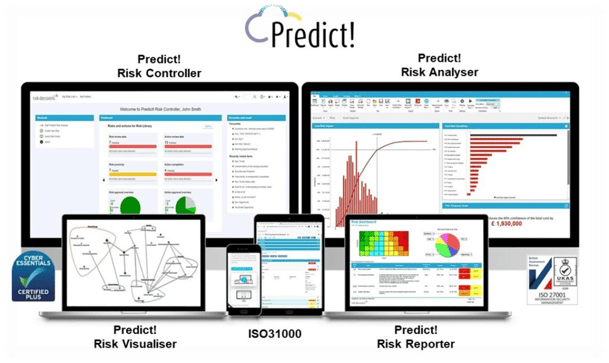
An overview of Predict! features
Predict! also serves as a centralized site for conducting risk modeling—not just risk monitoring—through its integration with @RISK risk analysis software. @RISK is a Microsoft Excel add-on that enables users to run Monte Carlo simulations and analysis for activities like cost risk assessment, directly from their risk registers in Predict!.
Many organizations, even large ones, still rely on deterministic methods that provide just one answer to questions like “When will this project milestone be finished?” or “What will it cost to shut down this production line for maintenance?” These single-point estimates often fall apart in real-world scenarios. Once a team surpasses the projected date or misses the expected cost, the rest of the plan quickly falls out of alignment.
With Monte Carlo simulation, teams can generate a range of likely outcomes that account for uncertainty. And with sensitivity analysis, teams can further refine these results to identify the risk factors most likely to cause the greatest disruption or cost.
Centralizing risk monitoring and analysis with Predict! and @RISK doesn’t just improve insight quality and strengthen visibility today—it also lays the groundwork for future AI-driven capabilities. Any large language model or machine learning approach to risk management depends on well-structured, unified data. Lumivero’s risk management solutions provide exactly that foundation, ensuring organizations are ready to take advantage of emerging technologies as they evolve.
Ready to learn more about how you can advance your risk management practices with Predict! and @RISK? Request a demo today.