









Key takeaways
Decision intelligence in portfolio decision-making combines data, analytics, AI, and human judgment to make better decisions—mapping how actions lead to outcomes, so people decide with confidence, not guesswork. It's not business intelligence (which reports what happened) or decision automation (which replaces the decision). For portfolio leaders, the goal is augmenting human decisions with connected data, quantified risk, and shared visual context, not automating them. The most common failure mode is deciding from siloed reports where strategy, risk, and project data never meet.
Decision intelligence for strategic portfolios is a discipline that connects data, analytics, AI, and human judgment so organizations can make and act on decisions with confidence rather than guesswork. It doesn't just report on the past or predict the future—it models how a decision is likely to play out, so people can weigh trade-offs before committing. The term originated as an extension of data science, augmented with decision theory and managerial and social science, using decision modeling to represent how actions lead to outcomes.
Most "what is decision intelligence" pages describe a machine learning platform for automating high-volume operational decisions—a different problem than portfolio leaders' funding and capital-allocation calls, which happen a handful of times a year, not thousands of times a day. The more useful decision intelligence definition isn't a platform that decides for you—it's a practice for connecting data, quantifying risk, and giving decision-makers a shared picture, so the humans making high-stakes calls can make defensible ones.
Decision intelligence vs. business intelligence vs. data science
Business intelligence tells you what happened; data science predicts what's likely; decision intelligence helps you decide what to do about it.
|
Discipline |
What it answers |
Time orientation |
Typical output |
Who uses it |
Portfolio example |
|---|---|---|---|---|---|
|
Business intelligence |
What happened? |
Past/present |
Dashboards, reports, KPI’s
|
Analysts, executives |
A dashboard showing last quarter's portfolio spend by program |
|
Data science |
What’s likely, and why? |
Future (predictive) |
Predictive models, forecasts, classifications
|
Data scientists |
A model forecasting which projects are likely to slip schedule |
|
Decision intelligence |
What should we do, and what happens if we do? |
Future (prescriptive) |
Decision models, scenario models, trade-off analysis |
Decision-makers, analysts
|
Comparing three portfolio funding scenarios and their downstream risk before committing budget |
None of these replace each other. In practice, a mature portfolio function uses all three—but decision intelligence is the layer that turns dashboards and predictions into an actual, defensible choice.
Consider a portfolio example:
- Business intelligence: Project A is 15% over budget.
- Data science: Projects with these characteristics have a 70% probability of further cost growth.
- Decision intelligence: If we continue funding Project A, what is the impact on strategic goals, cash flow, dependent programs, and overall portfolio risk—and is that impact better or worse than reallocating the budget elsewhere?
How decision intelligence works: The decision lifecycle
Decision intelligence is most effective when treated as a continuous lifecycle rather than a one-time analysis. The stages below double as decision intelligence examples in practice—a working sequence you can apply to a specific decision rather than an abstract framework:
- Connect data. Unify strategy, project, risk, financial, and operational data so decisions are made from a common evidence base rather than disconnected reports. Often the hardest step—not because the data doesn't exist, but because it's scattered across systems owned by different teams, none of whom see the whole portfolio.
- Model and analyze. Quantify uncertainty, assess risk exposure, and apply predictive or prescriptive analysis to understand the range of likely outcomes, not just a single-point estimate. A single forecasted number hides the risk; a modeled range of outcomes shows it.
- Explore trade-offs and scenarios. Test alternative funding, sequencing, or delivery options before committing resources, and compare their strategic, financial, and risk implications. It's far cheaper to test three funding scenarios on a model than to live through three funding mistakes.
- Decide, act, and monitor. Align stakeholders around one shared view, make the call, and track whether the decision held up as conditions changed. The loop closes when the organization checks whether the decision produced the outcome it expected, and feeds that back into the next one.
This lifecycle mirrors how mature portfolio organizations operate: data becomes analysis, analysis becomes insight, insight becomes action, and action produces measurable outcomes that feed the next decision.
See this framework in action with SharpCloud
SharpCloud turns this same lifecycle into a working system: complex data flows into analysis, analysis becomes insight, insight drives action, and action produces a result that feeds back into the next decision. Each stage depends on the one before it—a decision modeled on disconnected data is only as good as the data feeding it, no matter how sophisticated the analysis layered on top.
The core components of a decision intelligence approach
A practical decision intelligence capability rests on five components:
- Connected, unified data — strategy, project, finance and risk data brought into one place instead of scattered across spreadsheets and siloed systems.
- Analytics and risk quantification — turning uncertainty into numbers, not gut feel. Tools such as @RISK (Monte Carlo simulation) can quantify uncertainty, while Predict! provides enterprise portfolio and program risk management visibility.
- Visualization and decision modeling — a shared visual representation of the decision, so stakeholders work from the same picture instead of reconciling conflicting reports. This is where SharpCloud sits: a visual decision environment that brings strategy, projects, and risk together for portfolio leaders.
- Human judgment and collaboration — the discipline stays human-in-the-loop; data and models inform the decision, but accountable people still make it.
- Governance — a consistent way to record why a decision was made and what assumptions it relied on, creating a defensible audit trail rather than relying on memory after the fact.
Together, these components form what's sometimes called a decision support system: the connected infrastructure that makes a decision intelligence practice possible, rather than a single tool that decides on its own.
Decision intelligence for project and portfolio decisions
Most decision intelligence content is written for a general enterprise audience. For portfolio and strategy leaders, portfolio decision-making raises different practical questions: which projects get funded, how they get sequenced, and what changes when risk shifts mid-portfolio. The same principles apply to strategic decision-making more broadly—capital allocation, transformation programs, market entry—but portfolio decisions are where they show up most often, because a portfolio bundles many of these calls together at once.
Three problems show up repeatedly in portfolio decisions:
- Fragmented data. Strategy lives in one tool, project status in another, risk registers in a third—and none of them talk to each other at the moment a funding decision actually gets made. According to Lumivero's State of Risk Report 2025, 40% of organizations cite lack of real-time visibility as their biggest portfolio risk-management challenge, and only 12% manage risk at the portfolio level at all.
- Quantified vs. gut-feel trade-offs. Without quantified risk, portfolio trade-offs default to whoever argues most persuasively in the room. Decision intelligence replaces that with a modeled range of outcomes for each option, so the trade-off is visible before the money moves.
- Dependency and impact visibility. Projects inside a portfolio are rarely independent—delaying one can quietly derail three others. A decision intelligence practice makes those dependencies visible, so leaders can see downstream impact before committing, and keep decisions current as conditions change rather than treating a decision as a one-time event. This matters most on large, long-running programs: McKinsey Global Institute research has found that the average capital project exceeds budget by 80% or more and run roughly 20 months over schedule—outcomes that are far harder to catch early when dependencies between projects aren't visible until something has already slipped.
A useful way to picture this: Network Rail's risk information was spread across multiple teams, tools, and frameworks, making it hard to see how individual risks connected or compounded across the wider organization. Bringing that data into one visual environment with SharpCloud surfaced dependencies and shared controls that had been invisible, giving senior leaders a clearer enterprise-level view of exposure and more confidence in prioritizing mitigation and aligning on decisions.
The same pattern shows up at different scales: Femern A/S used one integrated framework across a €7 billion, 18-kilometer undersea tunnel program, and Hatch standardized risk across a $35 billion global portfolio—in both cases, replacing inconsistent, disconnected views with a single connected one.
Decision intelligence vs. decision automation: Where humans stay in the loop
Not every decision intelligence use case looks the same, and the difference matters more than most explainers admit.
Decision automation
Some decision intelligence platforms are built to automate decisions outright—high-volume, operational, repeatable calls like approving a credit application, flagging fraud, or setting a price in real time. This is the territory of category-defining automation vendors like FICO, SAS, and Aera, and it's a legitimate, valuable use of the term. It works because the decisions are numerous, similar to each other, and low-stakes individually.
Decision intelligence for strategic portfolios
Portfolio and strategy decisions are the opposite profile: low-volume, high-stakes, and rarely repeatable in exactly the same form. Deciding whether to fund a transformation program, how to allocate capital across a portfolio, or whether to greenlight a major project isn't a decision you want a machine making alone—it's a decision you want made by accountable people, informed by the best possible data and modeling.
For decisions like these, the goal is augmented decision-making: giving decision-makers connected data, quantified risk, and a shared visual model, so their judgment is better-informed—not replaced altogether. That distinction, more than any technology choice, is what should determine whether an organization needs a decision automation platform or a decision intelligence practice built around human decision-makers.
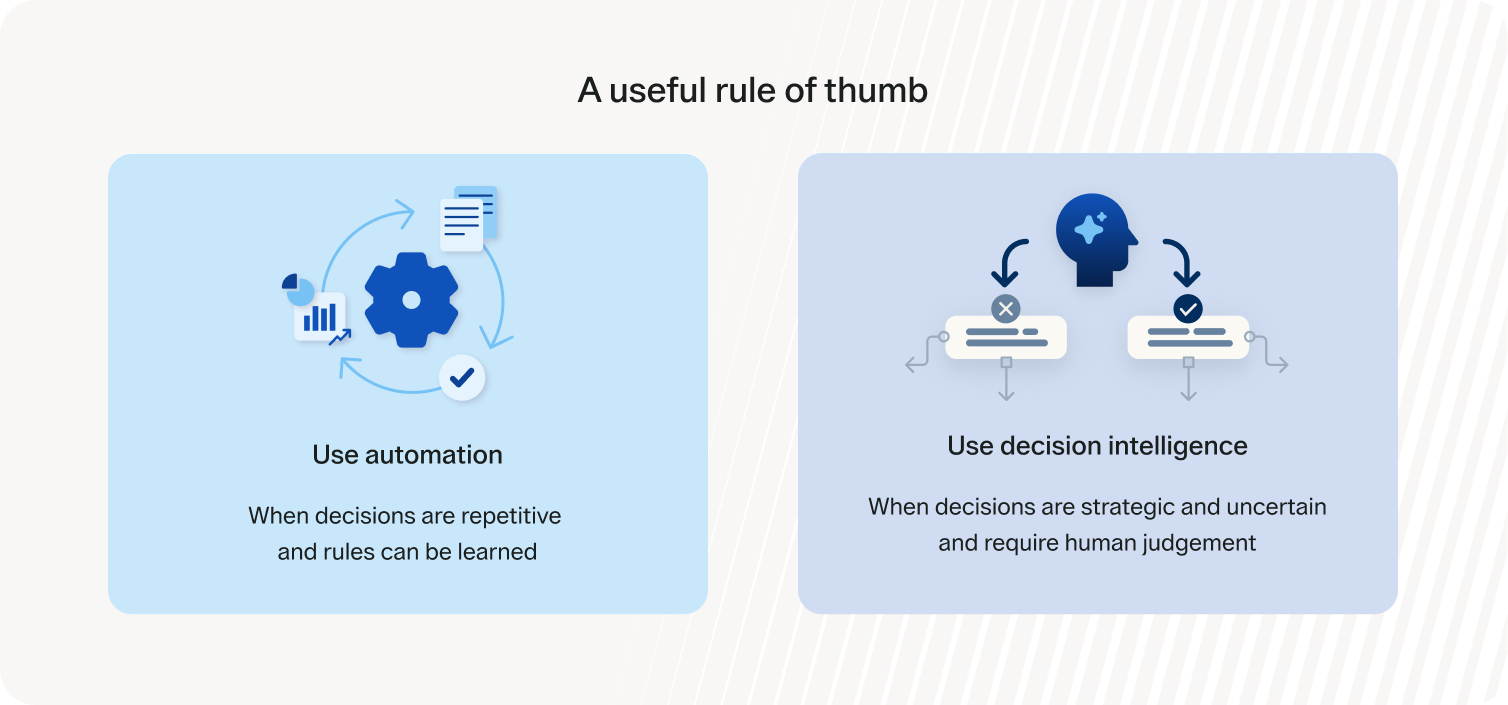
For strategic portfolio decisions, full automation is the wrong goal—augmentation and alignment are the point. Getting stakeholders working from the same data and the same picture is often what actually unblocks a stalled decision, more than any model or algorithm does. It's a line almost no automation-first vendor draws, because it isn't a technology claim—it's exactly the reassurance a skeptical exec is looking for before they commit to a platform at all.
It's worth being direct about why this matters beyond a vendor-positioning point. When a machine makes a routine pricing or fraud call, an occasional bad call is an acceptable cost of running thousands of decisions at speed. When a portfolio decision commits tens of millions of dollars over multiple years, there's no equivalent tolerance for being wrong at scale—and there's no substitute for a human being able to explain why a decision was made, to a board, a regulator, or a stakeholder, months or years after the fact. Decision intelligence for portfolios is built for that second world: one where the record of how a decision was reached matters as much as the decision itself.
How to get started with decision intelligence
Building a decision intelligence practice doesn't require replacing your tools overnight. A practical starting sequence:
- Audit where portfolio decisions currently stall — is it missing data, disagreement over risk, or simply no shared picture to decide from?
- Connect your data sources — bring strategy, project, and risk data into a shared view instead of leaving them in separate systems.
- Quantify risk on the decisions that matter most — apply probabilistic analysis to major funding, schedule, or resource commitments rather than trying to model every project in detail.
- Build a shared visual model — create a single representation of objectives, initiatives, dependencies, and risks so stakeholders are looking at the same picture.
- Align stakeholders around one picture — decision intelligence only works if everyone is working from the same data.
- Decide, act, and monitor decision quality — track whether the assumptions behind the decision remain valid and whether new information changes the preferred course of action.
- Mature one level at a time — start with the portfolio's biggest bottleneck decision, not a full organizational overhaul.
This article focuses on decision intelligence as a practice, not on the day-to-day mechanics of running a portfolio. If you're looking for that instead, see our guides on how to manage a portfolio of projects and the best PPM tools.
If you want a deeper walkthrough of applying this to a full project portfolio, our guide to intelligent decision-making across project portfolios covers the practice in more depth, with a framework you can apply directly.
How Lumivero supports decision intelligence for portfolios
Lumivero approaches decision intelligence as a connected portfolio decision capability, not a standalone automation engine or a set of separate risk, visualization, and decision tools.
SharpCloud is a visual decision environment that connects strategy, portfolio, and risk data in one shared context. Leaders can see impact across the portfolio, align faster, and decide with confidence—the shared visual model referenced throughout this guide.
@RISK brings Monte Carlo simulation into Excel to quantify uncertainty and exposure, turning "what could go wrong, and how badly" into modeled numbers rather than guesses.
Predict! adds portfolio and program risk management with enterprise-grade visibility, giving you a complete, ISO 31000-compliant view of risk across individual projects, programs, and the wider organization.
Unlike governance-first GRC platforms or visualization-only portfolio tools, Lumivero connects quantified risk, portfolio context, and executive decision-making in one system—trusted by 90% of the Fortune 100 and more than 27,000 customers and built by risk professionals and data scientists.
If you're evaluating how this would work for your own portfolio, request a SharpCloud demo, or download the guide to intelligent decision-making across project portfolios for a deeper walkthrough.

Nicky Clarke
Freelance B2B technology copywriter
Nicky Clarke is a freelance B2B technology copywriter with more than 11 years' experience creating content for enterprise software companies. Having spent over a decade leading content and communications for SharpCloud, she specializes in project management, risk management, and strategic decision-making—producing blogs, website content, e-books, and thought leadership that make complex concepts accessible, engaging, and relevant for business audiences.
Frequently asked questions
Decision intelligence for strategic portfolios is a practical discipline for making better decisions by combining data, analytics, AI, and human judgment. It maps how actions lead to outcomes so people can choose with confidence rather than guesswork.
Business intelligence tells you what happened; decision intelligence helps you decide what to do next. BI reports on past and present structured data, while decision intelligence adds predictive analysis, scenario modeling, trade-off evaluation, and decision context to guide the actual choice.
No. AI is one set of tools that decision intelligence can use. Decision intelligence also includes decision theory, risk analysis, visualization, governance, collaboration, and human judgment. The objective is better decisions, not simply more advanced algorithms.
Not necessarily. Some high-volume operational decisions benefit from automated decision intelligence platforms; high-stakes portfolio and strategic decisions usually need connected data, quantified risk, and shared visual context more than they need automation.
It connects strategy, project, and risk data into one view so leaders can weigh trade-offs, model scenarios, understand dependencies, and see downstream impact before committing resources—instead of deciding from siloed reports. Learn more in our guide to intelligent decision-making across project portfolios.
No. For strategic portfolio decisions, decision intelligence is designed to augment human decision-makers, not replace them. It improves the quality, speed, transparency, and consistency of decision-making while keeping executive judgment in the loop.
Start by identifying where portfolio decisions repeatedly stall, connect the data sources involved, quantify uncertainty on the most important decisions, and build a shared visual model so stakeholders are making decisions from the same picture rather than from disconnected reports.