



Blogs
Explore insights, tips, and industry trends

Case studies
See how organizations achieve real results

eBooks and reports
Access in-depth research and expert analysis

Research
Discover original research and data-driven insights

Webinars
Join live and on-demand sessions with experts

Whitepapers
Access research and expert analysis


Monte Carlo simulation in the age of AI: What changes, what doesn’t, and what gets better
By Manuel Carmona, (PMI-RMP® Instructor-MBA), Director at EdytrAIng, Ltd.
Key takeaways
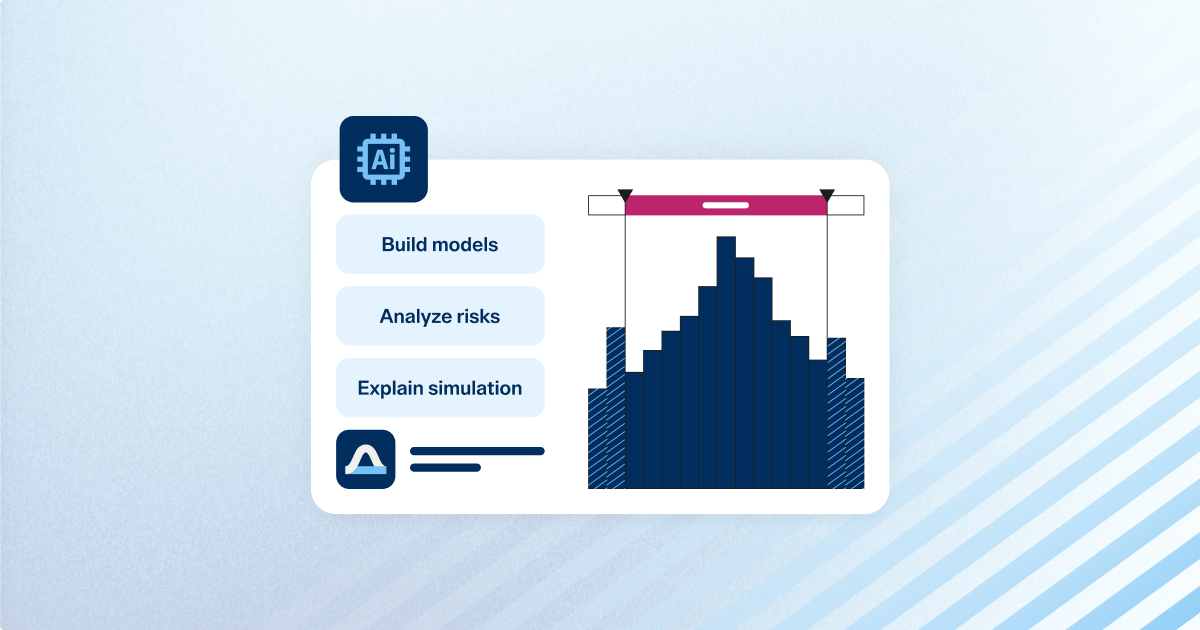
AI does not replace the simulation engine, the discipline of probabilistic thinking, or the audit trail required by boards, regulators, and investment committees. What it removes is the friction that has always kept practitioners from using Monte Carlo well—the fluency gap on distribution choice, the build-time on the model, and the communication problem that historically reduced a hundred-page analysis to a single point estimate in the board paper.
For CFOs, project managers and insurance executives, this shift moves the conversation from one number to a distribution, why it now becomes practical to run probabilistic models inside ordinary decision cycles, and where to start. The article also introduces @RISK Agent which embeds Anthropic's Claude for Excel inside the @RISK environment via Lumivero's Model Context Protocol layer, enabling model review, natural-language Q&A, simulation interpretation, iterative refinement, and executive report generation, all without compromising the accuracy or auditability of the underlying simulation.
AI does not replace Monte Carlo simulation. It removes the friction that has always stopped practitioners from using it well—and stopped boards from seeing the answer the simulation was built to give.
The board meeting has not changed. The CFO still asks the same question she asked five years ago. "What is the probability we make money on this—and what does the world look like in the scenarios where we do not?" The deck in front of her still shows a single NPV, an IRR, a payback period. Three numbers, three decimal places, no probability attached to any of them.
Her instinct is well-founded. Of 16,000 capital projects studied at Oxford's Saïd Business School, only 8.5% finished on time and on budget. Just 0.5% delivered on time, on budget, and with the projected benefits.¹ The deterministic deck in front of her cannot tell her where this project sits on that distribution—or what would have to go right for it to land in the 0.5%.
What has changed is the cost of giving her a real answer.
Five years ago, building the simulation that answers her question—sampling thousands of internally consistent combinations of cost, price, demand, schedule, competitor entry—took an analyst with two specific kinds of fluency. The first was statistical: knowing when a lognormal beats a triangular, when a cumulative distribution beats both, when correlations matter and when they do not. The second was tooling: knowing how to wire those distributions into Excel, name the inputs, set the outputs, run @RISK, read the tornado, and translate the histograms into language the board would actually act on. Either fluency on its own was not enough. Together they took years to build, and most teams never built them.
Artificial intelligence has not removed Monte Carlo simulation from that picture. It has removed the friction that has always stopped good practitioners from using it well and stopped good companies from putting the answer in front of their boards.
This article is the anchor for a six-part series on what that shift means in practice. Before the case studies and the field guides, it is worth being precise about three things: what AI does not change, what AI does change, and what now becomes possible that was not possible before.
What does not change
The mathematics has not moved. A lognormal is still a lognormal. The central limit theorem still does what it did. The principle that you cannot reason about a portfolio of risks by averaging point estimates is as true as it was when Stanislaw Ulam framed it in the 1940s. AI does not produce new probability theory. It does not invent shortcuts that let you skip the simulation engine. The Monte Carlo step still has to happen, and it still has to happen in software that knows what it is doing.
The discipline has not moved either. Distinguishing what is uncertain from what is unknown. Pinning down the bounds before assuming the shape. Asking the subject-matter expert to commit to ranges and percentiles rather than nodding along to a flat scenario. Reading the tornado and asking which of the top three drivers is something the project team can actually influence. None of that becomes optional because an AI can now help you write the model.
And the auditability requirement has not moved. If anything, it has become more pointed. A pension trustee, a credit committee, an insurance regulator, a project director signing off on a five-hundred-million CAPEX—none of these readers can act on a number unless they can trace it back to the assumptions and the data. A simulation result that came out of a black-box conversation between a manager and a chatbot is not a defensible result. It is a story dressed up as evidence.
These three constraints—the mathematics, the discipline, the audit trail—define the boundary inside which the change happens.
What does change—the friction is gone
The first piece of friction AI removes is the choice of distribution.
For a long time, the bottleneck in front of every practitioner was a fluency gap. A planner has historical data and an expert opinion about a project duration. Should it be a triangular, a PERT, a lognormal, a cumulative? Each choice has a defensible answer; getting to that answer used to require either a textbook or a senior colleague. AI compresses the conversation to seconds. You describe the source of the input—three percentiles from a wind-yield consultant, a pair of bounds from a regulator, a fitted dataset from past contracts—and a competent assistant points you at the right function and explains why. The decision still belongs to the analyst. The hesitation that used to add days has gone.
The second piece of friction is the build itself. Wiring up a model in @RISK has never been rocket science, but it has always required attention to detail—naming inputs so the tornado is readable, choosing the right output cells, setting the simulation to enough iterations, lay out parameter tables. AI helps with all of that, but more importantly it catches the small errors that historically only showed up the morning before the steering committee: the cell where a triangular was left in for a fixed input, the correlation matrix that does not satisfy the constraint of being positive-definite, the seed left unset between simulation runs.
Each of those used to cost an evening. Now they cost a prompt.
The third piece of friction is the speed of iteration. A board asks a follow-up question—what if the regulator slips by ninety days, what if the supplier concentration risk doubles—and historically the answer came back at the next meeting. With an AI assistant working alongside the model, the answer comes back in minutes. The board's appetite for risk-adjusted thinking is shaped, at the margin, by how quickly that follow-up loop closes. When it closes inside the meeting, the conversation moves from "we need to revise the model and come back" to "let me show you what that scenario looks like now."
What gets better—the communication problem, finally
The other change is the one practitioners have been waiting for, and it is more important than the speed.
Monte Carlo has always struggled to tell a story.
A project sponsor opens a deck and sees a histogram with a long right tail and a tornado chart with eight regression coefficients. Even if every number is correct, even if the simulation was run on ten thousand iterations with proper sampling, the sponsor often cannot translate what they are looking at into a decision. The result is a familiar pattern: a hundred-page risk-modeling exercise gets compressed into a single P50 number for the board paper, and most of the analytical value is left on the cutting-room floor.
This is the gap AI is closing.
A modern AI assistant connected to the simulation output—not to a generic dataset, but to the actual distributions, the actual tornado, the actual correlations—can write the executive narrative directly from the model. The narrative is grounded. It says: under the simulated scenarios, the project clears the hurdle rate in ninety-two percent of iterations; the eight percent of cases where it does not are dominated by the joint event of regulator slippage beyond Day 150 and aggressive competitor entry in Year 1; the management lever with the largest variance contribution is the win-rate on Year-1 tenders. That paragraph used to require a senior consultant a full day to write, and the consultant typically had to push back twice on the project team's instinct to round it down so "the project looks good." It now takes a prompt and a careful read by the analyst.
For a CFO, the conclusion paragraph is the entire point of running the simulation. For a project manager, it is the difference between presenting a chart and presenting a recommendation. For an insurance executive sizing a treaty, it is the difference between a quote that prices the mean and a quote that prices the tail.
What this means for how you think about projects
Monte Carlo simulation, used well, changes how a leader thinks about a project. Not the analyst—the leader.
The shift is to stop reasoning in single numbers. NPV is not a number; it is a distribution. Schedule is not a number; it is a distribution. Liability under a contract is not a number; it is a distribution. Once that habit takes hold, the conversation in front of the steering committee changes. The question stops being "what is the answer" and becomes "what is the shape of the answer, and which inputs control its shape." That is the question every senior decision-maker should be asking, and historically the bottleneck on asking it was the cost of producing the shape in the first place.
AI removes that cost. It does not remove the discipline of producing a defensible shape, but it removes the practical barrier that kept the discipline confined to specialists. A project manager who could not have built a probabilistic schedule six years ago can now sit down with @RISK and an AI assistant and produce one before lunch. An insurance underwriter who used to outsource the loss-curve modeling to an actuarial consultancy can now stress-test it themselves and bring a sharper question back to the consultancy. A CFO who used to receive three numbers—base, downside, upside—now receives a distribution and can ask the right second-order questions about it.
Where @RISK Agent fits
The shift described above only works if the AI is connected to the model, not to a generic chatbot two browser tabs away.
Lumivero's @RISK Agent is the connection. It embeds an AI assistant—running on Anthropic's Claude—directly inside the @RISK environment in Excel and routes every interaction through Lumivero's Model Context Protocol layer. The MCP is the part that matters: it gives the AI access to the structured contents of your @RISK model—the distributions, the correlations, the simulation output—under the sharing rules your organization has already set for Claude, and nothing more. The simulation engine does not change. The audit trail does not change. What changes is that the analyst can ask questions of the model in natural language and get answers grounded in the actual numbers in the workbook.
What @RISK Agent is not is a substitute for the simulation. It does not run Monte Carlo in a chatbot, hallucinate a distribution shape, or invent a correlation. It is a layer on top of the @RISK engine that closes the speed gap and the communication gap. The mathematics, the discipline, and the audit trail stay where they belong.
Where to start
If you are reading this as a CFO, the first action is not to build a model. It is to ask the next investment paper to come to you with a distribution rather than a point estimate, and to ask the analyst what software produced it.
If you are reading it as a project manager, the first action is to take one model you already run as a deterministic schedule and put a probability distribution on the three or four inputs you already know are uncertain. Run the simulation. Read the tornado. The number that surprises you on the tornado is the number worth a second conversation with the team. For a sense of how that reading of the tornado plays out on a large capital decision, this look at risk management in the energy sector walks through exactly that process on a €900 million offshore wind investment.
If you are reading it as an insurance executive, the first action is to take one treaty you priced last quarter and run the loss curve through a probabilistic stress test. The mean is rarely where the money is.
The discipline is the same as it has always been. The friction is gone. The next five articles in this series will show what that looks like in detail—in prompt design, in three industries, and in the research on cost estimation that explains why Monte Carlo has been the right method all along.
For a practical walkthrough of prompt design, risk-register review, and distribution selection, see this guide to using AI with Monte Carlo simulation.
Ready to remove the bottlenecks in your risk workflow? Learn more about @RISK Agent today.
Catch up on the rest of the series:
- AI prompt engineering for risk managers: A practical field guide with @RISK Agent
- AI and risk management in energy and utilities: How @RISK and AI are changing the game
- AI and risk management in infrastructure and civil engineering
¹ Flyvbjerg, B. & Gardner, D. (2023). How Big Things Get Done. Currency / Penguin Random House. Drawing on the author's database of more than 16,000 capital projects, BT Centre for Major Programme Management, Saïd Business School, University of Oxford.

Manuel Carmona
Director, EdytrAIng, Ltd.
Manuel Carmona, PMI-RMP® Instructor-MBA, teaches quantitative risk analysis for project finance, with a focus on renewable energy, infrastructure and natural-resource transactions. EdytrAIning runs blended training and consulting programs combining @RISK modeling with AI-assisted workflows.


How can we help you? Contact us.