









Key takeaways
The Iron Triangle of cost, time, and resources remains the core constraint in construction programs, but the real challenge is how those constraints are understood and managed. Traditional planning and single-point estimates struggle to reflect uncertainty and interdependence in modern delivery environments. Probabilistic methods such as Monte Carlo simulation help quantify uncertainty and reveal where risks concentrate across the system. However, insight alone is not enough—without shared visibility, even well-modeled programs fail to translate analysis into aligned decisions. The missing link is not more data, but visibility of how decisions impact the Iron Triangle in real time.
Large-scale construction and infrastructure programs—whether shipyards, highways, or energy facilities—operate under constant pressure. Deadlines shift, budgets tighten, and resources fluctuate. At the center of it all is the iron triangle: the trade-off between cost, time, and resources.
Understanding it is straightforward. Managing it in the real world is not.
Modern construction programs are too dynamic for static planning. Requirements evolve, supply chains shift, labor availability changes, and external disruptions regularly force re-evaluation of priorities. Yet many delivery systems still rely on static plans and point-in-time estimates that cannot reflect this volatility.
This article explores why balancing the Iron Triangle remains construction’s central challenge, where traditional methods fall short, and why visibility is the missing link in improving decision-making across complex programs.
The Iron Triangle: A simple model under real pressure
At its core, the Iron Triangle applies to all project-based work—not just construction. It consists of three constraints:
Schedule: How quickly can the project deliver? Compressing timelines increase pressure on cost and resources.
Cost: What budget constraints exist? In large construction programs—particularly firm fixed-price environments—exceeding allocated hours or budgets directly impacts profitability.
Resources: Who and what is available? Labor, equipment, and materials ultimately determine what’s achievable.
The principle is simple: improving one constraint typically impacts at least one of the others. Faster delivery usually increases cost or resource pressure. Lower cost often extends timelines or reduces flexibility. Limited resources constrain both schedule and budget options.
The real challenge, however, is not the model—it’s the environment it operates in, and the lack of visibility into how constraints interact in real time.
Why the Iron Triangle breaks down in practice
Large construction programs are uniquely vulnerable to disruption. They are constantly shaped by changing conditions and competing priorities.
Three factors in particular drive this instability in the Iron Triangle:
- Shifting requirements - Scope changes, evolving stakeholder expectations, or incomplete early definitions often lead to mid-project adjustments. Small changes can cascade across cost, schedule, and resource allocation.
- Resource volatility - Labor shortages, contractor availability, illness, or competing organizational priorities can quickly reshape what is achievable. In large programs, short-term resource gaps can create long-lasting disruption.
- External disruption - Weather events, supply chain delays, regulatory changes, and geopolitical instability all introduce uncertainty that cannot be fully planned for in advance.
Collectively, these factors create a continuously shifting delivery environment where constraints and trade-offs are often only understood after delivery is affected.
A useful example comes from a government infrastructure project during the COVID-19 pandemic. Early assumptions about physical co-location created delays due to limited remote working infrastructure. Once teams adapted and removed that constraint, productivity increased significantly and the project ultimately finished ahead of schedule. The real bottleneck was not time or funding—it was an unrecognized operational constraint.
The lesson: constraints aren’t fixed—and they’re not always where you expect. Visibility is what makes them understandable in time to act.
When decisions become the bottleneck
One of the most underestimated risks in large construction and infrastructure programs isn’t technical complexity—it’s decision latency.
On major projects, progress depends on a constant flow of approvals, design confirmations, procurement decisions, and stakeholder alignment. When that flow slows down, the impact is immediate and far-reaching.
Common causes for bottlenecks in construction decisions include:
- Misaligned stakeholder priorities
- Unclear ownership of key decisions
- Cost sensitivity on high-value approvals
- Long lead-time procurement decisions requiring early commitment
The issue is rarely a lack of information—it’s a lack of clarity about what matters most at any given moment.
Delivery teams often understand which decisions are critical to progress. However, stakeholders outside execution may not see how those choices affect downstream delivery. As a result, less important decisions receive attention first, while critical approvals are delayed or missed entirely.
In practice, this leads to stalled procurement, idle crews, disrupted sequencing, and cascading delays across dependent workstreams. At the scale of shipyards or national infrastructure, these aren’t minor inefficiencies—they become program-level risks.
Slow decisions actively reshape program outcomes. Decision latency becomes a structural problem in how priorities are set across the program. Without clear visibility into how decisions impact delivery, these bottlenecks persist longer than they should.
The Guide to Intelligent Decision-Making Across Project Portfolios
Discover how to connect data, analyze risk, and make smarter project portfolio decisions with greater visibility, aligned priorities, and real-world strategies for complex organizations.
Download guide →Why critical path thinking still gets misused
When operating inside the Iron Triangle, not all work is equal. Delivery is governed by a critical path—the sequence of activities that determine overall project duration. Work that does not contribute to that path is, by definition, secondary.
A simple test of project discipline: Should you pull resources off critical path work to satisfy a stakeholder “pet project”? The answer is no. Yet in complex programs, this trade-off is made more often than it should be.
For example, in road construction, installing visible infrastructure elements early may appear productive. But if excavation or utility work still needs to occur, that effort can be wasted or reworked later, consuming both time and resources without advancing delivery.
The same principle applies across large construction programs:
- Resources are diverted away from critical activities
- Low-impact tasks are prioritized for visibility rather than value
- Skilled labor is misallocated to non-essential work
Collectively, these decisions erode schedule certainty and delay completion. Without clear visibility into dependencies, decision-making defaults to urgency, perception, or stakeholder influence rather than true delivery impact.
The rule is simple: if it doesn’t move the critical path forward, it is not the priority.
The challenge is that most planning tools were never designed to make these trade-offs visible in real time.
On-demand webinar: From Misalignment to Decisions Guided by a Golden Thread
Explore what it means to move from misalignment to decisions guided by a true golden thread—using connected data to provide ongoing decision guidance from strategy through initiatives, delivery, risks, and outcomes.
Watch now →The gap between data and decisions: Why Gantt charts break down at scale
Most construction programs still rely heavily on Gantt charts for planning and tracking delivery. While useful at small scale, they struggle in complex environments.
At program level, thousands of interdependent tasks, multiple contractors, and shifting timelines create dense networks that are difficult to interpret and even harder to maintain dynamically.
More importantly, Gantt charts suffer from a more fundamental issue: they are static. Once conditions change—and they always do—the plan quickly becomes outdated.
- This creates a widening gap between planning and execution:
- Changes are made in isolation without understanding downstream impact
- Resource shifts create unintended bottlenecks elsewhere
- Schedule updates lag behind real-world conditions
Teams rely on experience rather than system-wide visibility
The plan stops functioning as a decision tool and becomes a historical record of intent. At scale, teams are left managing complexity reactively rather than understanding it dynamically.
When plans can no longer reflect reality, the next question becomes how to create visibility into uncertainty rather than rely on static assumptions.
One bridge to this problem is making the Gantt chart itself probabilistic—modeling task durations as ranges rather than fixed points. But even then, schedule-level visibility alone isn't enough. In large construction programs, individual timelines feed into broader portfolios where decisions at one level cascade across many others, and that's where a different kind of solution is needed.
From fixed estimates to probabilistic thinking
Traditional project planning relies heavily on single-point estimates:
- “This task will take 6 weeks”
- “We expect 8 days of weather delay”
In large construction programs, this creates a false sense of precision. The Iron Triangle is then managed as if cost, time, and resources behave deterministically, when in reality they fluctuate continuously under uncertainty.
Some teams use OPM-style estimating—optimistic, pessimistic, and most likely scenarios. While useful for introducing ranges, it remains subjective and does not explain how uncertainty behaves across the system or impacts the Iron Triangle as a whole.
A more robust approach is probabilistic planning, where outcomes are expressed as distributions rather than fixed values. Tools such as @RISK and Predict! apply Monte Carlo simulation to model thousands of possible program outcomes across time, cost, and resource uncertainty.
For teams that live in Gantt charts, ScheduleRiskAnalysis—part of Lumivero's DecisionTools Suite—brings this probabilistic thinking directly into the schedule itself. By applying Monte Carlo simulation to task durations, dependencies, and resource variability, it transforms a static project timeline into a probability-weighted view of delivery. Teams can see not just when a milestone is planned, but how likely it is to be met—and where schedule risk is most concentrated.
Critically, these insights don't stay at the project level: they connect upward into program and portfolio views, setting the foundation for the kind of system-wide visibility that makes the Iron Triangle manageable at scale.
This makes the Iron Triangle trade-offs explicit. Instead of assuming fixed outcomes, organizations can see how different risk profiles shift schedule, cost, and resource balance in practice.
Outputs move from single-point forecasts to probability-based statements such as: “There’s a 70% probability of completing by June 15th, and a 95% probability by July 15th.”
This fundamentally changes decision-making. Conversations shift from defending a fixed plan to understanding how choices affect the balance between cost, time, and certainty. More importantly, it highlights which uncertainties actually matter—allowing teams to focus mitigation where it has the greatest impact.
AI in project management: Powerful, but no substitute for context
Artificial intelligence is increasingly used in project management for schedule optimization, resource allocation, and risk detection. It can process large volumes of data and identify patterns that would be difficult to see manually.
However, in construction environments, context is critical. Physical constraints, regulatory requirements, and supply chain realities cannot be inferred reliably from data alone.
Without careful validation, AI outputs can:
- Rely on outdated assumptions
- Miss local constraints
- Over-simplify complex dependencies
- Create false confidence in recommendations
For example, labor or material assumptions based on pre-disruption conditions may distort planning if not actively checked against current reality.
For this reason, AI is most effective not as a decision-maker, but as a challenge mechanism—helping teams test assumptions, explore alternative scenarios, and surface risks that may not be immediately visible. Lumivero's @RISK Agent reflects this philosophy: connecting your @RISK Excel environment with Anthropic Claude to flag issues before you simulate, answer plain-language questions about your model, and explain complex Monte Carlo outputs clearly—without removing the human judgment that construction environments demand.
But even with better insight, a deeper issue remains: understanding alone does not create alignment.
SharpCloud: Closing the visibility gap in the Iron Triangle
Better forecasting and stronger models improve understanding—but they don't automatically ensure stakeholders interpret and act on that understanding consistently. Large construction programs don't suffer from a lack of data. They suffer from a lack of connected visibility across cost, schedule, and resources.
This is where SharpCloud becomes critical. It transforms fragmented project information into a visual, interconnected environment where dependencies, risks, and trade-offs are visible in context—showing how changes in one part of the program ripple across the whole.
When combined with tools such as Predict! and @RISK, the effect is even more powerful:
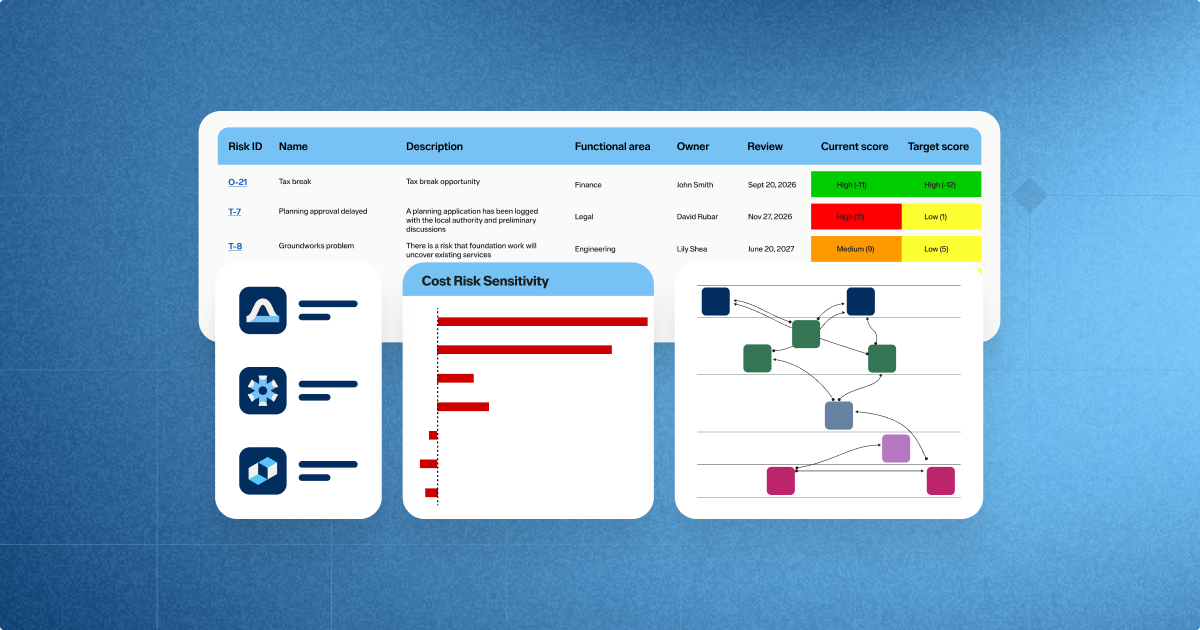
- Predict! centralizes project and portfolio risk data with enterprise-grade dashboards, audit trails, and real-time visibility
- @RISK runs Monte Carlo simulations in Excel to quantify cost, schedule, and risk exposure across thousands of scenarios
- SharpCloud connects these outputs into a shared, visual decision layer—making trade-offs and dependencies clear to every stakeholder
Together, these decision tools close the gap between analysis and execution by turning fragmented insights into a connected operational picture.
Teams can see how delays cascade across interdependent workstreams, understand resource conflicts before they materialize, and evaluate trade-offs between cost, time, and certainty in a shared context. Most importantly, stakeholders are no longer interpreting disconnected reports—they are engaging with the same system of truth.
This is where visibility becomes the missing link in the Iron Triangle. Not by simplifying complexity, but by making it navigable.
Managing the Iron Triangle in practice
The Iron Triangle hasn’t changed. Every construction program still operates under the same fundamental constraints of cost, schedule, and resources. What has changed is the complexity of the environment—and the tools available to manage it.
The organizations that consistently deliver complex infrastructure programs tend to share three capabilities:
- They use probabilistic models rather than single-point estimates
- They structure schedules with explicit uncertainty modeling
- They maintain connected, visual decision environments that align stakeholders
Together, these approaches shift delivery from reactive management to proactive control. The Iron Triangle remains a constraint—but it is no longer static. It is a dynamic system shaped by decisions, timing, and information flow.
The difference between struggling and successful programs isn't whether uncertainty exists—it's whether organizations can see it in time to do something about it.
See the Iron Triangle differently
Cost, schedule, and resources will always compete. But with the right visibility, that tension becomes manageable—and even a strategic advantage. See how Lumivero's connected decision-making solutions helps construction and infrastructure teams turn complexity into confident decisions.
Frequently asked questions
The Iron Triangle refers to the trade-off between cost, schedule, and resources that governs every construction program. The principle is simple: improving one constraint typically impacts at least one of the others. Faster delivery usually increases cost or resource pressure; lower cost often extends timelines or reduces flexibility. What makes it difficult to manage in practice is the environment it operates in—shifting requirements, resource volatility, and external disruptions create a continuously shifting delivery environment where constraints and trade-offs are often only understood after delivery is affected.
Traditional planning relies on single-point estimates that create a false sense of precision. Monte Carlo simulation—available through @RISK—models thousands of possible program outcomes based on uncertainty ranges, expressing results as probability distributions rather than fixed values. This shifts conversations from defending a fixed plan to understanding trade-offs between time, cost, and certainty.
Large construction programs don't suffer from a lack of data—they suffer from a lack of connected visibility across cost, schedule, and resources. Even well-modeled programs can drift away from aligned execution when stakeholders are not working from the same connected view. The missing link is shared, visual decision context: a way to connect data, dependencies, and trade-offs into a form that supports real-time understanding across teams and turns insight into coordinated action.