
Consumer acceptance is critical for the success of biofortified foods—nutritional value alone isn’t enough. Using XLSTAT, researchers uncovered that sweetness, light texture, and smooth mouthfeel were the strongest drivers of preference for kisra made with nutrient-rich sorghum. The study shows how XLSTAT helps translate sensory data into clear insights directly within Microsoft Excel.
Malnutrition continues to be a major public health challenge in many countries, driving collaboration across agriculture, logistics, healthcare—and food product development.
One tactic for enhancing nutrition is to swap out traditional, micronutrient-poor ingredients for biofortified ingredients. However, if biofortified ingredients result in different tastes or textures, people may not be willing to cook with or eat them—defeating the purpose of biofortification.
For this reason, sensory research is essential for ensuring foods made with biofortified ingredients meet consumer preferences for taste, texture, and other attributes.
A study led by Manhal Gobara Hamid of Sudan University of Science and Technology explored how consumers respond to kisra, a traditional Sudanese flatbread, when made with a biofortified sorghum cultivar. The team used Lumivero’s XLSTAT statistical software to analyze sensory data—leveraging advanced methods such as CATATIS and CLUSCATA, developed by Lumivero’s Head of Quantitative Research, Fabien Llobell—to uncover how taste, texture, and consumer preferences align with nutritional innovation.
kisra is a traditional Sudanese flatbread that is prepared from a fermented dough that’s cooked on hot plates or pans. The dough is made from sorghum, one of Sudan’s staple grain crops. While sorghum is protein- and carbohydrate-rich, some varieties of the grain lack important micronutrients—vitamins and minerals like iron and zinc.
The Sudan University team wanted to see if consumers would accept kisra made with a biofortified cultivar of sorghum called the Dahab cultivar, which was first introduced into Sudan from India in 2022. Dahab sorghum is higher in iron and zinc than other varieties, but would it still result in palatable kisra?
The team recruited skilled kisra bakers to prepare nine dough batches using traditional fermentation methods. These nine batches either used biofortified Dahab sorghum, one of five other varieties, or a combination of Dahab and another variety. Samples were cooked and presented to 102 sensory testing participants for taste testing. The team took steps to reduce the impact of visual stimuli, environmental differences, and variations in hunger levels which could influence participants’ responses.
Participants were asked to give an initial rating for each kisra batch. This is known as a hedonic test, which measures overall food acceptability. The team then asked participants to complete a check-all-that-apply (CATA) survey to rate the kisra more minutely, describing their perception of how well the kisra samples stacked up to their ideal kisra based on taste, aroma, sweetness, appearance, and more. This CATA survey helped researchers understand what the most and least preferred attributes of each kisra sample were.
To further analyze the data, the team utilized the CATATIS method, which helps generate a qualitative consensus value—a homogeneity index—that tells how much the overall group liked each sample. It also produced an individual weighted value for how much each taste tester aligned with the rest of participants. “These metrics,” the team wrote, “[are] critical for identifying trends and developing products to meet consumer expectations.”
Next, they conducted a CLUSCATA analysis to see if the taste-testers could be grouped by their responses. This helps further understand variations among different demographics that can guide product development. For example, researchers found that gender was not a significant factor driving preferences—instead, the frequency with which a taste-tester consumed kisra, age, and education were more influential.
The results of the Agglomerative Hierarchical Clustering (AHC) are displayed in a dendrogram (a tree-like visualization, shown below) that showed two clear clusters of responses. One had strong preferences for kisra made only from the biofortified Dahab sorghum or another variety called Daber (the blue cluster), while a second (the red cluster) liked a kisra made from a blend of Dahab and Daber sorghums.
A cluster analysis has also been done on CATA data with CLUSCATA to see the different characterizations of products per the assessors.
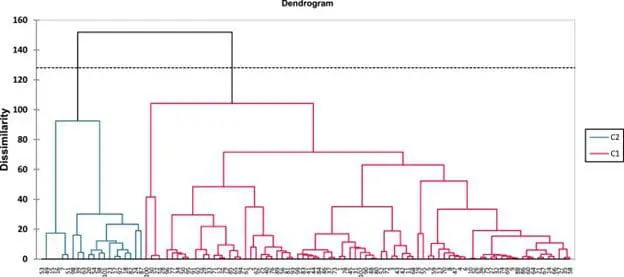
Dendrogram visualization of the AHC results
Having determined which sorghum cultivars were most popular and which taste-tester profiles lined up with certain preferences, the researchers moved on to evaluate which attributes of kisra products were the most likely to influence a tester’s overall liking score.
They analyzed the data using an analysis of variance test, also known as ANOVA, run in XLSTAT. The researchers categorized the results into three groups:
“This analysis provided actionable insights into sensory attributes that drive consumer preferences, guiding potential product modifications to better align with consumer expectations,” wrote the team.
The kisra evaluation showed promising results for the biofortified Dahab sorghum. The samples that contained Dahab (or a blend of Dahab and Daber) were most positively correlated with the attributes the group rated highest: sweetness, a light texture, and a smooth mouthfeel.
The team concluded that, “these findings support the development of kisra products tailored for broader adoption in Sudanese markets and offer valuable insights for guiding future biofortification program in other countries.”
Want to enhance your research with powerful statistical tools in Microsoft Excel? XLSTAT brings advanced methods like ANOVA, clustering, and sensory analysis devoted tools into an intuitive, no-code environment. Buy XLSTAT today to get started.
Explore other ways XLSTAT has powered real-world breakthroughs in our Behind the Breakthroughs series: