Mitigate Risks

Monte Carlo Sensitivity Analysis

Stop the guesswork and start identifying factors that make the largest impact on your output with probabilistic sensitivity analysis. By combining sensitivity analysis with Monte Carlo simulation, you can analyze the impact of different variables in your model by ranking inputs in order of importance and easily communicate results with tornado charts and spider graphs – leading to more informed decisions.

Prioritize Risks by Ranking their Impacts

Analyzing uncertainty, and specifically the key inputs that drive that uncertainty, is at the heart of risk analysis. Which variables actually impact your outputs the most? When you prioritize your key risks, you can efficiently and optimally assign controls and mitigations across your entire business.

What is Sensitivity Analysis?

The Monte Carlo method is a computerized mathematical technique that allows people to quantitatively account for risk in forecasting and decision-making. At its core, the Monte Carlo method is a way to use random samples of parameters to explore the behavior of a complex system. A Monte Carlo simulation is used to handle an extensive range of problems in a variety of different fields to understand the impact of risk and uncertainty.

Rank Your Inputs in Order of Importance

Deterministic sensitivity analysis is a method of analyzing models that allows you to rank your inputs in order of importance. It’s an advanced yet accessible practice that helps you make informed decisions on topics such as effective allocation of your organization’s limited resources and risk mitigation. By itself, risk sensitivity analysis is critical information, but can be a complete game-changer when combined with Monte Carlo simulation to create probabilistic sensitivity analysis.

Communicate Results with Graphs

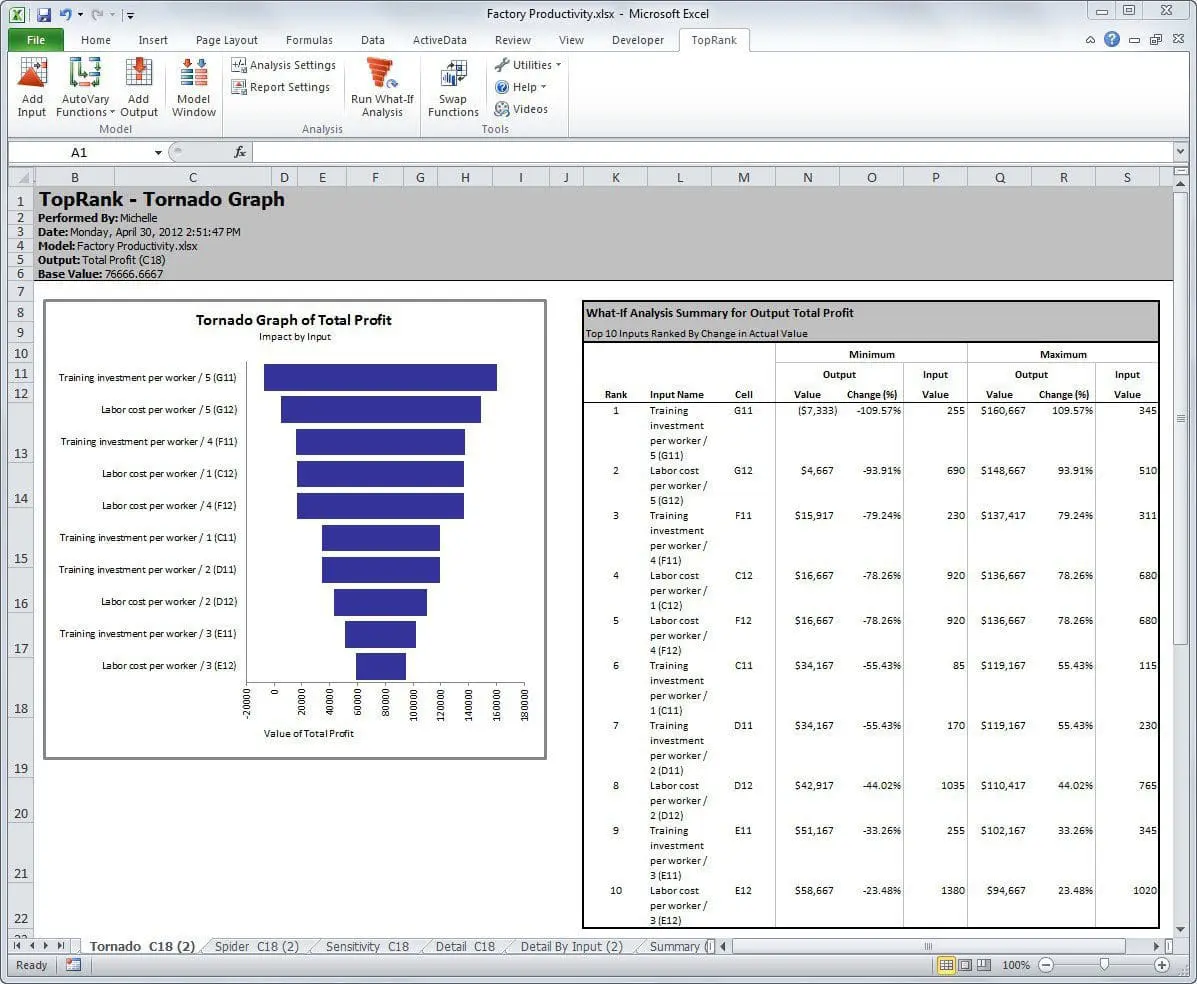
A Monte Carlo sensitivity assessment model displays quantitative data based on the behavior of outputs in response to changing inputs. This data allows the creation of tornado diagrams and spider graphs, giving a visual representation of the inputs’ relative impact on your key outputs. Together, these graphs and data provide communication tools and hard numbers to validate your business and research decisions.

How Does Monte Carlo Sensitivity Analysis Work?

Sensitivity analysis operates directly on your preexisting model – modeling sensitivity analysis in the form of a tornado diagram. After the software will identifies all inputs affecting an output you specify (e.g., NPV, Total Project Cost, or Return), the inputs are stepped through a meaningful range of values (such as +/- 10%) – indicative of the uncertainty in each. For every one of these values, the entire model is recalculated and new data is recorded for all identified outputs. This data represents the direct impact that each input has on the calculated output value. The magnitude of this range is the metric by which the inputs are ranked and are conveniently displayed in tornado charts and spider graphs. A greater impact score on the sensitivity model means an input is more important, requiring mitigation or further investigation and modeling.
A tornado graph showing the results of a sensitivity analysis. Large bars on top have the most impact.

Local and Global Sensitivity Analysis

In general, sensitivity analysis falls into one of two categories: local and global.

Sensitivity Analysis Software from Lumivero

magnifierarrow-right
linkedin facebook pinterest youtube rss twitter instagram facebook-blank rss-blank linkedin-blank pinterest youtube twitter instagram