












Key takeaways
Construction and utilities projects come with unique, persistent challenges—cost overruns, resource conflicts, schedule delays—that traditional project management approaches simply weren't built to solve. Probabilistic methods like Monte Carlo simulation reveal the full range of possible outcomes and the risks that actually drive variation. Combined with structured front-end planning (PDRI) and portfolio visibility (SharpCloud), organizations move from reactive project control to proactive, evidence-based decision-making. The result: projects delivered with greater confidence, better stakeholder alignment, and stronger outcomes across the board.
Construction and utilities projects continue to face persistent challenges that traditional project management approaches struggle to address. Cost overruns of 5–15% and schedule delays of months—or even years—are still widely accepted as normal outcomes rather than exceptions.
The question is: does it have to be this way?
Cost overruns and schedule delays aren't inevitable—they're often the result of risk models that can't account for real-world uncertainty. Dr. Luis Henrique Martinez, Director of Project Controls at Clearway Energy Group, made that case in a recent Lumivero webinar, walking through how probabilistic risk analysis with Monte Carlo simulation helps construction teams improve forecasting, identify the risks that matter most, and build contingency plans they can actually defend. These principles form part of a wider approach to AI in capital project management, where AI can also support scheduling, resource planning, and earlier issue identification. Read on to explore the key webinar takeaways plus an expansion on portfolio risk management in construction, or watch the webinar on demand.
The problem with deterministic risk analysis in construction
Most construction organizations still manage risk using deterministic approaches: single-point estimates for cost and schedule, red-amber-green (RAG) risk ratings, and static assumptions embedded in spreadsheets and reports.
This approach compresses uncertainty into a single assumed outcome, which is inherently misleading. It creates false precision and encourages decision-making based on one version of reality rather than the full distribution of possible outcomes. This shift from deterministic assumptions to more predictive decision-making reflects wider risk management trends 2025 identified across construction, manufacturing, energy, and utilities.
Consider a wind farm project with a fixed completion date. That date is not a forecast—it is one point on a spectrum of thousands of potential outcomes. Weather delays, equipment issues, or regulatory approvals each behave as distributions rather than constants. When reduced to single values, organizations lose visibility into schedule confidence, true risk drivers, and meaningful trade-offs between cost, time, and risk.
This is compounded by how risk behaves in practice: typically, 20% of risks drive 80% of project outcomes—yet deterministic approaches treat all risks as if they carry equal weight.
In large infrastructure programs, interdependencies amplify the problem, with small delays cascading across multiple workstreams.
This is where probabilistic approaches replace assumption with measurable uncertainty.
Front-end risk management with PDRI
Most organizations focus probabilistic analysis on execution—but a significant share of a project's risk exposure is locked in long before construction begins. Incomplete project definition is one of the most reliable predictors of cost overruns and schedule delays, yet it's rarely treated with the same analytical rigor as schedule or cost risk.
The Project Definition Rating Index (PDRI), developed by the Construction Industry Institute, provides a structured framework for assessing project readiness across three areas:
- Basis of project decision – Is this the right project?
- Basis of design – Is the design sufficiently defined?
- Execution approach – Can the project be delivered as planned?
PDRI is most valuable when applied iteratively throughout development, rather than as a one-off assessment before construction starts. By evaluating maturity at initiation, mid-development, and pre-construction stages, organizations can track readiness and identify emerging risks early.
PDRI uses a scoring system where lower scores indicate better project definition. The results speak clearly: projects scoring below 200 on the scale consistently demonstrate stronger outcomes, typically delivering around 5% under budget with fewer change orders. Projects scoring above 200 face cost overruns, schedule delays, and change orders consuming 3% or more of total budget.
Crucially, incomplete elements identified during the final assessment become direct inputs into risk registers, turning definition gaps into quantified risk exposure.
For more informed decision-making, those risks should then be analyzed with probabilistic modeling—reflecting the full range of outcomes each gap could produce, rather than a single assumed result. From there, it's a matter of continuity: the risks captured during front-end planning need to be tracked through execution, with connections and decision trade-offs remaining visible and actively managed as the project evolves.
This is what full-context decision-making looks like in practice: uncertainty surfaced early, quantified rigorously, and tracked continuously across every stage of delivery.
The shift to probabilistic risk analysis
Probabilistic risk analysis fundamentally changes how uncertainty is understood and managed.
Instead of asking “when will we finish?”, organizations begin asking:
- What is the probability we will finish by this date?
- What range of outcomes should we realistically expect?
- Which risks actually drive cost and schedule variation?
This shift replaces assumption-based planning with quantified uncertainty.
Research across construction organizations implementing Monte Carlo simulation shows that 90% achieve at least a 10:1 return on investment, with one-third achieving 100:1 or higher, according to Construction Industry Institute. These results are not driven by increased effort, but by improved decision quality through better representation of uncertainty.
Monte Carlo simulation and decision-making
Tools such as @RISK enable probabilistic modeling through Monte Carlo simulation.
Rather than running a project schedule once with fixed inputs, the model is run thousands of times. Each iteration samples from probability distributions assigned to uncertain variables such as activity durations, risk events impacting costs and resource availability, and weather impacts.
The output is a full distribution of possible outcomes, enabling organizations to move from deterministic assumptions to probabilistic decision-making:
- “There is an 80% probability of completing by mid-March”
- “There is only a 50% probability of achieving the aggressive February target”
Contingencies become evidence-based, and schedule commitments are defined in terms of confidence levels rather than single-point estimates.
Modeling construction risk probabilistically
To model risk effectively, it is important to recognize that not all risks behave the same way.
Construction risks typically fall into three categories:
- Single-occurrence risks – events that happen once or not at all, such as approvals or contract awards
- Repeated risks – events that may occur multiple times, such as weather disruptions or supply delays
- Bounded repeated risks – risks tied to a finite number of assets, such as defects across turbines or equipment units
Repeated risks such as weather disruption are commonly modeled using Poisson distributions, based on expected event frequency derived from historical data. This allows variability in occurrence to be represented realistically rather than assumed as fixed.
Beyond frequency, probabilistic modeling also captures impact ranges rather than single-point values, reflecting the true uncertainty in construction environments.
When these inputs are processed through Monte Carlo simulation in @RISK, they generate full probability distributions of outcomes. Sensitivity analysis then identifies the risks that drive variation, typically following a Pareto pattern where a small number of risks account for the majority of impact.
Managing risks with probabilistic risk registers
Running a Monte Carlo simulation gives you a clear picture of which risks matter most and what they could cost. But that insight only drives better outcomes if it's captured, owned, and actively managed through execution. That's where most organizations lose the thread.
Traditional risk registers tend to be static: a list of identified risks, assigned owners, and RAG ratings that get updated sporadically and rarely reflect how the risk landscape is actually evolving. They capture what was known at a point in time rather than what's true right now.
Probabilistic risk registers with Predict! change that dynamic. Rather than recording risks based on gut feel or assumption, they carry forward the quantified outputs of simulation—probability distributions, confidence intervals, and sensitivity rankings—so that every risk entry reflects a defensible, data-driven assessment of likelihood and impact. In Predict!, those risks are then assigned RAG ratings that are grounded in that quantified data, giving teams an at-a-glance view of status that's backed by simulation rather than intuition. As new information comes in, those ratings can be updated, keeping the register aligned with reality rather than drifting away from it.
This is the critical link between quantifying uncertainty and managing it:
- Risks identified during front-end planning (PDRI) feed into the register with quantified exposure
- Monte Carlo simulation outputs inform probability and impact ranges for each entry
- Owners are assigned to specific, measurable risks—not vague categories
- As the project progresses, the register evolves, reflecting updated inputs and changing conditions
The result is continuity across the entire project lifecycle: the uncertainty surfaced early and quantified through simulation doesn't get filed away—it stays live, visible, and connected to the decisions being made on the ground.
Portfolio intelligence with SharpCloud
Improving individual project performance is only part of the challenge. Construction organizations increasingly operate portfolios of interconnected projects, where performance is shaped by system-wide interactions.
This is where portfolio intelligence becomes essential.
SharpCloud provides a visual layer that connects project data into a coherent portfolio view, enabling decision-makers to understand relationships, constraints, and strategic alignment across multiple initiatives. This shared visibility underpins cross-functional alignment, ensuring decisions are made from a consistent source of truth rather than fragmented reporting.
SharpCloud complements detailed planning in Predict! and quantitative risk analysis in @RISK by providing:
Strategic alignment across the portfolio
Every project links directly to strategic objectives, making investment patterns instantly visible. This allows leaders to quickly assess whether delivery activity matches strategic intent.
Dependency visualization
Construction portfolios contain hidden dependencies—shared contractors, equipment, site sequencing, and regulatory approvals. SharpCloud makes these relationships visible, ensuring delays in one area immediately reveal downstream impacts.
Resource conflict identification
Competing demands for critical resources become visible before conflicts occur. Instead of reacting to shortages, portfolio managers can proactively re-sequence plans and avoid downstream delays
Risk concentration
Portfolio-level views expose systemic exposure—such as reliance on a single approval pathway or concentrated weather risk—allowing organizations to address vulnerabilities early.
The integrated decision cycle: Predict! + @RISK + SharpCloud
The real transformation occurs when planning, risk analysis, and portfolio visibility are connected into a single decision ecosystem:
@RISK applies probabilistic analysis to project plans, converting deterministic schedules into distributions of possible outcomes and identifying the risks that drive schedule and cost variability. The result is contingency planning that's evidence-based, and schedule commitments defined by confidence levels rather than single-point estimates.
Predict! then takes those quantified risks and brings them into structured, executable project plans—capturing risks in probabilistic risk registers, assigning RAG ratings grounded in simulation data, and tracking them continuously through execution so that nothing identified during planning gets lost as the project evolves.
SharpCloud then aggregates this information into a portfolio-level visual system, enabling stakeholders to understand performance, dependencies, and strategic alignment in real time.
This integration enables collaboration across stakeholders through a shared, continuously updated view of plans, risks, and portfolio performance—allowing decisions to be made faster, with greater alignment and confidence.
Together, these capabilities form a continuous decision cycle:
- Build detailed, executable project plans
- Quantify uncertainty through probabilistic modeling
- Track and manage risks with probabilistic risk registers
- Visualize portfolio-level implications
- Adjust decisions based on evidence
This connected workflow closely reflects the decision intelligence process, where data, analysis, scenario exploration, and action feed into one continuous decision cycle. This integration moves organizations from isolated project control to true portfolio intelligence.
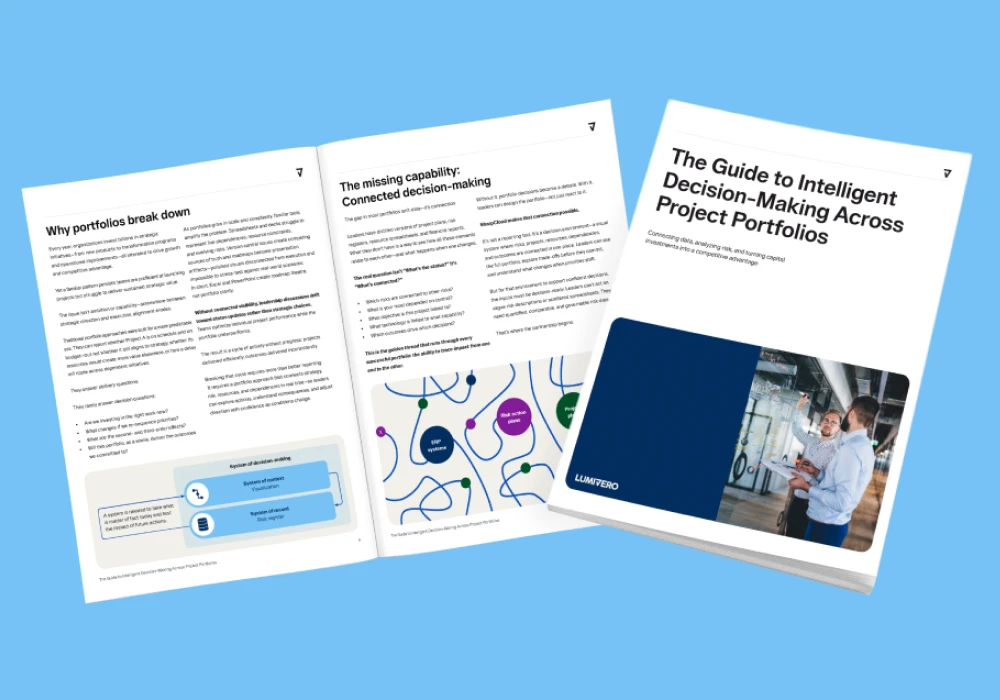
Intelligent Decision-Making Across Project Portfolios Guide
Discover how to connect data, analyze risk, and make smarter project portfolio decisions with greater visibility, aligned priorities, and real-world strategies for complex organizations.
Download eBook →Practical applications in construction portfolios
Weather risk modeling
Weather events are modeled probabilistically using Poisson distributions in @RISK, based on expected frequency from historical and expert data. This enables contingency planning grounded in probability rather than assumption, producing clearer forecasts of potential delay scenarios.
Multi-project resource optimization
SharpCloud provides portfolio-level visibility of resource allocation across projects. Competing demands for specialist equipment, contractors, or labor are identified early, allowing portfolio managers to resolve conflicts through proactive sequencing or capacity planning before delays occur.
Regulatory dependency management
Using SharpCloud’s dependency mapping, permitting and approval processes are visualized across the portfolio. This makes cascading delays explicit—so when one approval is delayed, teams can immediately see downstream project impacts and adjust plans accordingly.
Strategic portfolio balancing
SharpCloud enables organizations to visualize investment distribution across different project types, helping ensure resources align with strategic priorities rather than being allocated reactively across competing initiatives.
Continuous improvement through lessons learned
Effective risk management doesn't end at project delivery—it improves through structured learning. Leading organizations capture lessons at key milestones such as Final Notice to Proceed, Mechanical Completion, and Substantial Completion, ensuring insights are recorded while still fresh, before teams transition and critical detail is lost.
These insights feed directly back into risk modeling. By comparing forecasted outcomes with actual results, organizations can validate assumptions, refine probability distributions, and identify gaps in their risk registers. Over time, this builds a more accurate and robust foundation for future projects.
This is where probabilistic risk analysis creates a compounding advantage.
As models improve, so does decision quality—creating a continuous feedback loop between planning, execution, and future performance.
According to Construction Industry Institute’s research, construction organizations shows that teams adopting probabilistic risk analysis achieve 10:1 to 100:1 return on investment, driven by:
- More accurate and defensible contingency planning
- Faster, more confident decision-making
- Reduced resource conflicts across portfolios
- More predictable project outcomes
Together, these capabilities transform risk management from a static process into a continuously improving system—where every project strengthens the next.
From project control to portfolio intelligence: What's possible now
Construction and utilities projects will always involve uncertainty. Weather patterns shift, supply chains fluctuate, and regulatory environments evolve. The critical challenge is not eliminating uncertainty but understanding and managing it effectively.
Deterministic approaches attempt to simplify this complexity. Probabilistic and data-driven approaches make it measurable, structured, and actionable.
The impact of probabilistic approaches is already well established—enabling more accurate forecasting, better risk prioritization, and more confident decision-making.
By combining structured front-end planning (PDRI), quantitative risk analysis (@RISK), probabilistic risk registers (Predict!), and portfolio intelligence (SharpCloud), organizations create an integrated decision ecosystem that connects planning, uncertainty, and execution.
This represents a shift from reactive project management to proactive, system-level decision-making.
The organizations that will outperform in the next decade are not those that avoid uncertainty, but those that model it, understand it, and act on it with greater speed and clarity than their competitors.
The capability already exists. The advantage now lies in adoption.
Turn uncertainty into a competitive advantage
Discover how Lumivero’s decision solutions improve decision-making and delivery confidence across complex construction programs. Book a demo to see the difference.