Roof fall rates (RFR) in coal mines are a critical measurement of the safety and stability of mining environments. Using machine learning-powered algorithms and @RISK, it’s possible to develop better predictions of the RFR, even in complex mining environments.
Underground mining, including coal mining, plays an important role in the global economy. While mining practices and extraction technology have advanced, roof collapses in mines are still a major risk to workers and mining operations. These are most prevalent in coal mines, which account for 18.8% of all roof collapses, according to “Optimizing Underground Coal Mine Safety.”
Mining engineers define the roof fall rate (RFR) of a mine as the number of roof fall incidents divided by the amount of linear distance a mine has advanced during a given period. Traditional methods of evaluating RFR involve extensive manual observation and calculations—and, until recently, relied on static predictions that don’t account for the high degree of uncertainty present in mining conditions.
Is there a way to use modern probabilistic analysis models to better calculate RFR? That’s what Hadi Fattahi, Hossein Ghaedi, and Danial Jahed Armaghani of the University of Technology Sydney wanted to investigate. They evaluated two different algorithms and conducted a sensitivity analysis using @RISK to determine which factor most affected RFR. Their paper, “Optimizing Underground Coal Mine Safety: Leveraging Advanced Computational Algorithms for Roof Fall Rate Prediction and Risk Mitigation,” reports on how their initial exploration fared.
Dr. Fattahi’s team wanted to identify better modeling options for evaluating and predicting RFR. First, they looked at past attempts to use computer modeling and found that many methodologies still relied on extensive field testing by engineers. These studies also tended to focus on roof falls at intersections of tunnels. Additionally, these prior methods relied on linear, static models—models which could not incorporate high levels of uncertainty present in various mines. While some attempts have been made to apply probabilistic modeling to coal mining risks, they have mostly focused on the risks of explosions.
The team decided to apply optimization algorithms to the problem. Optimization algorithms are machine-learning algorithms which, as the team wrote, “continuously adapt and refine their approaches based on new data or changing conditions, thereby achieving results that are not only more accurate but also more tailored to the specific problem at hand.”
The team compiled a database that included 109 different data points from across their study mine, and included parameters such as:
They used 80% of their data points to train the optimization algorithms and 20% of the data points to generate predictions.
Generating a range of outcomes for RFR is useful for mining engineers, as well as being able to understand the influence of specific input factors offers even deeper insight. For this purpose, the team decided to perform a sensitivity analysis of each of their optimization algorithms using @RISK. A sensitivity analysis involves randomly altering a single input parameter while keeping the others static to determine how changes in each parameter affect the model outputs.
The two optimization algorithms the team used were the harmony search algorithm (HS) and the invasive weed optimization algorithm (IWO). Using the sensitivity analysis function in @RISK yielded the following charts:
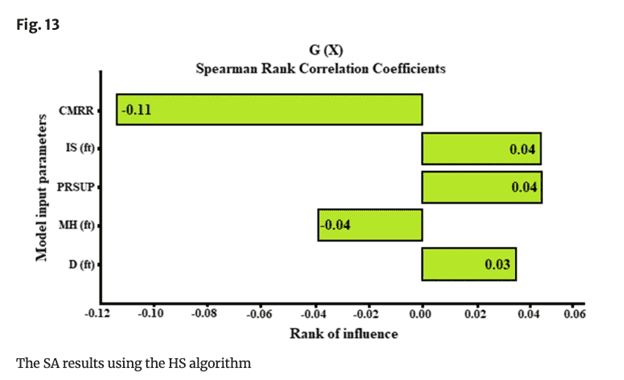
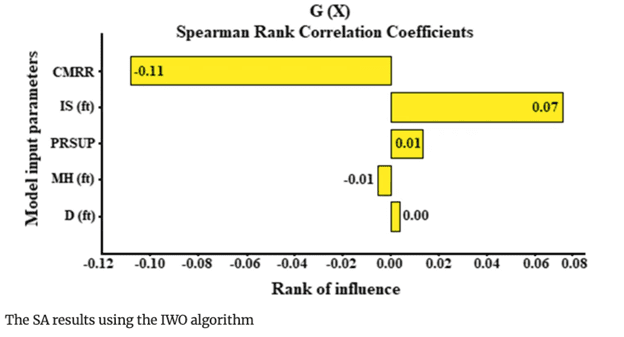
In both cases, the sensitivity analysis found that the coal mine roof rating (CMRR) was by far the most influential factor on RFR outcomes. This gives engineers and researchers a better understanding of what they need to focus on when trying to ensure the stability of coal mines—and the safety of coal mine workers.
The energy industry faces some of the world’s most complex operational risks—from underground mining and extraction to refining and transport. When every decision can impact both safety, understanding uncertainty isn’t optional—it’s essential.
With Lumivero’s risk and decision software, you can move beyond static spreadsheets to powerful, data-driven risk modeling that helps you predict potential hazards, prioritize preventive measures, and protect your workforce. Whether you’re managing mine stability, drilling operations, or large-scale infrastructure projects, @RISK delivers the insight you need to make confident, evidence-based decisions that keep operations resilient.
Ready to see how probabilistic analysis can make your operations safer and more efficient? Request a demo of @RISK today.