Move decisions forward with complete context and confidence






Establish a single source of truth that aligns leadership, portfolios, and teams around strategic priorities and trade-offs.
See how choices affect outcomes, risk exposure, and investment performance so leaders can evaluate trade-offs, eliminate uncertainty, and avoid unintended consequences.
Replace static reports with executive-ready views that enable faster alignment and decisive action.
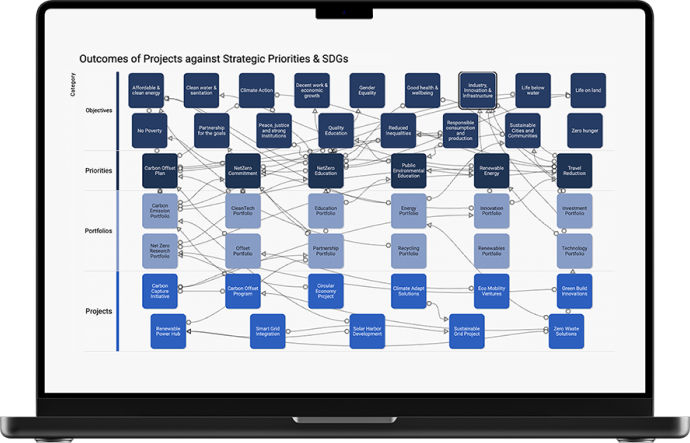
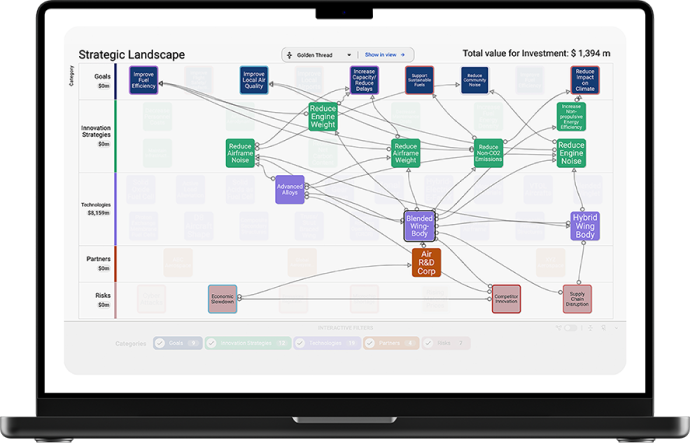
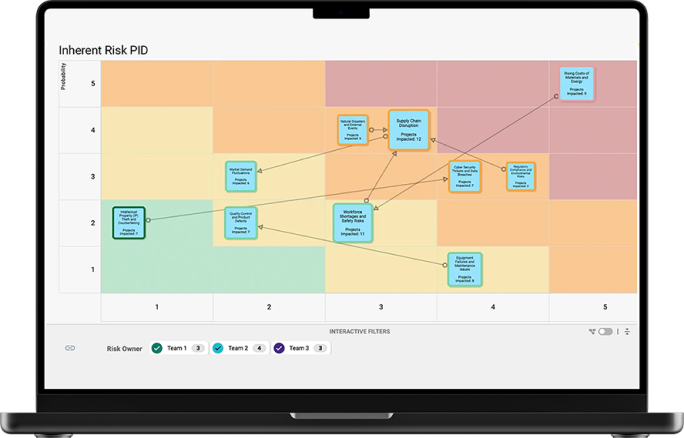


See programs, dependencies, and risk in one view to make confident trade-offs across cost, schedule, and mission readiness.
Connect portfolios and risk to prioritize initiatives, manage constraints, and deliver with greater confidence.
SharpCloud can work with portfolio, project, risk, strategic, and operational data from a wide range of sources including spreadsheets, structured datasets, and systems of record. Data is organized into flexible models that allow teams to visualize relationships, dependencies, and outcomes without forcing a single rigid schema.
SharpCloud helps teams visualize portfolios as connected systems rather than static lists. Projects, programs, risks, resources, and outcomes can be linked to show dependencies, trade-offs, and downstream impact, enabling better prioritization and alignment with strategic objectives.
SharpCloud enables teams to visualize risks in context by connecting them to initiatives, dependencies, and outcomes within the same decision environment. This makes it easier to understand exposure across the portfolio, explore scenarios, and communicate risk implications clearly to decision-makers.
SharpCloud integrates with a wide range of tools and systems to visualize live data from across your organization. This includes Excel, SharePoint, Microsoft Project, Azure DevOps, Jira, Smartsheet, SQL databases, and other business-critical applications.
With built-in connectors, REST API access, and automated sync options, SharpCloud lets you connect data without duplicating it—so teams can continue working in their preferred systems while leadership sees the full picture in SharpCloud.
Yes. Many SharpCloud connectors support scheduled batch synchronization (hourly or daily) so source data changes can flow into SharpCloud stories automatically without manual intervention.
Yes. Users can model different assumptions, priorities, or mitigation approaches by adjusting data and relationships, then comparing outcomes across scenarios. This supports informed discussion and decision-making, especially in complex or uncertain environments.
SharpCloud is designed to handle large volumes of interconnected data. Users can filter, segment, and customize views to focus on relevant subsets of information while executives and practitioners explore underlying detail when needed.
Yes. SharpCloud supports SSO via SAML 2.0 and integrates with identity providers like Azure Active Directory and Okta for secure, centralized authentication and user provisioning.
SharpCloud follows enterprise-grade security practices including encryption in transit and at rest, logical data partitioning, and hosting on Microsoft Azure with regional availability. User access controls and audit logs help protect sensitive information.
Yes. SharpCloud provides fine-grained access controls at the story and workspace level. Admins can assign roles such as viewer, editor, or owner to manage who can see or modify content.
No. SharpCloud is designed to sit alongside existing systems. It brings together insights from multiple sources to provide context, visibility, and decision support without requiring teams to abandon tools they already rely on.
Teams can start by importing existing data and creating initial visual views quickly, then evolve their models over time as needs grow. This supports fast time-to-value without heavy upfront configuration.

See how a single, interactive decision environment helps enterprises drive more efficient, profitable, and innovative outcomes.
