






Blogs
Explore insights, tips, and industry trends

Case studies
See how organizations achieve real results

eBooks and reports
Access in-depth research and expert analysis

Research
Discover original research and data-driven insights

Webinars
Join live and on-demand sessions with experts

Whitepapers
Access research and expert analysis

Academy
Build skills with structured courses and training

Certified trainers
Get expert training from certified professionals

International partners
Connect with trusted partners around the world

Knowledge center
Find guides, tutorials, and product documentation




How to gain deeper insights from interviews in qualitative research

Key takeaways
Interviews in qualitative research require careful planning, consistent execution, and systematic follow-up to produce analyzable data. Accurate transcription is essential, as coding and interpretation depend on reliable text. AI-based transcription and structured coding in ATLAS.ti reduce the gap between data collection and analysis, support comparison across interviews, and help identify patterns in large datasets. Built-in AI tools in ATLAS.ti also assist with coding, summarizing, and querying interview data while keeping analytical decisions grounded in the original material.
If you work in qualitative research, you’re likely well-acquainted with how to conduct interviews. Much of qualitative inquiry depends on understanding how people think, experience, and make meaning—and interviews remain one of the most direct ways to access that insight, especially when they sit within broader qualitative data collection methods.
But collecting and analyzing interview data isn't as simple as it sounds. Designing clear questions, conducting focused conversations, and managing large volumes of recorded data all require time and attention. And the work doesn’t stop once the interview ends. Transcription, organization, and analysis often become bottlenecks, especially when projects involve multiple participants or long recordings.
Oftentimes, the problem isn't how to do interview research—it’s finding ways to work more efficiently while still gaining deeper, more defensible insights. For these tasks, ATLAS.ti is designed to reduce friction in the interview research process by combining transcription, data management, and analysis in a single environment. Built-in AI tools help convert audio and video recordings into searchable text, support systematic coding, and assist with summarizing and reviewing interview content—allowing researchers to spend less time on mechanical tasks and more time working directly with their data.
In this article, we’ll share practical guidance for conducting and analyzing qualitative interviews, along with examples of how ATLAS.ti can help you move from raw recordings to structured, insight-driven findings with greater clarity and efficiency.
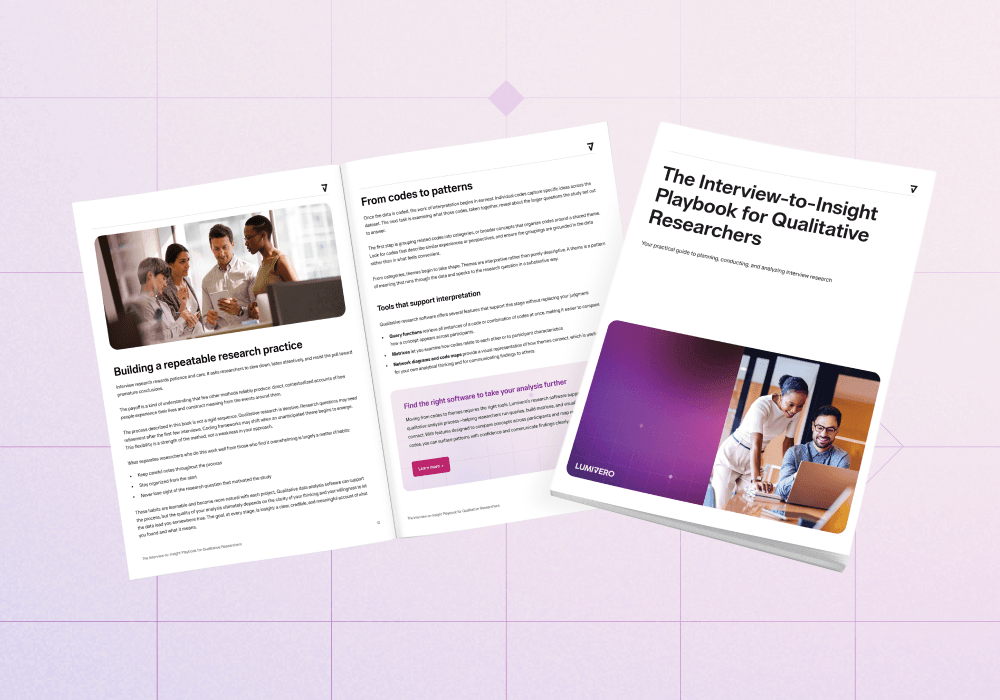
Get the guide: The Interview-to-Insight Playbook for Qualitative Researchers
Learn how to conduct interview research with greater confidence and clarity—from study design to final insight.
Why strong qualitative research interview practice matters
Interviews play a central role in many qualitative research designs. They allow researchers to document participants’ experiences, perspectives, and interpretations in their own words. When conducted well, interviews generate detailed data that can support thematic analysis, discourse analysis, grounded theory, and other data analysis approaches.
Despite their importance, interviews are often treated as a straightforward data collection step. Common issues include poorly aligned questions, leading prompts, uneven follow-up, and inconsistent recording practices. These problems can limit the depth of responses and complicate later analysis. Even strong interviews can lose value if recordings are incomplete, files are disorganized, or contextual information is not documented.
Careful interviewing improves both data quality and analytical potential. Clear questions help participants stay focused, while well-timed probes encourage elaboration without steering responses. Consistent procedures across interviews make it easier to compare cases and identify patterns. Attention to ethics, including informed consent and confidentiality, also supports trust and openness during the conversation.
High-quality interviews produce transcripts that are easier to code, interpret, and connect across a dataset. This creates a stronger foundation for analysis and allows qualitative data analysis tools, such as ATLAS.ti, to be used more effectively in later stages of the research process.
Practical research interview tips and techniques
Managing interview projects efficiently requires attention to both workflow and analytical practice. Small adjustments in how interviews are handled can reduce rework and support more consistent analysis.
Time savings often come from standardization. Using the same file naming conventions, interview guides, and transcription settings across interviews simplifies organization and reduces confusion later. Reviewing transcripts soon after transcription helps catch errors while the interview context is still familiar. Applying initial codes early can also prevent backlogs when multiple interviews are collected in a short period.
Common problems in interview analysis often stem from transcription and coding practices. Relying on uncorrected transcripts can introduce errors into the analysis, while overly broad or inconsistent codes make it difficult to compare interviews. Coding should focus on meaning rather than volume, with clear definitions that can be applied across cases. Periodic review of codes helps maintain alignment with the research questions.
As projects grow, maintaining quality becomes more challenging. Working in batches, documenting analytical decisions, and using memos to record reflections support consistency across interviews. ATLAS.ti’s tools for organizing documents, tracking codes, and reviewing linked data help manage larger datasets without losing sight of individual participants’ perspectives.
Quick tips for conducting more effective interviews for research include:
- Ask open-ended, reflective questions
- Validate respondents’ answers
- Use silence strategically
- Ask “why” and “how”
- Summarize respondents’ answers
- Look for contradictions or surprises
- Ask open-ended, reflective questions. Short and simple questions (e.g., “So did you feel happy?”) are easy to answer but also yield the least meaningful answers. Be sure to ask questions that can provoke respondents to produce longer and deeper narratives. Questions like “Can you tell me why you changed your perspective?” or “Can you think of a time when you faced a difficult decision?” can provide richer data for qualitative analysis.
- Validate respondents’ answers. No interview should be mechanical or formulaic. A good interviewer encourages respondents to provide meaningful answers, in part by valuing what has already been said. A simple “that’s interesting!” or “I didn’t think about that!” can signal to respondents that their ideas and perspectives are important to the research, leading them to contribute further when they feel validated.
- Use silence strategically. Some people have the tendency to fill every seemingly awkward pause or bout of silence with their own words and questions. This can close off opportunities for the respondent to continue their train of thought and provide deeper answers. Instead of this, be sure to give space for reflection during the interview rather than rushing to the next question. Make respondents comfortable with providing extended narratives.
- Ask “why” and “how.” Rich interview data comes from abundant details and context. In contrast, an interview that sounds like a pop quiz can often be superficial and incapable of addressing the research inquiry. When someone shares an opinion or experience, be sure to dig deeper: “Why do you think that happened?” or “How did that make you feel?” These follow-ups often uncover motivations and values that are not readily apparent in surface-level utterances.
- Summarize respondents’ answers. Many interview respondents may feel a desire to be recognized for their ideas. This starts with determining whether the interviewer is actively listening to what they have to say. As a result, when the respondent provides an extended narrative, summarize what you heard in your own words: “So what I’m hearing is that you struggled in your current job for the last three years.” This can clarify details but also validate respondents in a meaningful way.
- Look for contradictions or surprises. Interview data analysis isn’t always about taking respondents’ utterances at face value. Humans often contradict themselves or say something that may prove counterintuitive to common sense. These developments often signal critical or actionable insights that are worth exploring. Be courteous and respectful of respondents, but pointing out contradictions or surprises can prompt the respondent to provide more important details.
Step-by-step interview process
A clear interview process supports consistency and reduces avoidable problems during analysis. Decisions made before and during data collection directly affect how usable the interview material will be later.
Planning interview questions and structure
Interview planning begins with aligning questions to the research aims. Questions should be open-ended and specific enough to prompt detailed responses without narrowing participants’ answers. An interview guide helps maintain focus while allowing flexibility to follow relevant topics that emerge. Ordering questions from general to more focused can help participants ease into the discussion and provide fuller responses.
Recording and organizing interview data
Reliable recording is critical. Audio or video quality should be checked before each interview, including microphone placement, background noise, and file format compatibility. Consistent naming conventions for files make later retrieval easier, especially in projects with multiple interviews. Storing recordings, consent forms, and contextual notes together reduces the risk of missing information during analysis.
Interviewer technique and ethical practice
Effective interviewing requires active listening and clear communication. Interviewers should ask follow-up questions that clarify meaning or invite elaboration, rather than introducing new assumptions. Neutral prompts and pauses give participants space to expand on their responses. Ethical considerations include explaining how data will be used, confirming consent for recording, and protecting participants’ identities throughout the research process.
Transcription: The bridge to deep analysis
Oftentimes, interview recordings become analytically useful only once they are converted into text. Transcripts allow researchers to review responses closely, apply codes, compare participants, and trace patterns across interviews. Errors or inconsistencies at this stage can carry through the entire analysis, affecting how data are interpreted and reported.
Accurate transcription supports careful coding. Misheard words, missing segments, or inconsistent formatting make it harder to identify meaningful units of text. Decisions about whether to include pauses, emphasis, or nonverbal cues should be guided by the analytical approach and applied consistently across transcripts. For example, researchers can follow a structured thematic analysis process in qualitative research to familiarize themselves with interview transcripts, generate codes, develop themes, and interpret the findings.
Manual transcription offers a high level of control but requires substantial time, especially for long or numerous interviews. It can slow down projects and delay the start of analysis. Automated transcription reduces this burden by producing usable transcripts quickly, allowing researchers to move from data collection to analysis with less delay. Review and correction are still necessary, but the overall workload is reduced.
ATLAS.ti desktop includes AI-based auto-transcription for audio and video files, with one hour of transcription included at purchase and the option to add more as needed. When using ATLAS.ti for interviews, recordings can be automatically converted into text that is immediately ready for coding and analysis. This feature removes the need to manage separate transcription tools or files and ensures interview data is ready for analysis more quickly than ever.
Getting the most out of interview data in ATLAS.ti
Transcription can be the most time-consuming challenge in interview research, but analysis is the main consideration for turning raw, unstructured data into actionable insights. For rigorous research, you need a clear analysis plan that examines the interview data in an empirical manner to ensure that your presentation of the findings actually reflect what is in the transcribed data itself. ATLAS.ti provides tools that support this process from initial data import through more advanced data analysis tasks.
When working through interview data, deeper insights often emerge when researchers move beyond surface-level themes and look more closely at patterns, contrasts, and language. Useful strategies include:
- Exploring how themes co-occur across interviews
- Comparing what participants say versus what they describe doing—or with what related data shows they actually do
- Paying attention to what is not said, as absences can be analytically meaningful
- Tracking emotional cues or shifts in tone that signal deeper significance
- Examining the words and labels participants use, including shared language and subtle differences in meaning
The sections below show how ATLAS.ti supports these analytical techniques by helping you organize, code, and interrogate interview data in a structured and transparent way.
Importing and organizing interview data
Interview transcripts can be imported directly into an ATLAS.ti project alongside audio or video files, field notes, and related documents. Keeping transcripts linked to their original recordings allows researchers to return to the source material when clarification is needed. Document groups and naming conventions help separate interviews by participant type, location, time point, or other relevant attributes. This structure supports later comparison and filtering during analysis.
Coding interview transcripts
Coding involves assigning labels to segments of text that capture meaning relevant to the research questions. In ATLAS.ti, codes can be created inductively from the data or applied based on an existing framework. Researchers can code individual words, sentences, or longer passages, depending on the level of detail required. Consistent coding across interviews makes it easier to identify patterns and differences within the dataset.
If you need to compare interview cases against a consistent set of themes, the five framework analysis steps provide a structured workflow from familiarization through interpretation.
Using AI features to support analysis
Before AI, transcribing and analyzing interview data could take hours and more likely days to produce a credible presentation of findings. To be sure, the human researcher should be the main component of any qualitative research. But if you want to make the research process just a bit more efficient, then AI can be your best bet. ATLAS.ti includes AI tools that assist with common analysis tasks while keeping the researcher in control of interpretation.
Intentional AI Coding allows researchers to guide automated coding by specifying analytical goals or areas of interest. This can support early familiarization with large interview datasets or help surface segments relevant to specific concepts. Intentional AI Coding gives you a head start in the coding process with a preliminary hierarchy of codes that you can develop as you progress through your data analysis.
AI Summaries generate concise overviews of documents or selected passages. These summaries can be used to review individual interviews, compare participants, or prepare for deeper coding without replacing close reading. When you have long transcripts and need to distill extensive narratives or generate insights across large segments of text, you can use AI Summaries for some inspiration about how to process qualitative data and identify critical findings in less time.
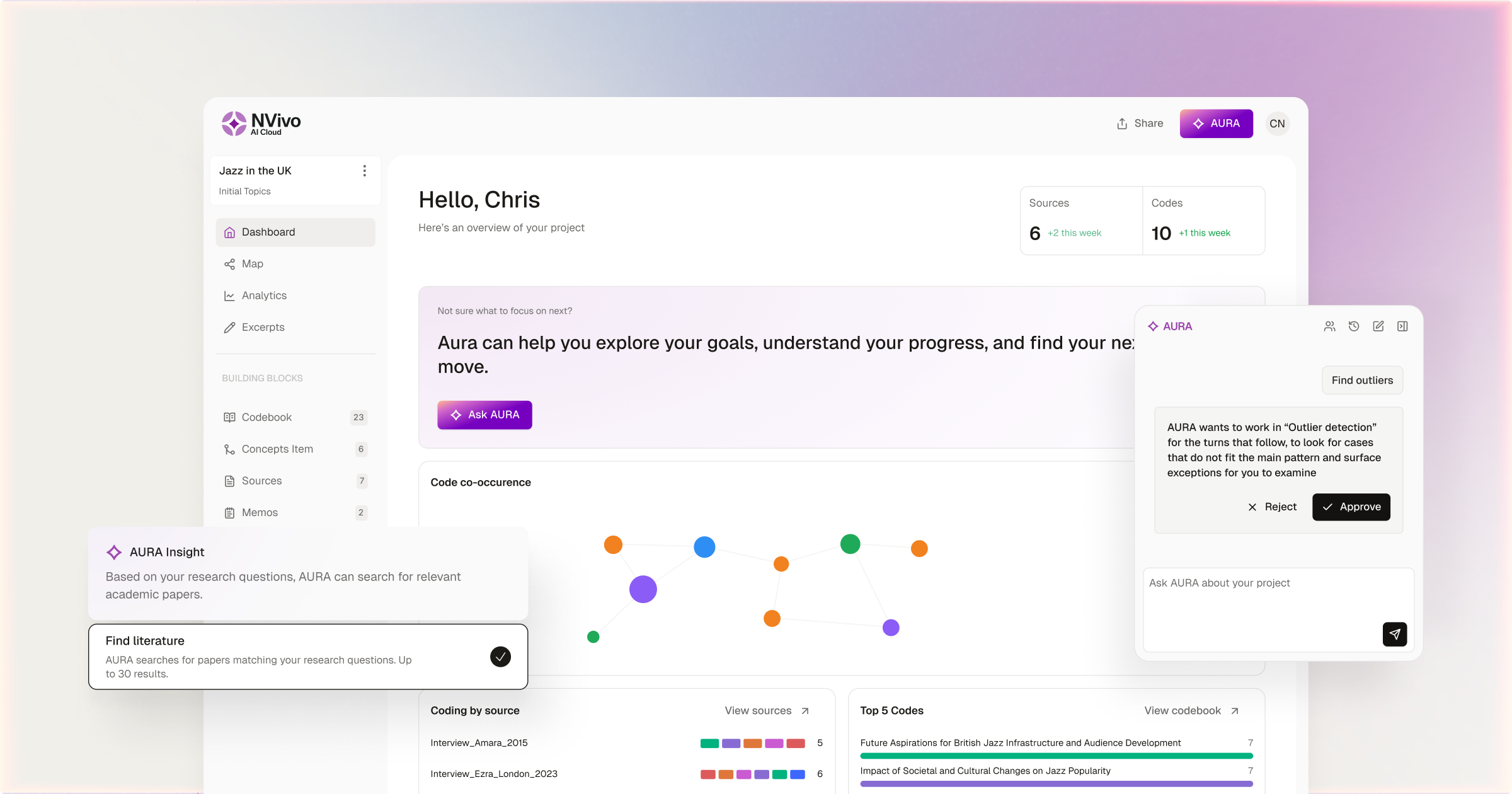
Conversational AI enables users to essentially “chat with your documents”, allowing researchers to ask questions of their data using natural language. Researchers can query interview content to locate examples, compare themes, or clarify how concepts appear across transcripts. Responses link back to the original data, supporting transparency and verification. Think of Conversational AI as an expert who has read your data and can answer questions easily and quickly to lead to more insightful data analysis.
Bring structure and clarity to interview research
High-quality interviews generate valuable data, but insight depends on how well that data is transcribed, organized, and analyzed. ATLAS.ti brings transcription, coding, and analysis into one structured workflow—helping researchers move from interviews to defensible findings with greater efficiency and clarity. With AI-supported transcription, guided coding, and flexible review tools, you can spend less time managing data and more time making sense of it.
Explore how ATLAS.ti and Lumivero’s research software support rigorous, insight-driven qualitative research. Learn more or get started today.
Frequently asked questions
AI transcription produces usable drafts quickly, but transcripts should always be reviewed and corrected. This ensures accuracy, especially for technical terms, accents, or overlapping speech, and supports more reliable coding and analysis.
AI coding tools are designed to support, not replace, researcher judgment. Intentional AI Coding can help surface relevant segments or provide a starting point, but researchers remain responsible for defining codes, interpreting meaning, and making analytic decisions.

How can we help you? Contact us.