Qualitative research is built on interpretation. It asks researchers to engage deeply with the language, context, and meaning of unstructured data. Whether you're analyzing interview transcripts, open-ended survey responses, or field notes, the goal is to understand how people make sense of their experiences.
That interpretive work is what makes qualitative research valuable, and it's exactly where generative AI introduces new questions. Artificial intelligence tools can process large volumes of text at scale, leading to countless potential applications for addressing tasks that are either tedious or time-consuming.
However, the core of qualitative data analysis still depends on the researcher's ability to move between data and meaning with transparency and rigor to critically address research questions.
ChatGPT is a large language model (LLM) developed by OpenAI. Given a sequence of words, it generates responses based on patterns learned from large-scale training data. It does this remarkably well, but ChatGPT's ability to critically analyze and synthesize data for new, defensible insights comes up short.
Qualitative analysis often depends on context, observation, and nuanced human cues—such as tone, behavior, and unspoken dynamics—that are not always fully captured in text. These layered interpretations are difficult to formalize or replicate through prompts alone. Beyond this, ChatGPT has no codebook memory, no methodological framework, and no audit trail. It can't track your evolving interpretation of a dataset, reflect on how your positionality shapes your reading, or document why one code was chosen over another. These are structural limitations that can't be addressed simply by giving it better initial instructions or using more powerful language models.
Despite these constraints, researchers are turning to ChatGPT in growing numbers. Qualitative datasets are getting larger, funding timelines are shrinking, and many researchers want clear guidance on what constitutes acceptable use.
The short answer: You can use ChatGPT for qualitative research, but only for specific supportive tasks, not as a replacement for a rigorous analysis process.
What can ChatGPT do in qualitative research?
ChatGPT is most useful when treated as a preparation tool rather than an analytical one. Within clear boundaries, it can reduce time on routine tasks and free up attention for deeper interpretive work:
- Transcript summarization: Generating condensed overviews of interviews or focus groups before deep reading.
- Initial code suggestions: Suggesting initial descriptive labels from a data excerpt for researcher review.
- Literature review support: Identifying relevant themes and theoretical angles across published work.
- Interview guide drafting: Brainstorming question angles and follow-up probes for semi-structured interviews.
- Write-up polishing: Improving readability of academic prose and drafting AI disclosure statements.
What can ChatGPT not do in qualitative research?
The limitations pose issues for tasks that are central to how qualitative research functions:
- No interpretive depth. It produces surface-level pattern descriptions rather than rigorous meaning-making.
- No codebook persistence. Every session starts fresh. ChatGPT does not inherently retain memory of prior coding decisions, meaning codes can't be applied consistently across sessions or data sources—making it impossible to establish the intercoder reliability checks that qualitative research requires.
- No researcher reflexivity. It can't examine how your perspective shapes interpretation.
- No audit trail. There's no transparent record of analytical decisions.
- Hallucination risk. It can invent codes, fabricate quotes, or draw connections never expressed by participants.
ChatGPT also operates within a context window, or a limited amount of text it can hold per conversation. It can't retain your evolving codebook across sessions or build on previous interpretations, making it unsuitable as an all-encompassing tool providing deep analysis.
How to use ChatGPT in a qualitative research workflow
Summarizing qualitative data
Summarization is one of the safest uses of ChatGPT. You can generate source-level overviews and condensed descriptions before beginning deep analysis, saving significant time during familiarization. The key distinction: summaries are not analysis. Treat them as orientation tools that prepare you for interpretive work.
Prompt example: "Here is an interview transcript. Provide a 150-word summary of the main topics discussed. Do not interpret or draw conclusions. Describe only what was said."
Generating initial codes
Paste a transcript excerpt of 300-800 words, specify your methodological approach (inductive or deductive), and ask for descriptive labels with definitions. Review every suggestion against your own reading. ChatGPT can prompt you to notice things you might have overlooked, but it can also produce surface-level labels or invent connections that don't exist in the data.
For integrating ChatGPT-generated codes into a structured environment, consider combining ChatGPT and NVivo for coding.
Prompt example: "I would like you to look at this qualitative data through an inductive approach. Generate 6-10 descriptive codes from the following excerpt. For each, include the code name, a one-sentence definition, and the specific text segment it applies to."
Identifying themes
Theme identification is where ChatGPT's limitations become most consequential. Provide your researcher-generated codes and ask for suggested groupings, but use the output as a reflection prompt as a precursor to the final themes that you will later generate.
Watch for groupings based on word similarity rather than conceptual meaning. ChatGPT clusters text by linguistic proximity, not by the interpretive logic that qualitative thematic analysis requires. Two codes might share similar language but represent fundamentally different participant experiences.
Prompt example: "I have attached a list of codes I have generated from my qualitative dataset. Suggest 3–5 candidate theme groups that cluster related codes together. For each theme, list which codes it includes and write a two-sentence description of what it captures."
Remember: ChatGPT has no knowledge of the original data at this stage. Use output as a reflection tool, not a final answer.
Writing up findings
ChatGPT can help transform bullet-point findings into first-draft narrative sections, improve readability of academic prose, and draft methods disclosure statements. This is a productive application because it involves text generation, which is what ChatGPT does well.
The risk to watch for is writing that subtly misrepresents your findings. ChatGPT will produce fluent prose regardless of whether the content accurately reflects your data. Always verify that AI-assisted write-ups faithfully represent what your analysis actually found, not what would make for a more compelling narrative.
Research design and literature review
Some of the lowest-risk uses of ChatGPT involve tasks that don't touch participant data. During the design stage, ChatGPT can help identify themes in published literature, suggest interview question angles, and stress-test a topic guide by generating potential follow-up probes. These tasks carry lower methodological risk because the output doesn't directly shape analytical findings and no confidential data is involved.
What are the limitations of ChatGPT for qualitative research?
Beyond practical constraints, ChatGPT presents challenges with direct implications for credibility, ethics, and publication. Limitations of ChatGPT for qualitative research include:
- No transparent audit trail. Qualitative research requires a traceable path from raw text data to interpretation. ChatGPT can't document coding decisions or produce a reproducible workflow, creating a gap increasingly scrutinized by reviewers.
- Hallucination in analysis. ChatGPT predicts plausible text without verifying claims against source material. It can generate convincing codes or quotes never present in your data, requiring close reading of every output.
- Data privacy risks. Participant data sent to ChatGPT is processed on third-party servers and may be retained depending on account settings. This can conflict with ethics approval, institutional governance policies, and IRB requirements.
- No researcher reflexivity. Reflexivity, or documenting how your position and assumptions influence interpretation, is a methodological necessity, preserving the human element of qualitative research. ChatGPT can't be reflexive, and over-reliance on its outputs risks producing qualitative data analysis that appears rigorous but lacks interpretive accountability.
ChatGPT vs. NVivo for qualitative research
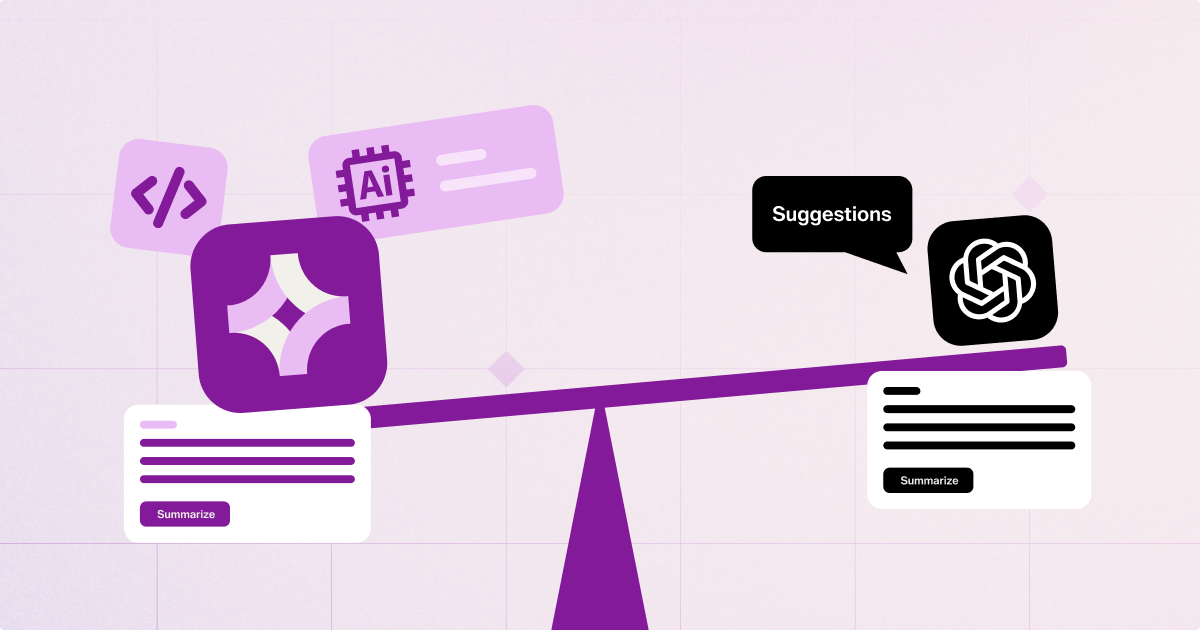
Qualitative researchers today know NVivo very well, but may be tempted by the speed, ease, and versatility that ChatGPT seems to offer. Sometimes it feels like it comes down to using one or the other. The key differences between the two come down to what qualitative methods actually require:
Comparing NVivo vs ChatGPT features for qualitative research
NVivo's AI Assistant works directly on your project data, retains your codebook, and keeps AI suggestions traceable within your existing workflow. Your data is processed with zero data retention: once the AI completes its task, the information is deleted from the server.
A practical workflow many researchers adopt is using ChatGPT for pre-analysis tasks such as cleaning transcripts, summarizing documents, drafting interview guides, then bringing data into NVivo for systematic coding and theme development. For a deeper look, see a full comparison of NVivo vs ChatGPT.
How to report ChatGPT use in qualitative research
Many journals now require explicit AI disclosure. Requirements typically include which tools were used, at which stages, and what human oversight was in place. Major publishers including Elsevier, Springer Nature, and the APA have formalized policies. Failing to disclose AI use can result in rejection or retraction.
AI disclosure template: "ChatGPT (GPT-4, OpenAI) was used to generate initial descriptive codes from [X] transcript excerpts. All AI-generated codes were reviewed, revised, and validated by the primary researcher against the original data. No participant data was submitted to external AI platforms without [IRB approval / ethics committee authorization]."
Start your qualitative research with NVivo
NVivo's AI Assistant supports transcript summarization, sub-code suggestions, and Framework Matrix AI summaries, all within a secure, audit-trail-compatible environment that general-purpose AI tools can't match. Whether you use ChatGPT for early-stage preparation or work entirely within NVivo, you get the structured, transparent workflow that qualitative research demands.