






Key takeaways
AI can transform capital projects through dynamic scheduling, better resource management, and enhanced risk analysis—but successful implementation requires strategic planning. This article addresses real questions from practitioners: where to focus AI efforts, how to handle errors, and why data quality matters. A key insight: AI works best when deployed consistently across projects and managed by people who review and validate AI outputs.
Capital projects are inherently complex—managing multiple dependencies, competing timelines, and resource constraints across long project lifecycles is a constant challenge for organizations. Recently, I presented “How AI is Redefining Capital Projects at a Fundamental Level,” exploring how AI can help address these challenges through dynamic scheduling, improved resource management, and smarter risk analysis.
During the Q&A, several attendees raised important practical questions that I want to address here:
- How do you assess where AI could help your organization?
- What happens if AI makes a mistake and it isn't picked up until work is underway?
- How do you ensure you have the complete and accurate data that AI needs to succeed?
These are the real concerns that organizations face when implementing AI, and in this article, I dive deeper into each one to help you understand where AI can create the most value in your capital projects and how to implement it successfully across your enterprise.
Knowing what you don’t know
An important preliminary step to an investment in AI is to assess your own organization to understand the areas where AI could help. That’s essential because, like any other piece of technology, you should only be implementing AI to help drive value into your organization. It’s not about the cool tech; it’s about making your enterprise better. If you don’t know where the biggest opportunities lie, that’s hard to achieve.
But without much knowledge of AI's capabilities—and the specific functionality of a particular tool—it's difficult to identify the 'best fit' areas to deploy it. This touches on something I think is really important when it comes to AI: you don't have to be the expert. I might even go further and say you probably shouldn't try to be the expert.
If you’re involved in capital projects, then you are likely operating in an industry that is highly complex, tightly regulated, and requires a diverse range of specialist capabilities to succeed. That means that you have numerous experts on different aspects of your industry and business, often with vast experience, helping you to succeed. You know that you couldn’t possibly operate at the level that you do without those experts.
To get the most out of AI, you need a similar level of expertise around the technology and how to leverage it in different scenarios and use cases. However, that expertise is not something that is core to your business—once you have gained that understanding, you won’t need it on an ongoing basis as you already have the technology in place.
It’s therefore more beneficial to ‘borrow’ that expertise from outside the company. Consultants, or professional services teams from vendors and their partners, will be more than happy to help you understand the opportunities that you have, how to prioritize them, and how best to leverage them. Over time, as your understanding grows, you can become more self-reliant, and perhaps add some technology expertise to your IT team to manage the systems that you have implemented.
What if AI gets it wrong?
AI-generated dynamic project schedules are a use case where AI can be tremendously helpful because of the complexity of capital projects and the number of dependencies—including dependencies that go beyond the project itself.
But what happens if AI makes a mistake with the schedule and it isn't picked up until work is underway? This is a legitimate concern, but it’s not exclusive to AI. Think about the projects that you have been involved in. Has there ever been one that didn’t have at least one error in the schedule? Probably not, and oftentimes those errors aren’t picked up until work is underway.
The other key thing to note with project schedules is that they frequently become wrong over time, even if they were right to start with. As work gets underway and the team learns more about the project, new dependencies are identified, some 'safe' assumptions turn out to be wrong, and estimates are found to be inaccurate. All of those factors can force changes to be made to the schedule.
AI isn’t immune from that, but if you are leveraging AI to help build project schedules, then you are likely also leveraging it to help manage those schedules. That results in a much more dynamic approach to the process—schedules can be reanalyzed and adjusted much more frequently, and with far less human effort, than if they are being managed manually. People remain in control of the process by reviewing and validating AI generated outputs, but the process becomes more effective, and more efficient.
Additionally, AI can help to identify potential issues sooner, making it easier to adjust and recover. It’s important to remember that AI is ‘just’ a technology, it’s not a magic solution that can eliminate problems. But it can be a tremendous help in identifying and managing those problems.
Training AI
When training AI, the need for complete and accurate data is critical. Ultimately, AI needs to be trained on as much data as possible in order to provide the best outputs when it is used. The problem is that not all of that data is created equal.
In your organization you likely have a number of different tools that are used for project management, and they all store data in slightly different ways. Some projects are better at capturing all the required data than others, and some projects have higher levels of accuracy in that data when compared to others. But, because it’s all just data, identifying the errors and issues can be difficult—especially when it comes to inaccurate data.
These data gaps and problems can slow down an organization’s ability to adopt and leverage AI, and it’s something that companies must plan for before committing. It’s also something that requires strong governance and control principles to ensure that AI tools aren’t given access to confidential data that should be restricted.
This raises a related question: how can AI assist if schedules are not currently resourced? This is clearly key information if AI is to support both schedule and resource management.
Without some historic or current data for AI to learn from, the technology is not going to be able to assist much. Put simply, if your historic projects don’t have schedules with tasks tied to resources and effort, then you are going to have to build out that information with your current and upcoming projects.
There may be opportunities to leverage data from elsewhere in an enterprise if it exists, or to use publicly available data around how long a particular task may take, or the type and number of resources needed to complete a particular piece of work. But there are risks around both of those scenarios. Other divisions may not operate in the same way, and if relying on external data, the source of it isn’t going to be easy to identify and again, it may not reflect the situation in your own organization.
This is a scenario where internal processes and approaches need to be improved to help the company become ‘AI ready’. That will also help the company to improve the quality of its project delivery even without AI, managing projects without a resource loaded schedule can’t be easy.
The path forward
AI has the potential to be a tremendous asset for organizations in the delivery of key capital projects—in fact, across the whole strategic portfolio. However, it’s critical to select the right tool, train it on the right data, and deploy it for the right use cases. Dynamic schedules, improved resource management, and greater risk management capabilities are ideal applications of AI and provide a springboard for future expansion across the enterprise and into other use cases.
Lumivero’s decision and risk management solutions can help organizations to leverage AI effectively in each of these scenarios—request a demo to learn more.
More expert insights from Andy Jordan
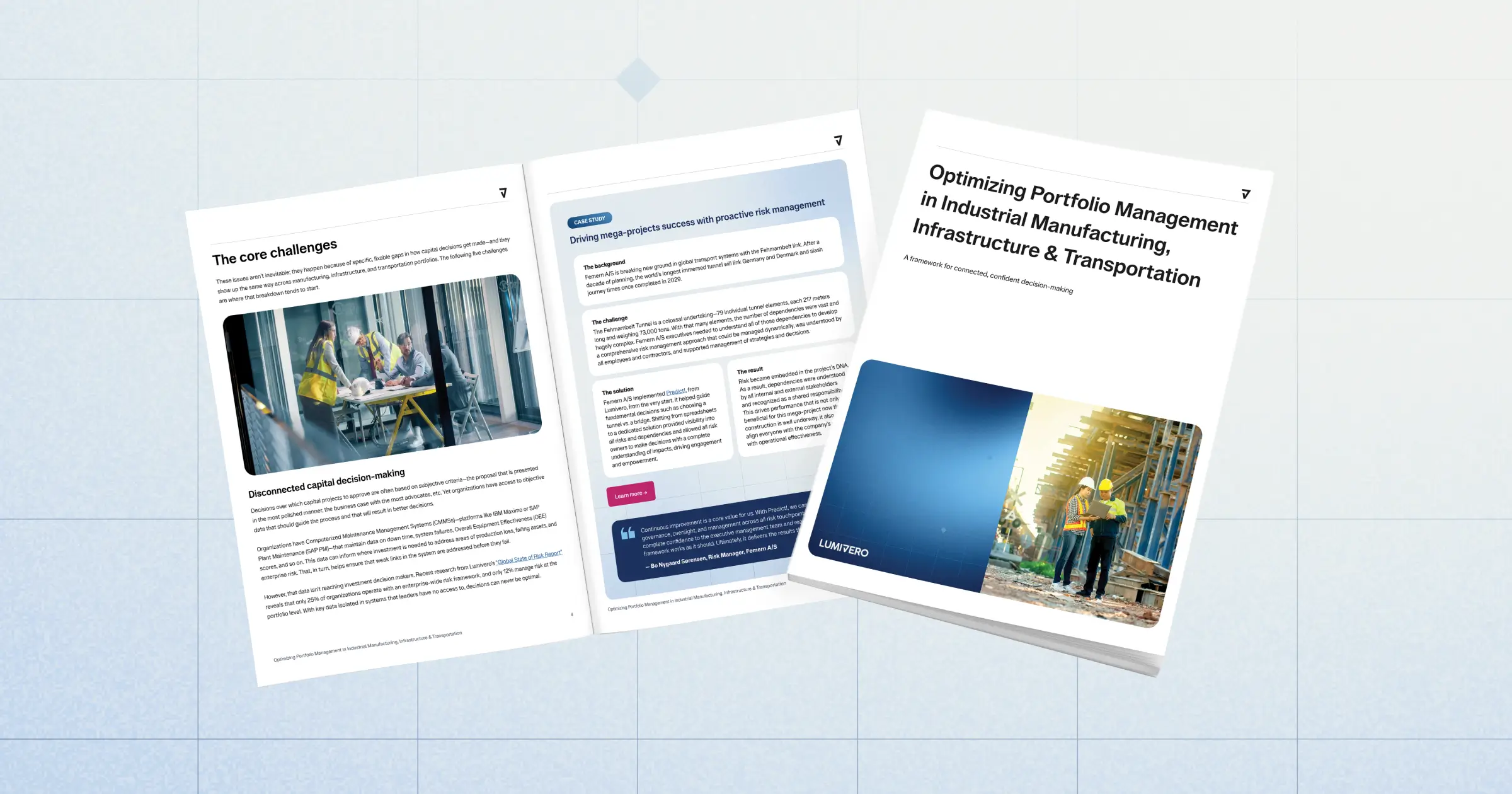
Gain a framework for connected, confident decision-making in “Optimizing Portfolio Management in Industrial Manufacturing, Infrastructure & Transportation.”
Download eBook →
Andy Jordan
President, Roffensian Consulting Inc.
Andy Jordan is President of Roffensian Consulting Inc., an Alberta, Canada based management consulting firm with a 20-year track record of success in strategic delivery, organizational transformation, portfolio management, PMOs and project management. Andy is an in-demand keynote speaker and author who delivers thought provoking content in an engaging and entertaining style, and is also an instructor in project management related disciplines including PMO and portfolio management courses on LinkedIn Learning.